


If you’re visiting or live in the beautiful northwestern Spanish region of Galicia, there’s no better way to impress the locals than with your knowledge of some of the most quintessential Galician words, some of which are untranslatable into English.
Galician or gallego is one of Spain’s four official languages recognised by the constitution along with Castilian (Spanish), Catalan and Basque.
It is spoken mainly in the region of Galicia by some 2.2 million people and has a lot of similarities with Portuguese.
READ ALSO: Five things to know about the Galician language
Here are some interesting Galician words and phrases that you should know.
Morriña – To miss one’s home or native land. In the dictionary it’s defined as “sadness or melancholy, especially nostalgia for one’s native land,” and it’s also one of the most commonly used terms among non-Galicians. Some Galicians also use it when they mean that they miss their friends and family too.
Luar – A beautiful word to refer to the light reflected by the moon, similar to moonlight in English.
Luscofusco – Another lovely word to describe light, luscofusco is the moment between night and day when all the light has almost completely disappeared and all you can see are shadows. The translation could be similar to dusk or twilight in English.
Chosco – This simply means blind. It could be temporarily blind if the sun gets in your eyes or someone who is blind because of a medical or physical condition.
Bico – Bico means kiss, like the Spanish word beso, but in gallego.
READ ALSO: Why is Spanish called ‘castellano’ in Spain?
Advertisement
Orballo – According to language experts Galician has around 70 words to describe rain – well it is one of the wettest places in Spain. Orballo is the type of very light rain that drenches you without you even realising it. Other rain words are Battuere used for intense rain and Torbón when rain accompanied by thunder and lightning.
Malo Será – This is the unique style of Galician optimism in any given situation. Literally it means that everything is going to be ok.
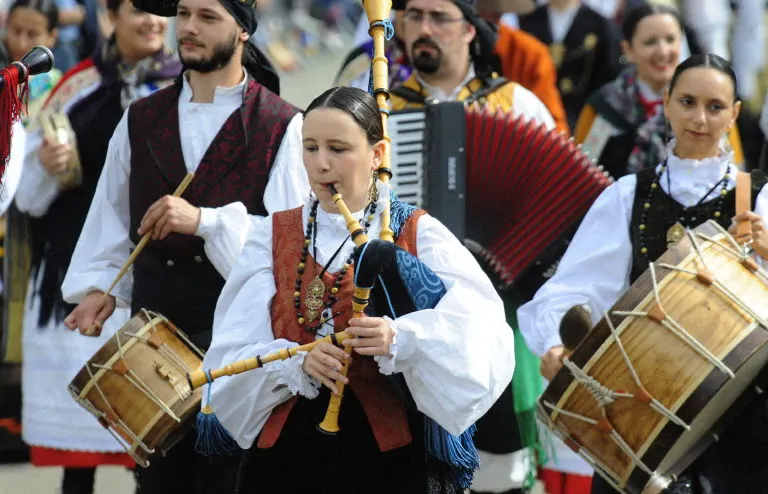
Foliada – This is a typical type of Galician party or as the official dictionary describes it “a nightly gathering of people to have fun, sing and dance”. It usually involves Galician bagpipes and tambourines.
Afouteza – This translates as courage, to have the disposition or spirit to do something without fear of dangers or difficulties. It could also be used to describe a person as bold too.
Advertisement
Larpeiro – Someone who likes to eat a lot and is gluttonous or a greedy eater who consumes more than they need.
Enxebre – This doesn’t really have a direct translation in Spanish or English. It means something that is pure, authentic and untainted. It could also be a characteristic of a country or region and that is not falsified, deformed or mixed with anything foreign, similar to purebred.
Polbo – This is one word that you might hear in Galicia a lot because it means octopus, which is a very popular dish there. It can be confusing, however, because the word polvo, pronounced similarly to polbo means powder in Spanish. So when someone in Galicia is offering you a plate of polbo, it’s probably octopus and not powder.
Quérote – No you’re not telling someone you want tea, this actually means ‘te quiero’ in Spanish or I love you in English.
Xeito: This literally translates as manner, skill or craft. When someone says you are doing an action with xeito, it means doing things well and with artistry and skill.
READ ALSO: The pros and cons of living in Spain’s Galicia region


