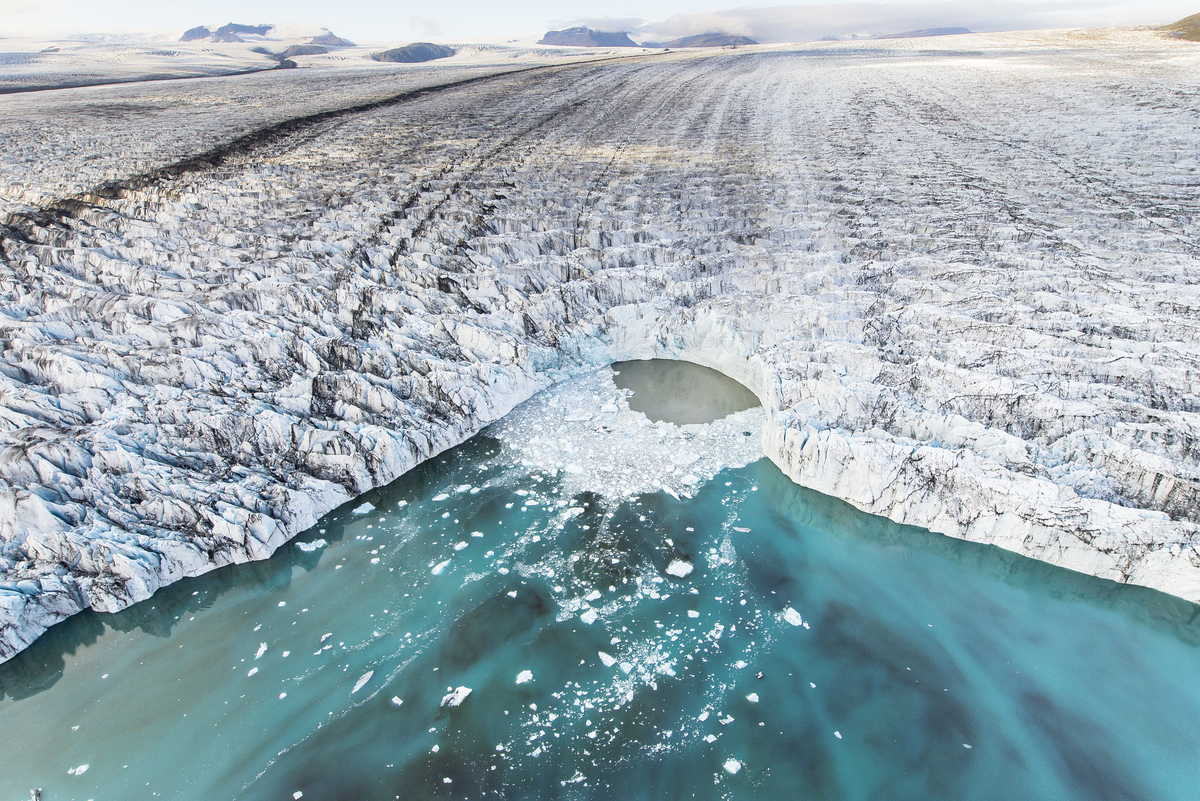
The Vatnajökull glacier in Iceland is the largest in Europe by volume.
Thorvardur Arnason
Iceland’s glaciers are among the fastest-melting ice sheets in the world. Both the sea and land are rising as a result, with consequences for tourism and shipping.
Iceland’s glaciers are melting so fast that future generations may wonder how the country got its name. The northern European island nation has lost 70 of its 400 glaciersExternal link. In the past 25 years, the total area of Iceland’s ice has shrunk by about a tenth while glacier thickness has dropped by an average of one metre a year, Hrafnhildur Hannesdóttir of the Icelandic Meteorological Office (IMO) tells SWI swissinfo.ch.
“The rate of glacial mass loss is among the highest in the world,” Hannesdóttir, the national correspondent for the Swiss-based World Glacier Monitoring Service (), added via email.
As the impact of melting ice become increasingly evident, the Nordic nation is preparing for a future with fewer or even no glaciers.
The World Glacier Monitoring Service (WGMSExternal link) collects and analyses data on the mass balance, volume, area and length of the world’s glaciers. It was established in 1986 and is based at the University of Zurich. The WGMS has a network of national correspondents in more than 40 countries.
During the International Year for the Conservation of Glaciers, we contacted some of them to find out about the state of glaciers in their region, the consequences of ice melt and adaptation strategies.
A glacier graveyard in Iceland
In 2014, glaciologists had declared the Okjökull Glacier, in the centre of the country, “dead” due to human-caused climate change, the first such declaration for an Icelandic glacier.
The glacier didn’t disappear completely, but it had become so thin that it was no longer being pulled by gravity down the mountainside. For the first time in tens of thousands of years, the glacier had stopped moving, a recent scientific paperExternal link explains.
Other glaciers may share the same fate. In 2024, Iceland became home to the world’s first glacier graveyard, a project initiated by Rice University in Houston in the United States.
Fifteen tombstones carved into the ice near the capital Reykjavik commemorate glaciers around the world that disappeared or are endangered due to climate change. They include the Pizol glacier in eastern Switzerland, which was declared extinct in 2019.
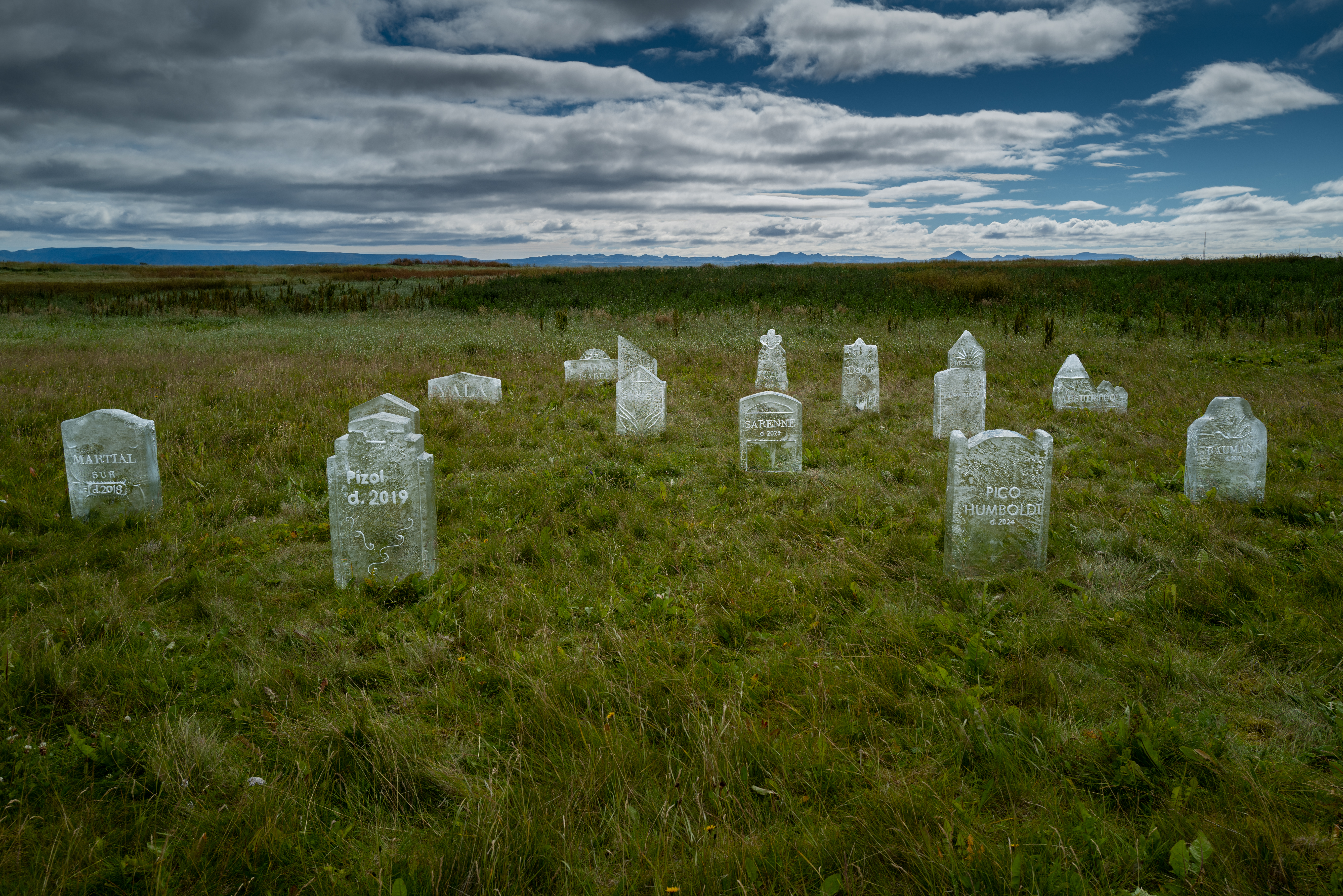
The glacier cemetery in Iceland.
Josh Okun / joklarannsoknafelag
Glaciers currently cover about 11% of Iceland’s land area (in Switzerland they cover 2%). Iceland lost more glacier mass between 2000 and 2010 than in the years since, Hannesdóttir notes. The reason for this slowdown could be the influence of North Atlantic winds on the island’s climate.
Nevertheless, Iceland’s large glaciers such as Mýrdalsjökull, Langjökull and Vatnajökull – the largest in Europe by volume – are retreating by several hundred metres a year. If temperatures continue to rise, Iceland will be virtually ice-free in 200 yearsExternal link.
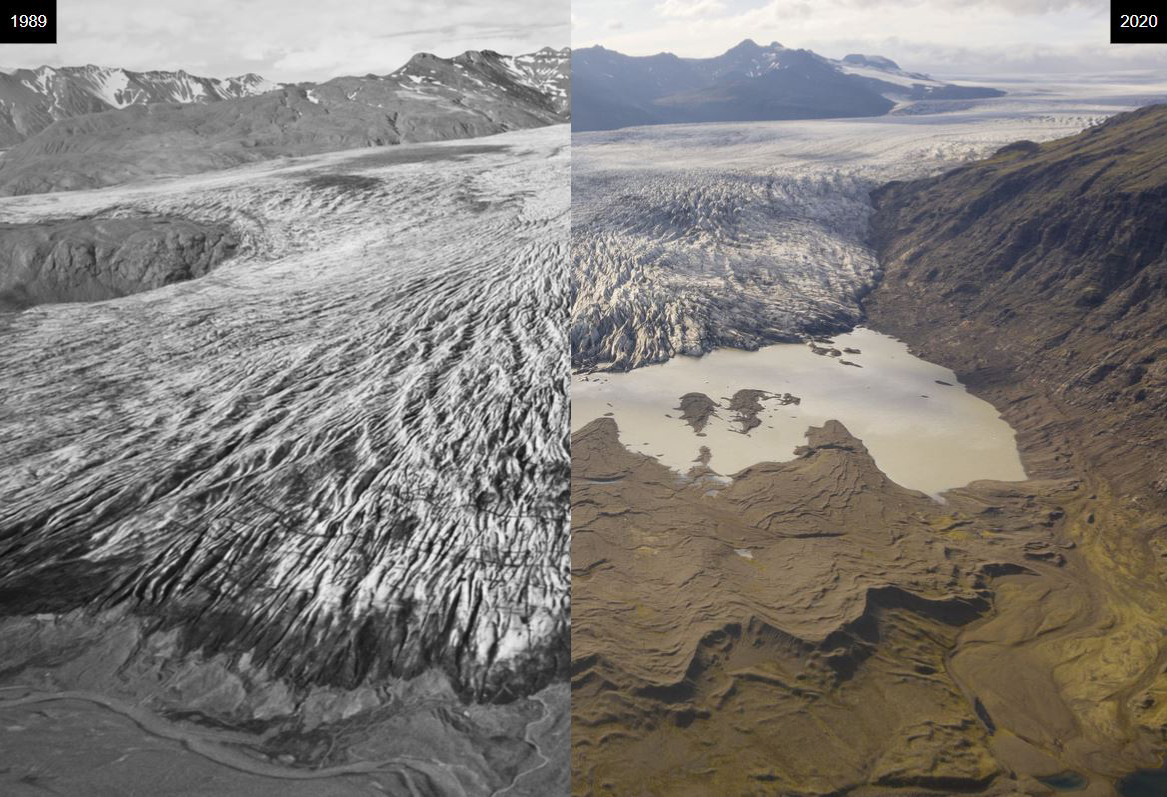
Evolution of the Hoffellsjökull glacier in Iceland from 1989 to 2020.
LMÍ (left) and Kieran Baxter / islenskirjoklar.is (right)
Glacier runoff to generate electricity
Glacier meltwater in Iceland is used to generate hydroelectric power, which accounts for about 73% of the electricity produced in Iceland (the rest comes from geothermal energy). Since the amount of water flowing from glaciers is expected to increase due to global warming, Iceland will likely expand its hydroelectric power output in the coming decades.
After that, however, the water running off glaciers will slow down. Iceland is expected to reach “peak water” – when meltwater runoff from glaciers is at its maximum level – in 40 to 50 yearsExternal link. In the Swiss Alps, the peak has already been reached in some regions and will be reached in others in the next few years.
How much Iceland’s glacier meltwater increases in the coming years will depend on the climate in the North Atlantic. That includes the so-called cold blob, an area of the ocean where the air has cooled instead of warmed like the rest of the planet, says Hannesdóttir.
>> Swiss glaciers are also melting faster and faster. The following article shows the possible domestic and international consequences:
More
More
The international consequences of a glacier-free Switzerland
Sea level rise and land uplift
If all of Iceland’s glaciers were to melt, sea levels could rise by one centimetre. It’s a similar effect to what would happen if all the glaciers in the Himalayas melted, according to a studyExternal link published in 2013.
Retreating glaciers also raise ground levels. Over millennia, the weight of glaciers has caused the Earth’s crust to sink into the softer mantle below, not unlike sitting on a memory foam mattress. As the ice melts, the pressure on the Earth’s crust decreases and the ground rises.
In the area around the Vatnajökull glacier, the . “This affects, for example, the harbour in the municipality of Höfn in southeast Iceland, which is becoming shallower, causing problems for ship traffic,” Hannesdóttir explains.
Other consequences of melting glaciers include rock avalanches as mountain slopes become more unstable, and increased risk of flooding due to the formation of glacial lakes.
>> Millions of people are at risk of flooding from glacial lakes. Scientists are accelerating research into the risks and potential measures to mitigate such catastrophes, but it’s easier said than done, as this article explains:
More
More
Floods from melting glaciers: Can they be predicted and prevented?
New forests in areas freed from glacier retreat
Iceland is addressing glacier melt with an integrated approach that includes natural disaster prevention, climate adaptation strategies and infrastructure adaptation.
About 2.3 million tourists visited Iceland in 2024External link, and Hannesdóttir says monitoring for possible landslides has begun near glaciers and in areas used for adventure tourism.
It’s also crucial to map glacier topography, she adds, since the changing course of glacial rivers has an impact on roads, bridges and other infrastructure.
Landsvirkjun, Iceland’s national power company, is planning to build new turbines and expand existing hydropower plants. In addition to increased glacier meltwater, the hydropower industry will be able to rely on increased precipitation, which is expected to increase from 1.2% to 4.3% by 2050 due to climate change, according to forecasts by IMO.
The Icelandic government is also promoting reforestation in areas cleared by melting glaciers, with a goal of increasing forest area fivefold by the end of the century. It means that Iceland could one day turn from a land of ice into a land of forests.

SWI swissinfo.ch
Edited by Gabe Bullard/vdv/ts