


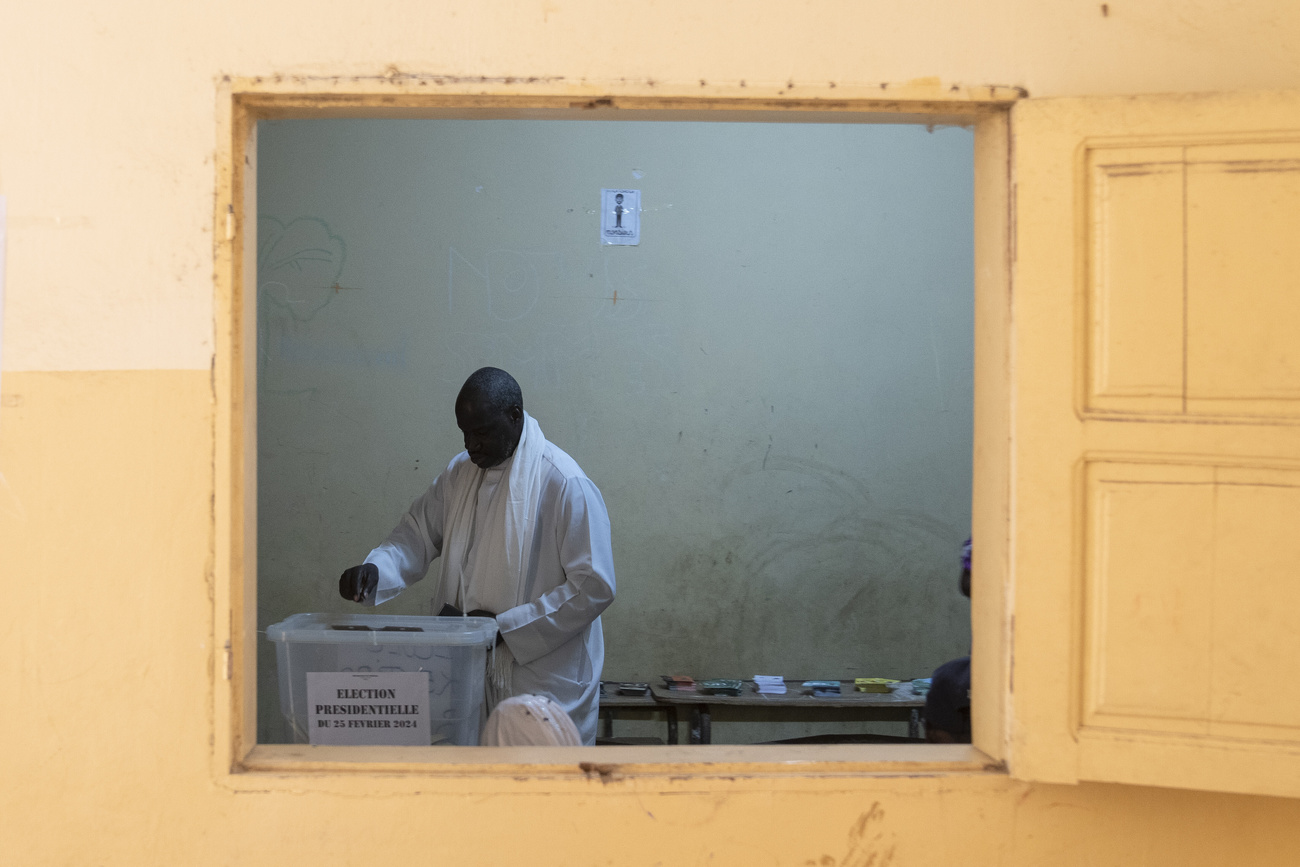
Encouraging free elections – and sending observers to monitor them – is one way Switzerland promotes democracy. Above, a man voting in Senegal, March 2024.
Associated Press
Amid a global democratic decline, the Swiss foreign ministry has issued new guidelines to clarify how it wants to help shore up freedoms around the world.

Readers will have heard by now that global democracy is not doing well. Autocrats are on the rise, freedoms are not, and according to the V-Dem InstituteExternal link, the world is about as democratic as it was in the mid-1980s. Meanwhile, Donald Trump hasn’t helped: his cuts at bodies like the US Agency for International Development (USAID) and the State Department have left a holeExternal link of $3 billion (CHF2.47 billion) in global democracy promotion.
What can Switzerland do about all this? On Wednesday, the foreign ministry tried to give some sort of an answer by publishing its first ever “Guidelines on DemocracyExternal link” – a strategic framework to guide its democracy promotion efforts in the coming years.
Reflecting the global situation, the tone is sober: for the period 2025-2028, the goal is to “safeguard the democratic world”, the guidelines state. This means not trying to turn authoritarian states into lands of freedom, but rather tackling the issue of “democratic backsliding” – the chipping away of processes and institutions in already-established democracies. That is, in places where “democratic processes and institutions already exist (at least to some extent) but are at risk”, as the Swiss foreign ministry writes.
Diplomacy and development
As to how Switzerland wants to do this, the guidelines list two main areas of action.
The first, a diplomatic track, is about using bilateral and multilateral dialogue to push democracy as an attractive model. Drawing on Switzerland’s experience as a wealthy place with stable institutions, it involves efforts to “counteract the widespread negative discourse surrounding democracy and bolster a more positive, meaningful approach”.
This diplomatic track involves using traditional Swiss good offices; it could also involve short-term support to pro-democracy protestors – although the foreign ministry doesn’t mention any specific examples of where this has been done.
The second area is a broad list of measures falling under the heading of “institutional and societal framework conditions”: for example, media support (e.g. the International Fund for Public Interest MediaExternal link), promoting free and fair elections, or tackling corruption. The foreign ministry also says it wants to step up civic education in schools in partner countries; it will also continue to promote federalism and decentralisation, aiming to ensure “decisions are taken as close as possible to citizens”.
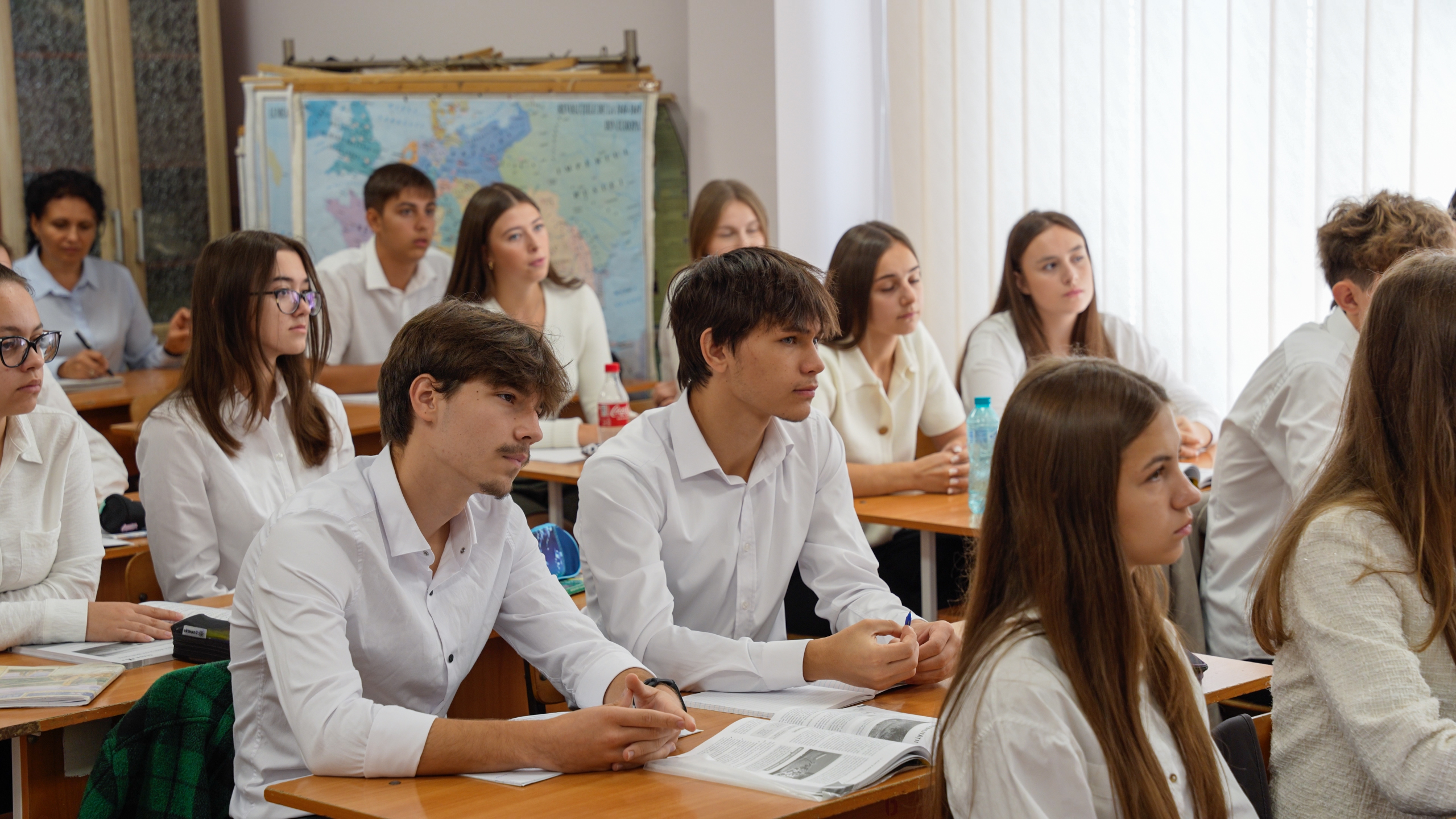
In Moldova, Swiss funding helps schoolkids learn about democracy and civic participation:
More
More
Schoolkids ready for Moldova’s democracy – with Swiss help
Taken together, the two approaches are not meant to catalogue everything Switzerland does in the democracy promotion field, the foreign ministry has stressed. Rather, they provide the strategic overview for the work of the various actors involved: mainly, the Swiss Agency for Development and Cooperation, the 26 cantons, and the foreign ministry itself.
Constitutional mandate
In general, the guidelines don’t mark a U-turn. Switzerland has a constitutional mandate to promote democracy and has long been active in the field. However, they do come as part of a government push in recent years to “raise the profile” of democracy in Swiss foreign policy.
In 2022, in the wake of Russia’s attack on Ukraine, Foreign Minister Ignazio Cassis saidExternal link Switzerland “can and will do more” to strengthen democracy in other countries – if asked. The 2024-2027 foreign policy strategy then boosted the strategic importance of democracy by naming it as one of four thematic priorities; now, the guidelines, which have been mooted for some time, are the strategic outcome of it all.
What they may change externally is difficult to say. Switzerland is not going to suddenly become the world’s biggest democracy exporter or start “lecturing others about how [it] really works”, as Ambassador Tim Enderlin from the foreign ministry said on WednesdayExternal link.
Nor is the country going to suddenly stop development projects in authoritarian countries in order to put them under pressure. On this front, the pragmatic approach remains, the guidelines say: promote civic space and human rights rather than democracy outright.
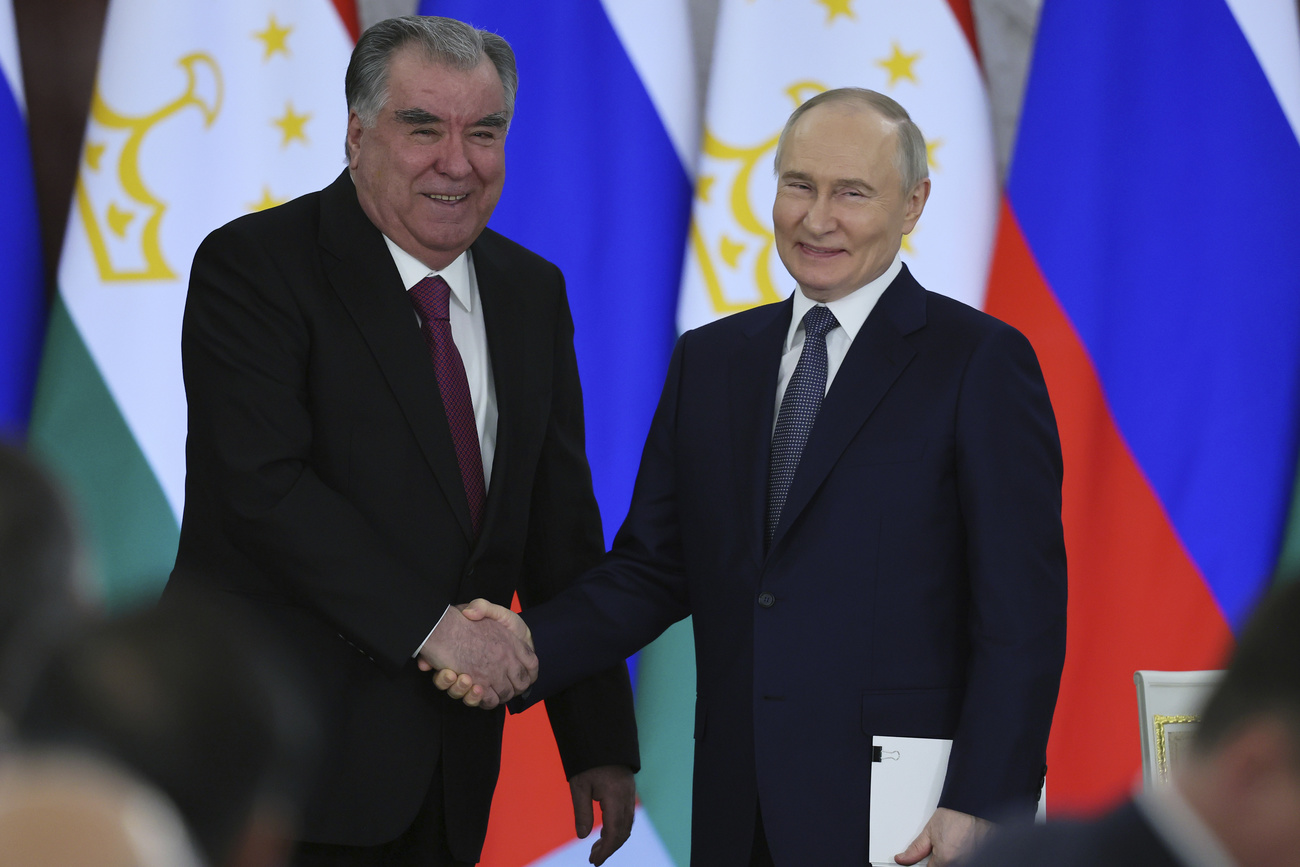
In Tajikistan, Switzerland promotes human rights and digital shifts while the country’s dictatorship rolls on:
More
More
Promoting democracy in authoritarian Tajikistan – is Switzerland making a difference?
Meanwhile, as part of an overall effort to become more forceful about tackling democratic backsliding, it will take some to judge the impact, reckons Daniel Bochsler, a professor of political science at Central European University in Vienna. For now, according to Bochsler, Switzerland is seen by partners as having particular competence in fields like conflict prevention or integrating diverse groups in a society – governance efforts which are “not far from democracy promotion, but which tend to avoid the term”.
As such, any shift in approach is still in its infancy: “it’s too soon to ask whether things have changed much in just a year [since the launch of the foreign policy strategy]”, Bochsler says.
Edited by Virginie Mangin/jdp


