


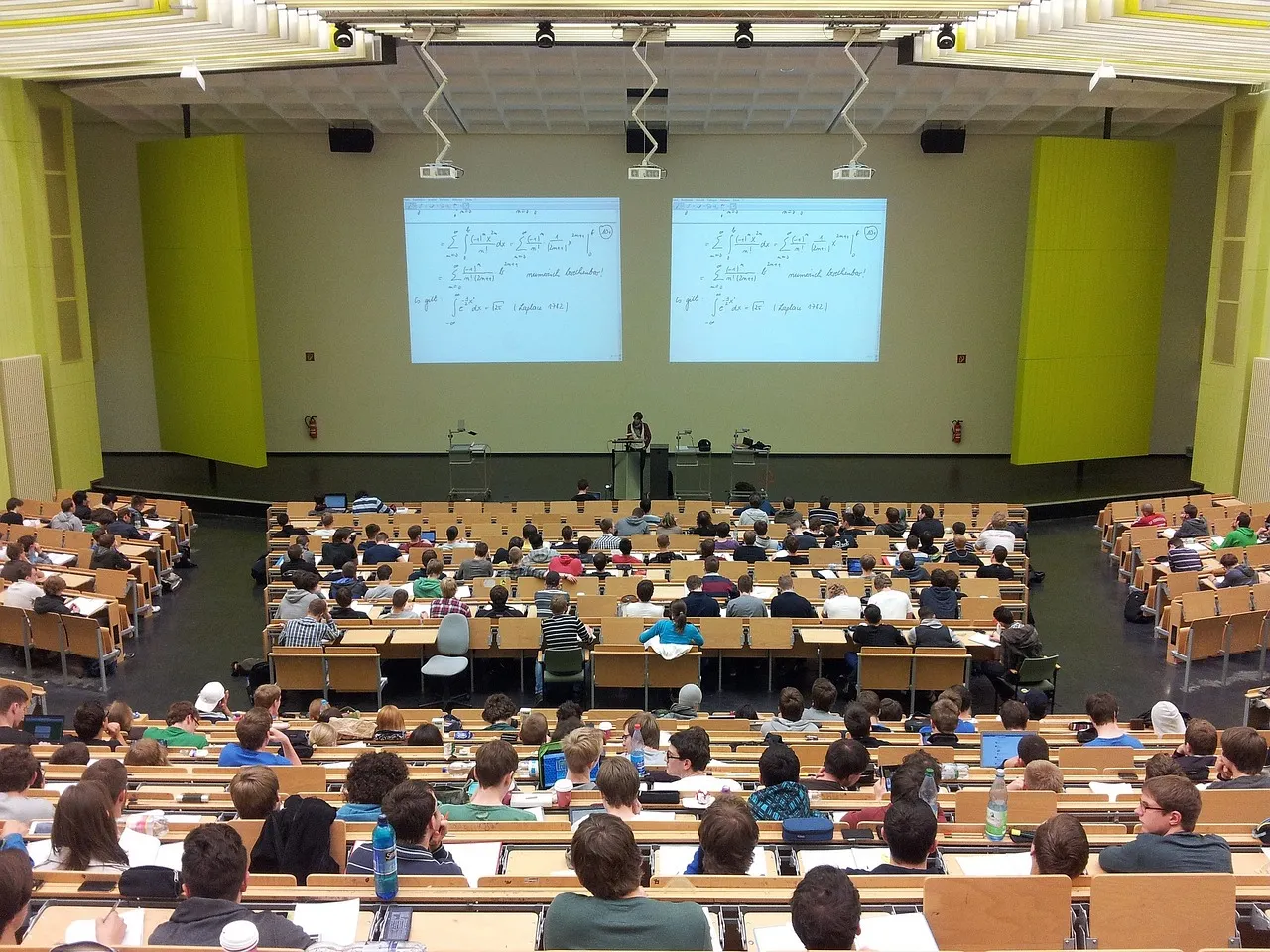
Tens of thousands of international students study at Swiss universities, but can they remain in the country once they finish?
First, let’s look at some numbers.
Overall, during the academic year of 2022/2023 (the last for which statistics are available), some 76,257 foreigners were enrolled in Swiss universities — a huge jump from just a decade previously, when 53,578 people from abroad attended.
By far the highest proportion of foreigners are studying in the two polytechnic institutes: the ETH in Zurich and the EPFL in Lausanne.
At the ETH, about 35 percent of the 21,000-strong student body are foreigners.
At the EPFL, this proportion is even higher — about half of the total of 13,000 students come from abroad.
The reason is that these two universities are highly ranked in their individual fields: the ETH focuses primarily on science, technology, engineering, and mathematics, while the EPFL’s strength lies in engineering, computer science, and other aspects of technology.
Both are also active in groundbreaking research and innovation in their respective fields.
Can these and other international students stay in Switzerland after graduation or must they leave the country?
Whether or not they can work in Switzerland after graduation depends on the students’ nationalities — in pretty much the same way as residency in Switzerland in general.
Those who are citizens of the European Union or EFTA states (Norway, Iceland, and Liechtenstein), can remain in Switzerland for 90 days while looking for employment.
If they find a job within this three-month period, they can apply for a work / residency permit, which is a pretty straightforward process; all they have to do is register at a commune in a canton where they will live and present an employment contract.
But things are much more complicated for students from outside the EU / EFTA.
Advertisement
Strict criteria
Generally speaking, the same requirements apply to students as for other people from third countries seeking employment in Switzerland.
This article explains conditions that must be fulfilled to be allowed to work in Switzerland:
READ ALSO: What do third-country nationals need to do to move to Switzerland?
There have been some legislative moves aiming to enable third-country students to stay and work in Switzerland after graduation, provided they obtain their degrees in fields that are needed — but are in short supply — in the labour market.
However, this project has hit some roadblocks in the parliament, primarily because no legal basis currently exists to allow foreigners subject to quotas to live in Switzerland indefinitely, on the same basis as their EU /EFTA counterparts.
READ ALSO: Will non-EU graduates ever get green-light to stay in Switzerland?
However, in some instances, requirements may be eased for non-EU/EFTA nationals who graduated from Swiss universities.
Advertisement
What is this about?
According to the Federal Act on Foreign Nationals (FNA), “foreign nationals with a Swiss university degree may be admitted if their work is of high academic or economic interest. They shall be admitted for a period of six months following completion of their education or training in Switzerland in order to find suitable work.”
‘Academic or economic interest’ in this context should be taken to mean that skills these people can bring to the table can’t be provided by either Swiss or EU / EFTA graduates in a field suffering from a shortage of qualified professionals.
To receive a temporary permit, candidates need a letter from the university confirming the end of studies, as well as proof that they have the necessary financial means as well as housing for the six-month period, so that they won’t rely on welfare benefits.
If no steady job is found within six months, the graduates must leave Switzerland, as this type of permit is not renewable
Generally speaking, and given the strict criteria, however, few foreign students are eligible for this kind of post-graduation permit.
Tell us about your own experiences of trying to stay in Switzerland after graduating. How hard is it?


