


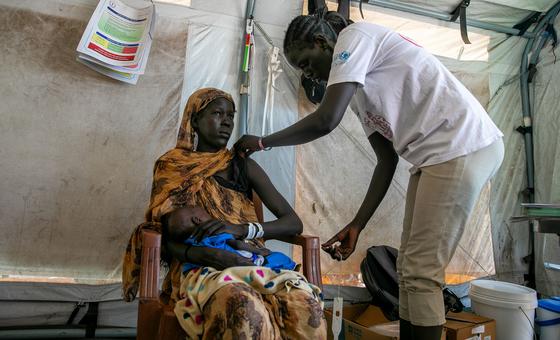
“Every time this happens, people lose access to health services – and sometimes, to hope,” said Dr Humphrey Karamagi, the UN World Health Organization (WHO)’s Representative in South Sudan. “Health is the last safety net. If it fails, everything else will also fall.”
The apparent airstrike on the hospital run by Médecins Sans Frontières (MSF) in Old Fangak in eastern Jonglei state, killed seven civilians and injured another 20, according to the UN humanitarian affairs coordination office (OCHA).
Healthcare not a target
The attack is the eighth time healthcare has been targeted since January “with health workers killed, facilities and essential supplies looted or destroyed”, the WHO official told journalists in Geneva.
“More attacks may lead to closing half the health facilities along the Nile,” he added.
Dr. Karamagi explained that humanitarian convoys and essential cold chain infrastructure had come under fire, at a time of escalating violence that has impacted civilians since South Sudan gained independence in 2011, descending shortly afterwards into civil war.
Since March, tensions have escalated in Upper Nile state, with deadly clashes between Government forces and armed groups. This has uprooted an estimated 80,000 people in three of the most affected counties, the WHO official said.
He added that clashes have also been reported in parts of Western Equatoria, Central Equatoria and Unity states, forcing communities – “mostly women and children” – to flee into neighbouring countries, including 23,000 arrivals in Ethiopia.
Diseases spreading
Back in South Sudan, outbreaks of cholera, malaria, measles and mpox are spreading rapidly, prompting the UN health agency to deploy rapid response teams and coordinate with local partners where possible, amid access restrictions linked to the escalating violence.
“The alternative, if we do nothing, would be bleak,” the WHO official warned, pointing to cholera cases that may double in just six weeks and measles deaths that could increase by up by 40 per cent.
Cholera alone has infected more than 55,000 people since September, killing over 1,000, the UN health agency said.
‘War crime’ condemnation
In a related development, the UN Commission on Human Rights (OHCHR) in South Sudan condemned the bombing as a potential war crime.
“This was not a tragic accident,” said Yasmin Sooka, Chair of the Commission. “It was a calculated, unlawful attack on a protected medical facility.”
MSF confirmed the hospital’s complete destruction, including its pharmacy and emergency care units. Further aerial bombardments were also reported in New Fangak, raising fears that such attacks are part of a broader military campaign.
The airstrike followed public threats by South Sudanese military forces who demanded the return of seized boats and labelled multiple Nuer-majority counties, including Fangak, as “hostile”.
“Designating entire communities as hostile is deeply irresponsible and may amount to collective punishment,” said Commissioner Barney Afako.
Plea for action
The UN Commission has urged immediate investigations into the bombing and warned that repeated violations threaten to derail South Sudan’s fragile peace.
With high-level delegations from the African Union and IGAD now in the capital Juba, calls for renewed dialogue are growing louder. “The path South Sudan is currently on is perilous,” Ms. Sooka warned. “If attacks like these continue with impunity, the Peace Agreement risks becoming meaningless.”
In his final appeal, Dr Karamagi emphasised the cost of inaction: “Help us make sure this doesn’t become the moment health – and hope – finally give way.”


