


Roman Signer takes his furniture on wild journeys. He plays with fire, simulates landslides and sends tables soaring into the air or sinking to the bottom of the ocean. SWI swissinfo.ch caught up with the Swiss artist ahead of his new exhibition at the Kunsthaus Zurich.

Roman Signer even transformed Appenzell’s Kamor mountain into a volcano in 1986 with his explosive art.
Super-8-Still: Peter Liechti
Volcanoes in Switzerland stopped erupting millions of years ago. The last lava flows on Swiss territory occurred when tectonic plates were still shaping the Alps. But in 1986 the Kamor mountain in northeastern Switzerland erupted – temporarily. For two minutes, the peak in Appenzell spewed fire as if it were Italy’s Mount Vesuvius or Iceland’s Eyjafjallajökull.
The eruption wasn’t a geological anomaly; it was art. Signer carried black gunpowder to the summit and gifted his home country a temporary volcano.
“I like it when nature reveals its destructive side, for example as a landslide or an avalanche. A peaceful creek can suddenly turn into a raging river during floods. It doesn’t always behave,” Signer told SWI swissinfo.ch at the opening of his latest exhibition. “It’s almost as if nature says ‘Watch out! I am someone’.”
Roman Signer was long considered a quirky tinkerer from eastern Switzerland, and Swiss media still label him a “rascal”.

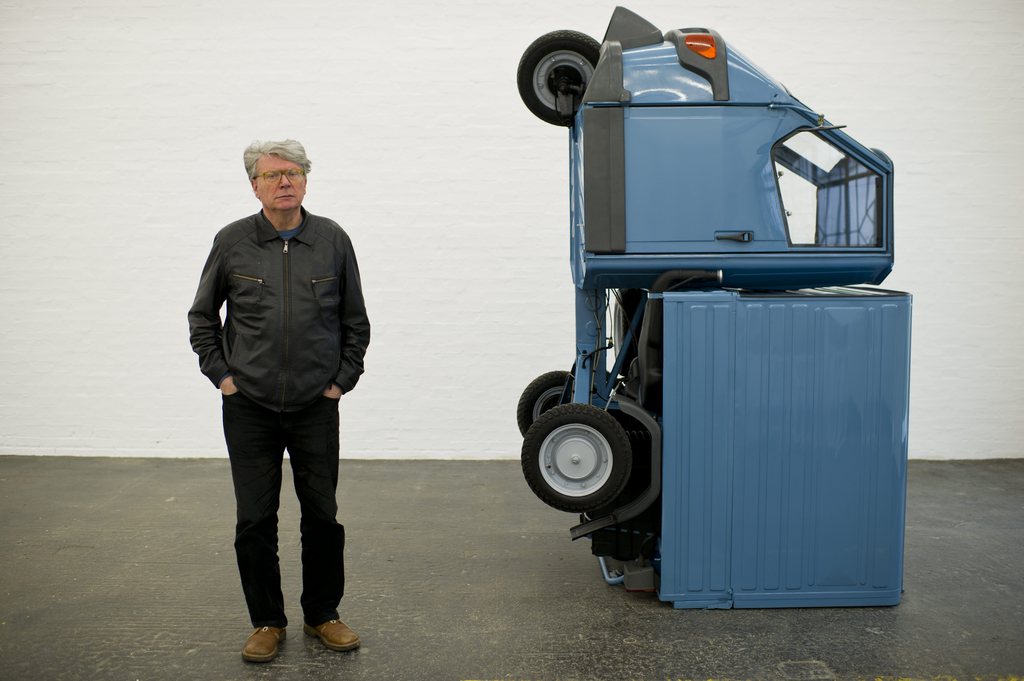
Roman Signer at the opening of his current exhibition at the Kunsthaus Zürich.
Stefan Rohner
But Signer has become one Switzerland’s most internationally acclaimed artists. He is equally valued by art collectors and an internet-based fan community, far removed from the art world. His breakthrough came at the 1987 contemporary art exhibition Documenta, where he blew up thousands of sheets of paper, sending them through the air and briefly creating a “paper wall”.
Signer is a big fan of fireworksExternal link. In one of his videos, a rocket whips the hat off his head; in another, a burst of fireworks sends both his office chair and him spinning in circles.

Roman Signer’s performance “Office Chair”, 2006.
Roman Signer
Many of his works have a short narrative, just like slapstick comedy, which has earned him plenty of likes on social media. In Switzerland, he is often perceived as an “explosive” artist who is primarily known for his entertainment value.
Signer does not like being reduced to Switzerland’s demolition master. At the opening of his latest exhibition, journalists were asked to stay clear of headlines referring to explosions and blasts as they fail to capture the true essence of his work.
Collaborating with nature
The title of his new exhibition, “Landscape”, is deliberately calm. Normally, museums shut out the outside world, but for this exhibition the Kunsthaus Zurich has left the space wide open. Sunlight pours through the windows which frame a view of trees, cars and the city beyond. Even the usual partition walls are missing, allowing the outside world to blend seamlessly with the art.
There is only one piece of art that is kept behind white walls and glass, purely for the safety of the visitors. At the opening, Signer set a decorated and motorised Christmas tree spinning so furiously that it hurled its Christmas baubles like glittering shrapnel.

The Christmas tree and its shattered baubles remain behind glass for the safety of the audience.
Roman Signer
Signer has long insisted that nature isn’t just his source of inspiration, it’s his co-author, complementing his work with its raw forces. For him, collaborating with nature can mean surrendering to gravity.
This is evident in performances where he wears fisherman’s trousers that slowly fill with water until gravity takes over and forces him to the ground. Or when he recreates his own version of a landslide.
Artistic shift in the 1970s
Signer discovered art relatively late in life. Born in 1938, he only decided to study sculpture in the mid-1960s following a serious illness. A turning point came in 1969, when he visited Harald Szeemann’s groundbreaking exhibition “When Attitudes Become Form”with his art school. This visit was pivotal: sculpture shed its rigidity, and personal mythologies took the spotlight. Artists began experimenting like scientists and developed their own theories, like Joseph Beuys for example.
More
More
The subtle and moving art of Roman Signer
Many see elements of Beuys’ art in Signer’s work. “Of course, I’ve heard of Joseph Beuys and paid attention to his work,” Signer says. “Naturally, there were some influences. I’m not a neutral space. But I take the liberty to embrace different intellectual currents. You have to follow your own voice.”
Signer’s work is part of the shift in art that took place around 1970. Using landscapes as his studio places him in the realm of land art. But other than artists such as Robert Smithson, Signer never left any traces in nature. He concentrates on performance art, but since he never felt entirely at ease on stage, he began filming his actions instead.
Sculpturing events
From the 1970s, Signer started to film small “events”, as he called them, with his Super 8 camera. He blew up chairs, made ballons break through layers of ice and burnt down bridges.

Burning bridges.
Roman Signer
Signer may not care much about how art historians classify his work, but he is clear about his craft. “I have always considered myself a sculptor, but not one of those…,” he explains, mimicking the motion of using a hammer. “Today the meaning of the term sculptor is very broad. Even videos can be sculptures.”
Signer’s exhibition at the Kunsthaus Zurich focuses largely on static objects, but transformation is the real heartbeat of his work, even when it happens silently. Take, for example, the time when he let a fuse burn from Appenzell to St Gallen over 35 days, igniting 200 small gunpowder cones along the way. There was no grand finale, no big bang, but a slow burn quietly exploring the passage of time.
Signer’s works often feel like grand escapes from everyday life. In one of his pieces, he tapes two umbrellas together; one umbrella catches the wind and is charging ahead while the other one drags reluctantly behind. Together, they make a run for it and break free from their creator’s grip.
Renaming objects
A story almost every Swiss child had to read in school talks about an old man so bored with his life that he shouts in frustration: “Something needs to change!” He starts renaming everything around him. The bed becomes a “picture”, the table a “carpet”, and the chair an “alarm clock”. The tale ends on a melancholic note with the old man lost in a haze of linguistic confusion and loneliness. Penned during the social upheavals of 1968, Swiss writer Peter Bichsel’s story is a children’s tale for adults laced with laconic anger.
Signer’s works carry a similar anti-authoritarian spirit. But he grants his objects far more liberties. He neither just renames them, nor does he use them merely as Marcel Duchamp used his urinal as a challenge to what can be classified as art. “Signer turns his objects into characters. A table turns into a sailor on an icy sea, while other things start to fly,” says Mirjam Varadinis, curator of his current exhibition. “These objects break free from their assigned meanings and stage their own miniature revolutions.”

“Table, Island” by Roman Signer, 1994.
Roman Signer
Signer describes his objects as if they existed in different “aggregate states of matter”. “There is the flying table and the floating table. It’s not random, and I often have to think carefully before I do something with the table.”
A table, he says, has many faces. “The kind of table I work with is not elegant. It’s a common kitchen table, a symbol for family. This is where you eat soup, have discussions and deal with problems, financial ones and others.”
Sometimes he blows up his table, sometimes he lets it be carried off by balloons or drones. And sometimes he sets it adrift on the sea. “I never saw that table again. I only saw the waves moving, and at some point it must have sunk to the bottom of the ocean. I left it to its fate, abandoned it,” he says, with what sounds like a hint of quiet regret in his voice.
Edited by Benjamin von Wyl. Adapted from German by Billi Bierling/ts


