


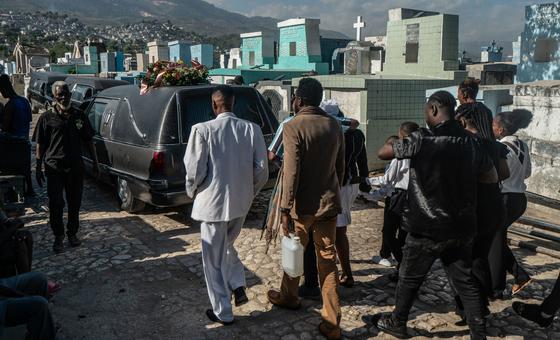
Between January 1 and March 31, at least 1,617 people were killed and 580 others injured in violence involving gangs, self-defence groups, or other members of the population, as well as during security force operations, according to the United Nations Integrated Office in Haiti (BINUH).
At least 161 kidnappings for ransom were recorded, 63% of which occurred in the Artibonite department.
Large-scale attacks
This period saw a surge in criminal group activity aimed at expanding territorial control in Port-au-Prince and surrounding areas. Aiming at destabilising Pétion-Ville, the communes of Delmas and Kenscoff were particularly targeted. In the Centre department, gangs attacked Mirebalais and Saut d’Eau to control roads to the Dominican Republic and facilitate the escape of over 515 inmates from Mirebalais prison.
The UN noted that actions by self-defence groups and unorganised members of the ‘Bwa Kalé’ movement remained a major source of human rights abuse, resulting in at least 189 deaths of individuals accused of gang ties or petty crimes.
The UN also raised alarm over at least 802 deaths during security operations, with 20% being civilians hit by stray bullets. Additionally, 65 summary executions were reportedly carried out by police officers and the Government Commissioner of Miragoâne.
Sexual violence
More than 333 women and girls survived sexual violence, 96% of whom were raped, often gang raped by gangs. At least 35 children were killed, and ten others injured, during gang attacks, police operations, or vigilante acts. Many were also trafficked and forcibly recruited by gangs.
Although the judicial system remains dysfunctional, authorities—supported by the UN—have begun efforts to address impunity. The Transitional Presidential Council adopted a decree to create specialised judicial units for mass crimes, sexual violence, and financial crimes.
Increase in deportations
Responding to a rise in deportations from the Dominican Republic, the International Organization for Migration (IOM) has increased operations in Belladère and Ouanaminthe. Around 20,000 Haitians were returned in April — the highest monthly total this year.
“The situation in Haiti is becoming increasingly critical. Every day, deportations and gang violence worsen an already fragile situation,” said Amy Pope, IOM Director General.
The sharp increase in extremely vulnerable deportees — especially women, children, and newborns — is alarming. Since 22 April, IOM and partners have assisted an average of 15 pregnant women and 15 lactating mothers daily at the Belladère and Ouanaminthe border crossings.
Population displacement
This deportation surge coincides with another emergency in the Centre department. Gang violence in Mirebalais and Saut d’Eau displaced over 51,000 people, according to IOM. While many found shelter with host families, about 12,500 are residing in 95 informal sites with limited access to services. Over 4,000 have sought refuge in Belladère alone.
Gang control of Mirebalais has isolated Belladère, blocking humanitarian access, medical supplies, and aid. Essential resources such as food, water, and medicine are running out.
“This is a deepening crisis that extends beyond the capital, with cross-border deportations and internal displacement converging on Belladère,” said Grégoire Goodstein, IOM Chief of Mission in Haiti. “Delivering aid is becoming increasingly difficult, as humanitarian actors are trapped alongside those they are trying to help.”
In coordination with the Directorate of Civil Protection, IOM is providing drinking water and hygiene kits tailored to the needs of women and children. First aid, medical referrals, and psychosocial support are being offered.
Temporary shelters have been set up, including hotel accommodations for lactating mothers. IOM is also working with Haiti’s National Migration Office and Ministry of Public Health to ensure newborns and mothers receive immediate health care and vaccinations.


