


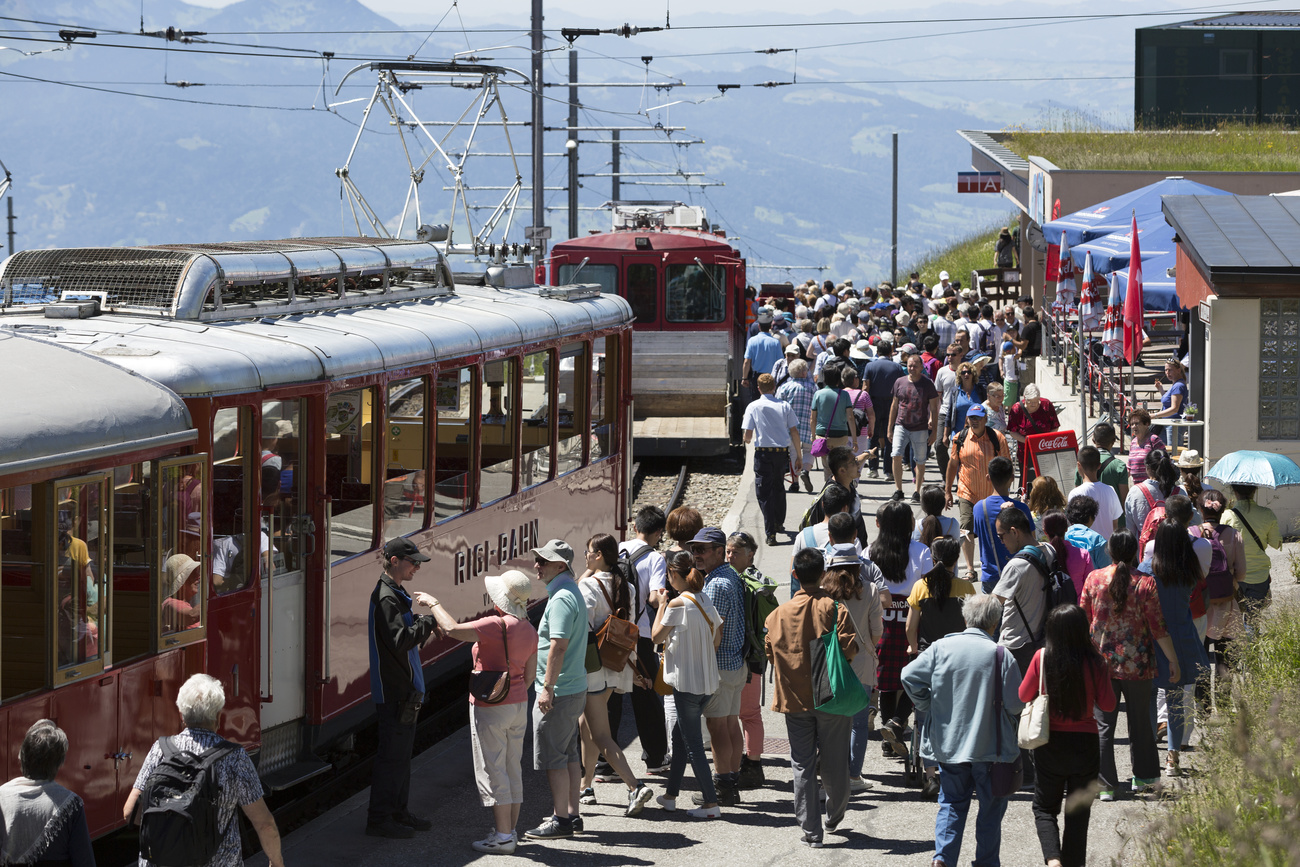
Switzerland strikes a careful balance between boosting its economy and preserving its infrastructure
Keystone / Gaetan Bally
Switzerland saw a sharp decline in net immigration last year, as fewer people arrived and more left the country than in 2023. What is the make-up of the foreign population and why was Switzerland less attractive year-on-year?
+Get the most important news from Switzerland in your inbox
The number of immigrants entering Switzerland in 2024 fell by 6% to 170,607. At the same time, the number of people leaving Switzerland increased, the Federal Statistical Office (FSO) reported in February.
This resulted in net immigration declining by 15,459 people (or by 15.6%) to a figure of 83,392 people.
What’s behind the decline?
This can partially be explained by a slowdown in the number of Ukrainian refugees arriving in Switzerland.
In 2023, Switzerland granted new 50,600 S permits, which allow Ukrainian refugees to work in the Alpine state. This contributed to the largest annual Swiss population growth since the early 1960s. The number of newly-issued S permits fell to 9,600 last year.
But this is not the only reason net immigration declined last year. A rising number of foreigners who had been resident in Switzerland decided to return home last year, particularly Portuguese nationals.
Switzerland saw a rapid rise in the number of Portuguese immigrants after the 2008 financial crisis. But a more recent improvement in economic conditions in Portugal has reversed this trend.
“Migration flows are greatly affected by economic factors. If the Swiss economic situation changes relative to other countries, we tend to see changes in migration,” Didier Ruedin, a senior lecturer at the Swiss Forum for Migration and Population Studies at the University of Neuchâtel, told SWI swissinfo.ch.
+ Meet the foreigners living in Switzerland
“Differences in economic opportunities between other countries and Switzerland have reduced.”
Some 60,597 EU/EFTA nationals left Switzerland last year, a 5.9% rise in the number of departing foreigners from these countries.
“After two years of strong economic growth, the [Swiss] labour market has calmed down as expected since spring 2024,” stated FSO.
More
More
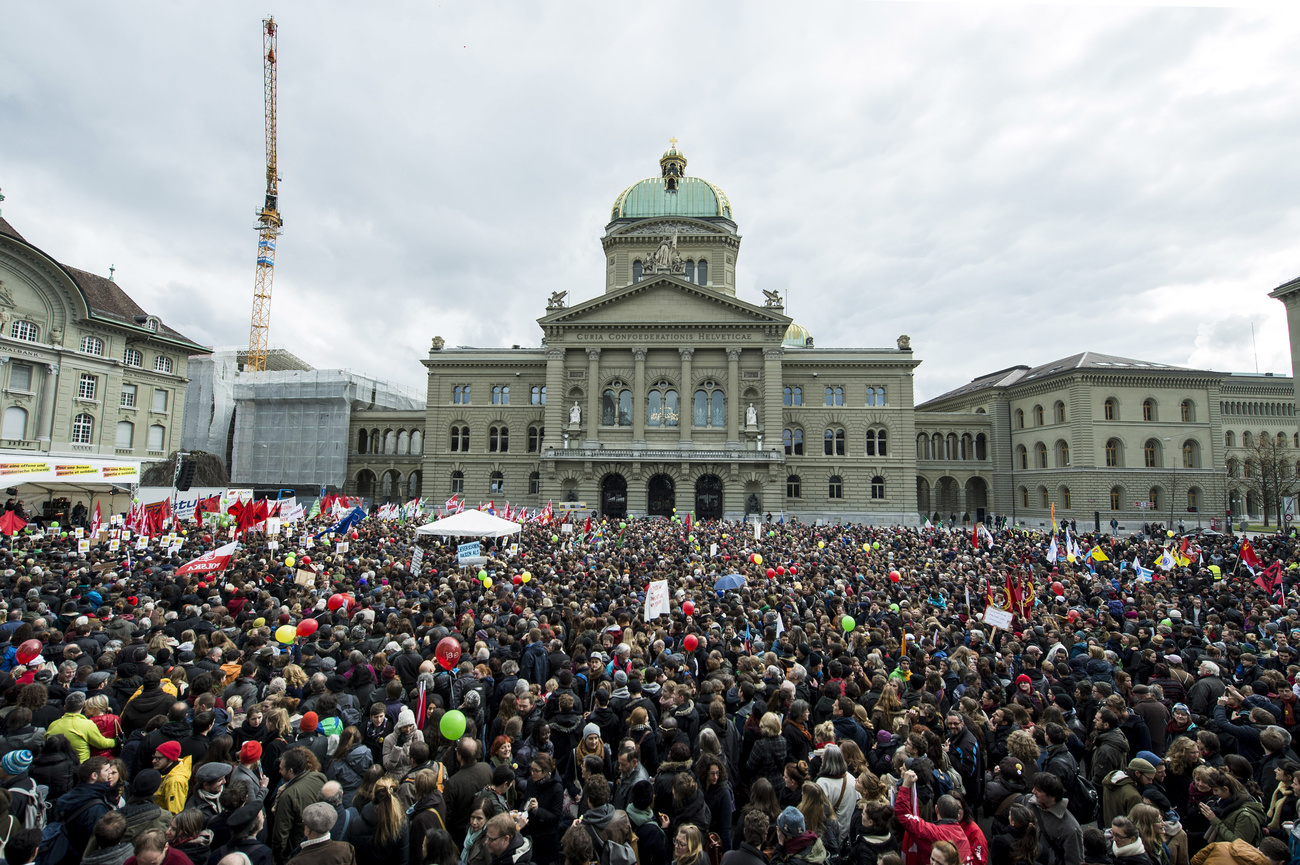
Immigration pressures force strategic re-think in Switzerland
Which nationalities prefer Switzerland?
The European Union and European Free Trade Association (EFTA – Norway, Iceland and Liechtenstein) remain the largest contributors to Swiss immigration at 70.7% of all new arrivals last year. Nations from these areas make up two-thirds of the foreign population of 2,368,364 in Switzerland.
Most immigrants traditionally come from neighbouring countries, such as Italy and Germany, or from slightly further afield in Europe, such as Portugal or Spain. Refugees from war-torn countries, such as Kosovo in the 1990s, have also built up significant communities in Switzerland.
Over the years, Italian nationals have become the largest foreign population living in Switzerland, followed by Germans and Portuguese.
But the trend has subtly changed in recent times. The largest group of immigrants (14%) arrived from Germany last year. The proportion of French immigrants has also picked up while the mix of Italians and Portuguese has decreased.
Most immigrants from the EU/EFTA arrive for job opportunities, while most arrivals from other countries come to be reunited with family members living in Switzerland.
What do the Swiss make of the foreign population?
Foreigners make up more than a quarter of the Swiss population. As in other countries, opinions are divided about the merits or problems associated with this situation.
More
More
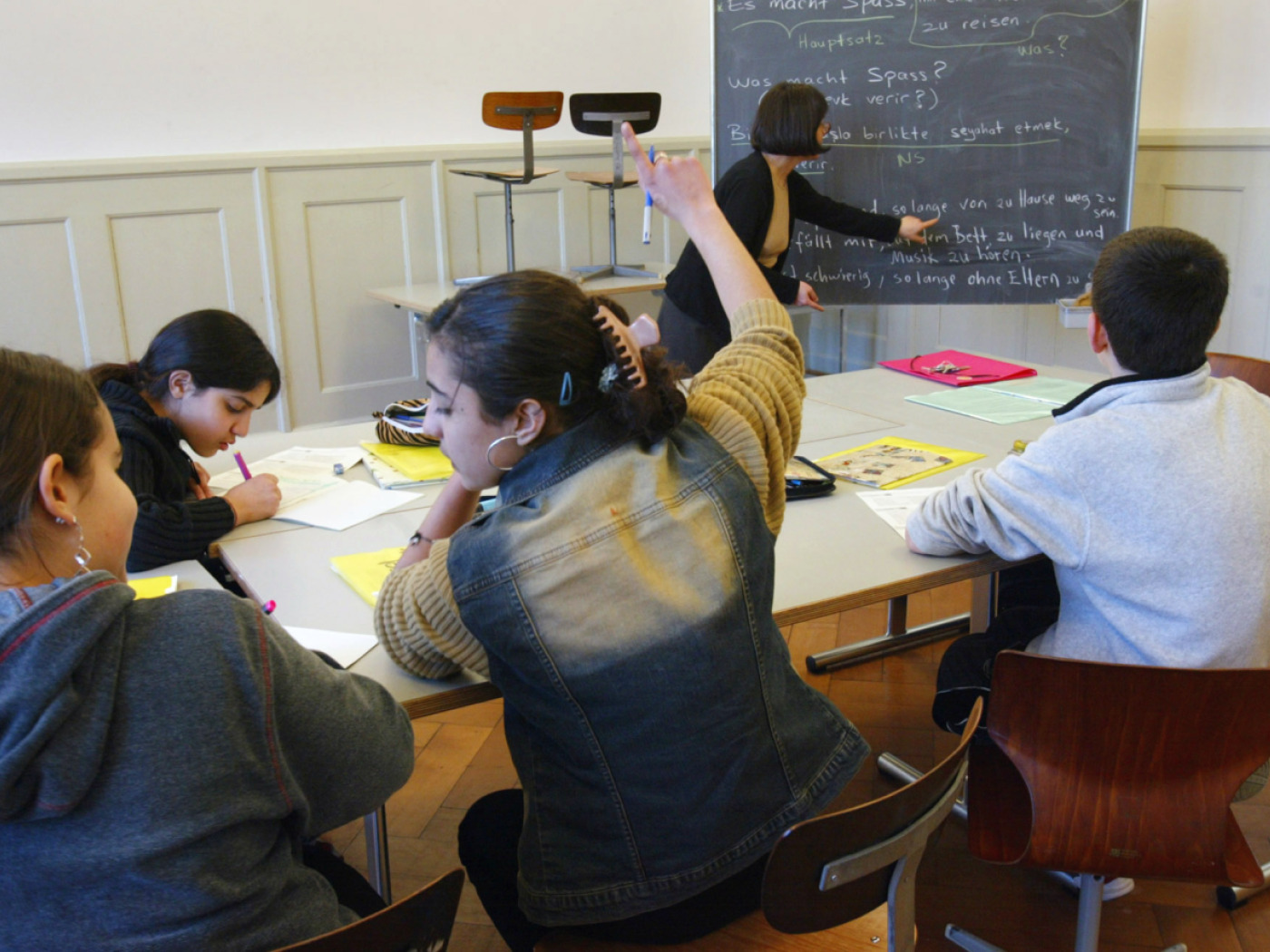
The image of foreigners in Switzerland has deteriorated
Business groups welcome foreigners for helping to fill open positions at companies. This vital supply of labour also helps pay for old age pensions, they argue. Trade unions, on the other hand, fear that foreign workers are forcing down wages.
Rightwing political parties have tried several times at the ballot box to limit the number of foreigners. Most referendums have failed, with the notable exception of a 2014 popular vote “against mass immigration” that strained Swiss ties with the EU.
A new initiative from the Swiss People’s Party to cap the population at ten million (it is currently just over nine million) does not have the support of the government.
Infrastructure, such as transport and housing, which is struggling to keep pace with a rising population, is being placed under intolerable burden, the initiative claims.
Why are people more uneasy about foreigners?
A survey carried out by the FSO every two years on Swiss attitudes to foreigners, found that views had hardened last year. The proportion of respondents who said they felt threatened by foreigners rose from 9% in 2022 to 12.2% in 2024.
This coincides with the rise of rightwing nationalist political parties in Europe, the Ukraine war and increased violence in the Middle East.
“We’re currently in a time of heightened uncertainty, and when there is uncertainty about the future and things we previously took for granted, some people react with negative attitudes to foreigners,” said Ruedin.
“There is a susceptibility to scapegoating which is actively mobilised by certain political actors and parties for political ends.”
Marc Bühlmann, a political scientist at the University of Bern, said a survey sample of 3,222 people can hardly be called representative of the entire population. And there are two ways of looking at the results.
“If 12% of the population views foreigners as a threat can also be interpreted positively,” he told SWI swissinfo.ch. “This means that, conversely, the rest of the Swiss population does not perceive foreigners as a threat. I find that much more remarkable.”
More
More
Immigration in Switzerland: a threat or a chance for prosperity?
Edited by Marc Leutenegger/sb


