


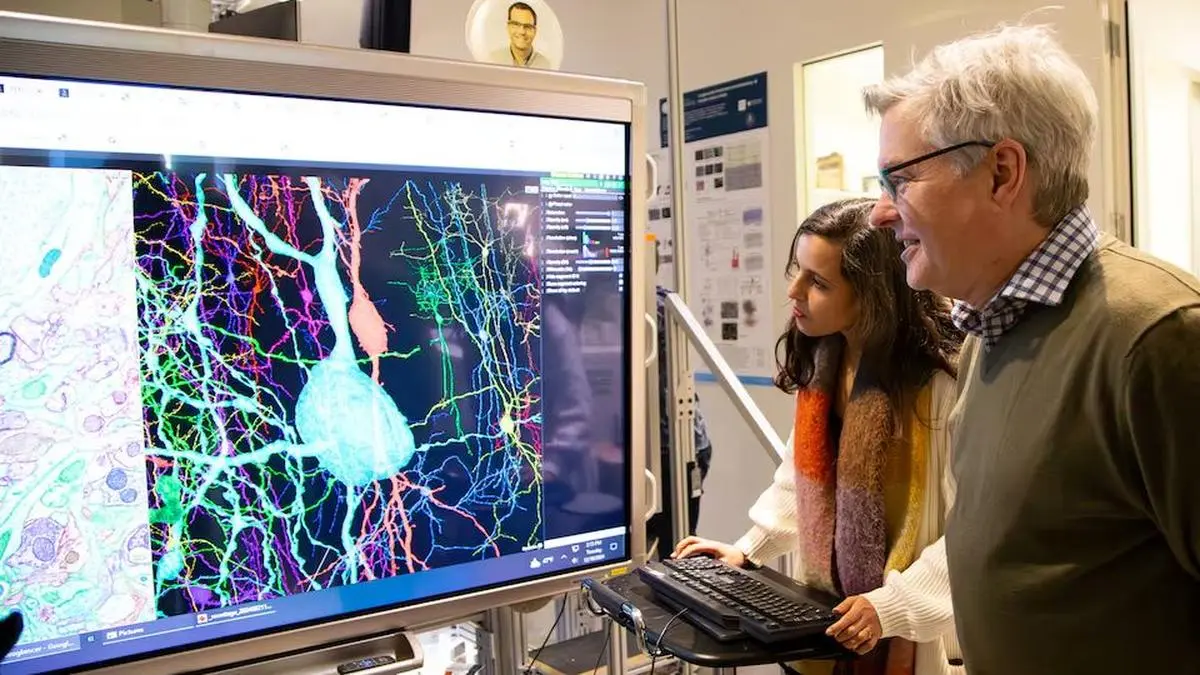
Researchers R. Clay Reid and Leila Elabbady examine data from the MICrONS project at an Allen Institute laboratory in Seattle, U.S., in this photograph released on April 9, 2025.
| Photo Credit:
Allen Institute/Handout via REUTERS
Neuroscientists have produced the largest wiring diagram and functional map of a mammalian brain to date using tissue from a part of a mouse’s cerebral cortex involved in vision, an achievement that could offer insight into how the human brain works.
They worked out the cerebral architecture in a tissue sample the size of a grain of sand bearing more than 200,000 cells including roughly 84,000 nerve cells, called neurons, and about 524 million connections between these neurons at junctions called synapses. In all, they collected data that covers about 3.4 miles (5.4 kilometers) of neuronal wiring in a part of the brain that processes visual information from the eyes.
“The millions of synapses and hundreds of thousands of cells come in such a diversity of shapes and sizes, and contain a massive complexity. Looking at their complexity gives, at least us, a sense of awe about the sheer complexity of our own minds,” said neuroscientist Forrest Collman of the Allen Institute for Brain Science, one of the lead scientists in the research published on Wednesday in the journal Nature.
The cerebral cortex is the brain’s outer layer, the main site of conscious perceptions, judgments and the planning and execution of movements.
“Scientists have been studying the structure and anatomy of the brain – including the morphology of different cell types and how they connect – for over a century. Simultaneously, they’ve been characterizing the function of neurons – for example, what information they process,” said neuroscientist Andreas Tolias of Baylor College of Medicine, one of the research leaders.
“However, understanding how neuronal function emerges at the circuit level has been challenging, since we need to study both function and wiring in the same neurons. Our study represents the largest effort to date to systematically unify brain structure and function within a single individual mouse,” Tolias added.
While there are notable differences between mouse and human brains, many organizational principles remain conserved across species.
The research focused upon a part of this region called the primary visual cortex, involved in the first stage of the brain’s processing of visual information.
The research was conducted by the MICrONS, short for Machine Intelligence from Cortical Networks, a scientific consortium involving more than 150 scientists from various institutions.
Researchers at Baylor College of Medicine created a map of neural activity in a cubic millimeter of the primary visual cortex by recording brain cell responses while the laboratory mouse ran on a treadmill while watching a variety of video images, including from “The Matrix” films. The mouse had been genetically modified to make these cells emit a fluorescent substance when the neurons were active.
The same neurons were then imaged at the Allen Institute. Those images were assembled in three dimensions, and Princeton University researchers used artificial intelligence and machine learning to reconstruct the neurons and their connection patterns.
The brain is populated by a network of cells including neurons that are activated by sensory stimuli such as sight or sound or touch and are connected by synapses. Cognitive function involves the interplay between the activation of neurons and the connections among the brain cells.
The researchers see practical benefits from this type of research.
“First, understanding brain wiring rules can shed light on various neurological and psychiatric disorders, including autism and schizophrenia, which may arise from subtle wiring abnormalities. Second, knowing precisely how neuronal wiring shapes brain function allows us to uncover fundamental mechanisms of cognition,” Tolias said.
One key finding highlighted in the research involved a map of how connections involving a broad class of neurons in the brain called inhibitory cells are organized. When these neurons become active, they make the cells to which they are connected less active. This stands in contrast to excitatory cells, which make the cells to which they connect more likely to become active. Inhibitory cells represent about 15% of the cortical neurons.
“We found many more highly specific patterns of inhibition than many, including us, were expecting to find,” Collman said.
“Inhibitory cells don’t just randomly connect to all the excitatory cells around them, but instead pick out very specific kinds of neurons to connect to. Further, it was known that there are four major kinds of inhibitory neurons in the cortex, but the patterns of specificity break up these categories into much finer groups,” Collman said.
Published on April 10, 2025


