


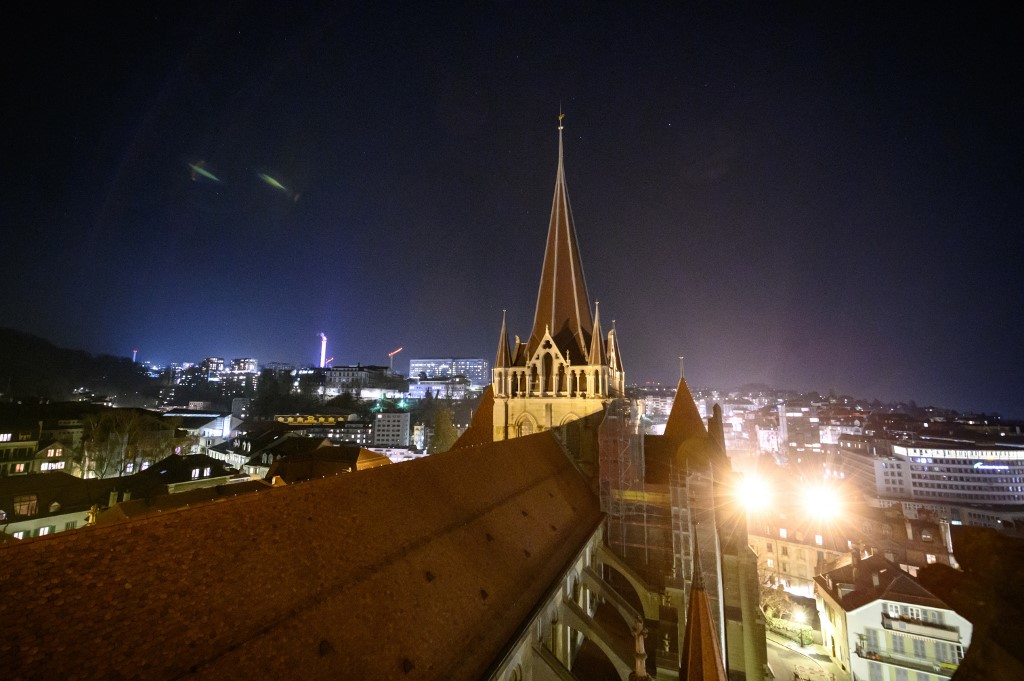
Vaud deputies are seeking to strip Lausanne of its function as the permanent seat of the canton’s capital — a decidedly far-fetched idea in Switzerland. Is this likely to happen?
Twenty-three Vaud deputies signed a motion submitted to the cantonal parliament, asking to amend an article in the constitution, which states that “Lausanne is the capital of the canton.”
Instead, they want the main municipality of each of the canton’s 10 districts to take turns, in the alphabetical order, as Vaud’s capital for one year.
The idea behind this multi-party proposal is to “invigorate” the canton “by bringing power closer to all regions,” the motion states.
This way, Lausanne would re-become a capital only once in a decade.
Under the proposal, each annual change of the capital, “will also provide the opportunity to have a large popular festival” in the district hosting the capital for a given year.
Does this motion have any chance of becoming law?
Realistically speaking, none.
Firstly, the 23 signatories of the motion are in the minority — there are 150 deputies in the Vaud parliament, representing the 10 districts in question.
The idea would have to gain the approval of the majority, which would be difficult to say the least, since a ‘moveable’ capital may sound good (to some) on paper, but in practice it would be a huge administrative headache for the canton in general and each district in particular.
The second major hurdle would be convincing Vaud voters to accept this outlandish proposal in a referendum.
Advertisement
What is the role of a cantonal capital anyway?
Whether Lausanne or capitals of the other 25 cantons (see below), these municipalities have political and administrative responsibilities relating to their respective populations.
Like Bern on the federal level, cantonal capitals are seats of local parliaments, courts, and other government offices and departments that regulate and oversee all public entities and infrastructure on their territories — for instance, schools, healthcare system, public transport, social affairs, and other services.
Imagine moving (if not physically then at least virtually) this administrative machine from one municipality to another every year, which would have to be the case if the proposal by Vaud MPs comes to fruition.
But wait…is this idea really unprecedented?
In modern-day Switzerland, yes, but there is a historic precedence on a federal level.
Before Bern became the seat of the federal government in 1848, this role rotated among several cities — very much like the role of the country’s president rotates among the seven members of the Federal Council.
“In the fledgling Helvetic Republic the honour went, in 1798, to Aarau – for all of four months”, according to the Swiss National Museum.
But “it soon became clear that there was not enough space in the little country town, and the capital was moved to Lucerne.”
Next, the title was passed on to Lausanne, followed by Fribourg, Solothurn, Basel, Bern, Zurich and again to Lucerne. “From 1815, this number was reduced to just Bern, Zurich and Lucerne, for two years each,” the museum’s records show.
It is not known whether this historic example has inspired Vaud deputies to do the same


