


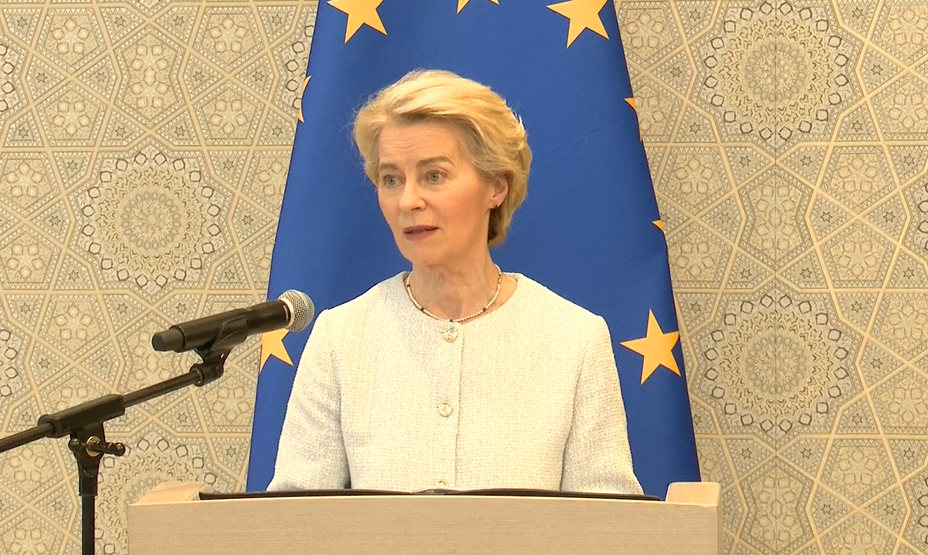
BAKU, Azerbaijan, April 4. The European Union
is building a strategic partnership with Central Asia, focusing on
four priority areas, the President of the European Commission,
Ursula von der Leyen, said at a press conference during the
EU-Central Asia summit in Samarkand, Trend reports.
“Today, a new chapter in relations between the EU and Central
Asia has begun. We are launching a new strategic partnership. This
means we can rely on each other, which is particularly important in
the modern world. The political will to deepen cooperation has
never been clearer, and to kick off this new phase, the EU has
launched an investment package under the Global Gateway program
worth 12 billion euro, focusing on four key areas,” von der Leyen
also said.
She emphasized that the first area is transport.
Ursula von der Leyen stated that the EU aims to bring regions
closer together, with the main project being the Trans-Caspian
Transport Corridor, in which the European Union is investing 10
billion euro. This project is expected to significantly improve
transportation infrastructure and facilitate trade between the EU
and Central Asia.
“The second area concerns climate, energy, and water resources.
These issues are crucial for protecting the ecosystem of the
region. Under this initiative, the EU is actively involved in the
construction of large hydropower plants, such as the Kambaratin
hydropower plant, which will support the region’s water and energy
security. Additionally, the EU has started the creation of a
‘green’ belt in the Aral,” von der Leyen noted.
According to her, the third area is digitization. Ursula von der
Leyen emphasized the importance of satellite technologies to
provide internet access to the most remote areas of Central
Asia.
“We want to connect remote villages, schools, and hospitals. For
this, the EU is using its world-class satellites to install ground
stations in the region,” said the president of the European
Commission.
She mentioned the fourth area — critical raw materials, which
play a key role in the transition to the clean economy of the
future. Central Asia has significant reserves of these materials,
and the EU offers fair conditions for cooperation in this
field.
The official emphasized that the EU wants to build local
value-added chains for critical minerals to create jobs in the
region and ensure that the value created in the region stays in the
region.
“This is our concept of fair partnership. This is the Global
Gateway approach. I am very pleased to see how our partners are
eager to implement these large-scale projects,” von der Leyen
concluded.
Stay up-to-date with more news on Trend News
Agency’s WhatsApp channel


