


If you’re moving to Spain or buying a property here, you’ll need an NIE or Foreigner Identification Number. Here’s our step by step guide on how to apply for one.
NIE stands for Número de Identificación de Extranjero. It’s a ‘Foreigner Identification Number’ for non-Spanish citizens.
You will need one to be able to do any financial transactions while living in Spain such as paying your bills, buying a property and opening a bank account.
Even if you’re a non-resident and buying a holiday home in Spain, you’ll one, but it’s important to remember that it does not authorise you to reside or work legally in Spain, only to make economic transactions.
READ ALSO: Everything you need to know about Spain’s NIE number
There are several ways you can get an NIE, depending on where you’re from and the method you use to gain residency in Spain.
If you’re an EU citizen you’ll be issued on one when you apply for your green residency certificate.
If you’re from a non-EU country you’ll have to apply for one before you apply for your TIE – Tarjeta de Identidad de Extranjero (Foreigner Identity Card), which you’ll get during the first three months of living in Spain.
The NIE consists of a letter, followed by seven digits, and ends with another letter. It will appear on either your EU green residency certificate or your TIE, whichever one applies to you.
It can be requested either when you’re Spain or at the Consular Office in your country of residence, if you need one sooner.
READ ALSO: The big differences between NIE and TIE in Spain
Advertisement
The first step is to book an appointment online so you can go in person and give the necessary documents to get your NIE.
You can apply for your appointment here. Be aware that the system will often say appointments are unavailable but keep trying at different times and you will eventually get one. They are free, so there’s little point paying for an agency to make an appointment for you, unless it’s urgent.
Select the province you live in and then choose your nearest police office and the reason for your appointment.
If you only need the NIE, you’ll click on – Asignación de NIE or Certificado de registro de ciudadano de UE if from the EU and also applying for the green card or Asignación de NIE no UE if from a third country.
READ ALSO: 14 things you should know about Spain’s NIE number for foreigners
Advertisement
In order to apply you’ll need to complete form EX-15 and take it with you to your appointment.
For this you’ll need to complete all your personal details such as name, date of birth, nationality and address.
Section four is the most important part. In the first section check the box for NIE and then under certificado, whether you’re applying for it as a resident or non-resident.
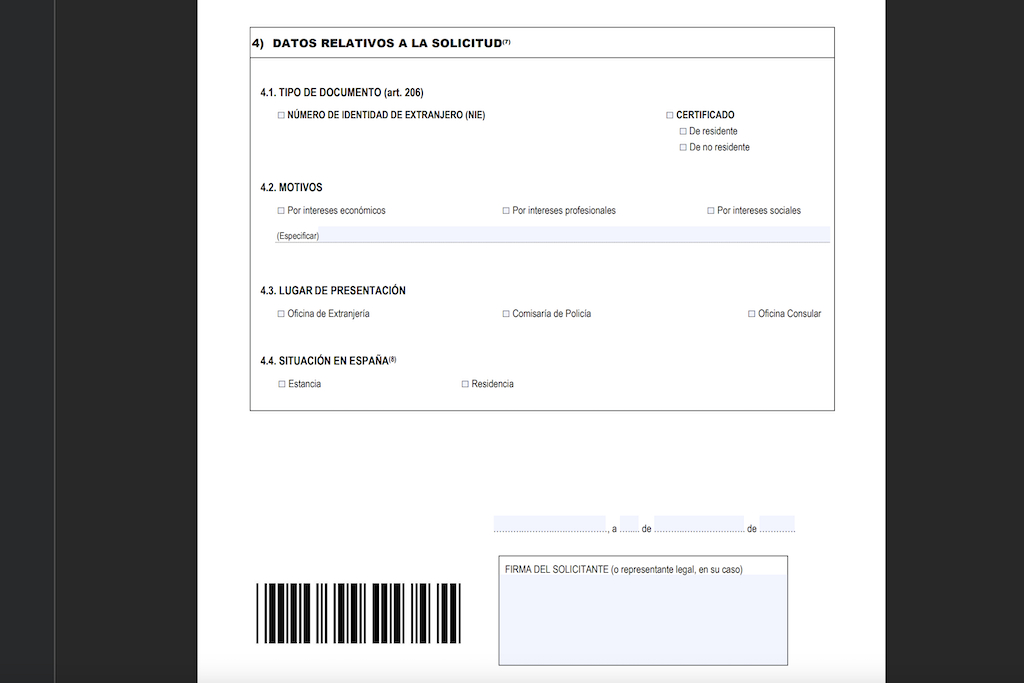
You need to complete modelo EX15 to get your NIE. Source: Spanish government
Next you need to state your motive for applying – economic interests, professional interests or social interests, select one and give the reason below, like you’re moving to Spain for a job or you want to buy a property.
The following question asks where you’re applying such as a foreigner’s office or local police station or consular office.
Lastly you need to state your situation in Spain, if you’re just staying temporarily – estancia or if you have been granted residency – residencia.
Then sign and date it and take it with you to your appointment.
Advertisement
Once you have done this, there are also several other documents you need to take to your appointment including:
- Your passport, with your visa in (if from outside the EU) and a photocopy.
- Modelo 790-012 form in order to pay your fee.
- Proof of why you need an NIE such as real-estate contract or a job contract for example.
If you’re from the EU and coming to Spain without a specific proof and you plan on looking for a job once you get here, you’ll also need to prove you have the financial means to support yourself and that you have private medical insurance. Make sure it’s a plan with no co-payments, otherwise it won’t be accepted.
Once you have completed all these steps and have presented all the necessary documents, you will be issued with your NIE.


