


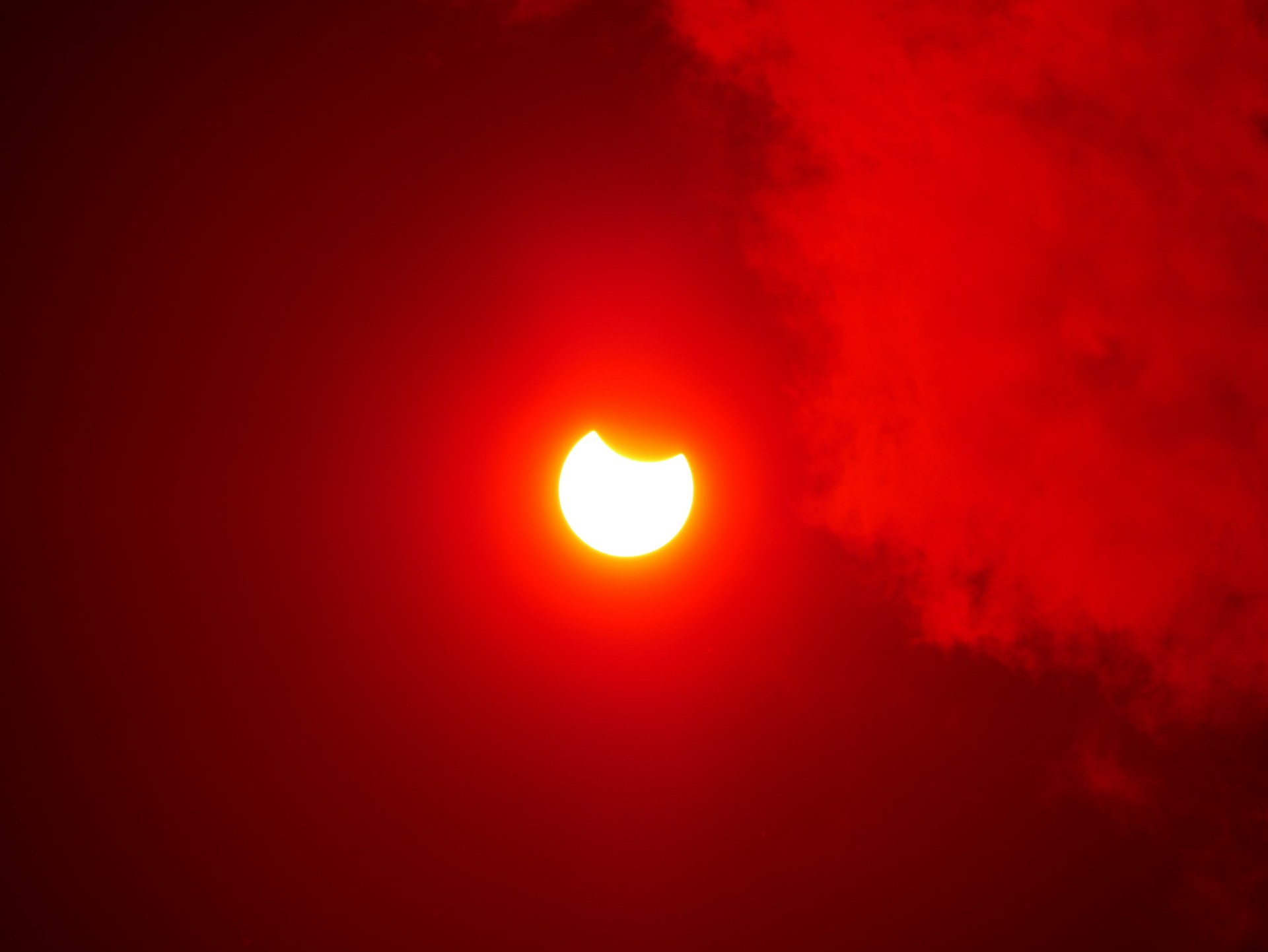
The skies over Switzerland will reveal a unique spectacle on Saturday when a partial eclipse of the sun takes place.
The eclipse will stretch from eastern Canada to northern Russia, and potentially be visible in most of Europe and some areas of northeastern North America and northwest Africa, according to France’s Paris Observatory.
The relatively rare celestial event occurs when the Sun, Moon and Earth all line up. A total solar eclipse is when the moon totally blots out the Sun, creating an eerie twilight.
At around 11:20am, the moon will begin to move in front of the sun, but it won’t not hide the sun completely.
The eclipse will begin slightly earlier in the west of Switzerland than in the east.
While part of the sun will be covered by the new moon from 11:14am in Geneva, the eclipse will not begin until 11:17am in Bern, in Basel from 11:18am and in Zurich from 11:20am.
But it won’t last too long so be sure not to miss it.
Depending on the location, maximum darkness will be reached between 12:02 and 12:07pm. At the peak of the eclipse around one sixth of the sun will be covered.
The moon will then retreat towards the top of the solar disc. Around 90 minutes after the start of the event, the partial eclipse will be over.
Be careful
People wanting to see the moon apparently take a bite out of the Sun will need to take precautions.
Looking straight at the Sun — during an eclipse or otherwise — can lead to irreversible vision loss.
Advertisement
“Using special glasses is one solution,” Deleflie said.
However if the glasses are not new, even a slight defect or “microscopic hole” can cause eye damage, he warned, advising people to try observing an eclipse at a local astronomy observation centre.
Saturday’s partial solar eclipse will be the first of the year, and the 17th of this century.
A bigger one is coming — On August 12, 2026 a total solar eclipse will be visible in Iceland, northern Spain and a parts of Portugal.
More than 90 percent of the Sun will also be obscured in parts of Europe including Britain, France and Italy.
It will be the first total solar eclipse since one swept across North America in April 2024.
With reporting from AFP


