


President Donald Trump appeared to invent a new weapon of economic statecraft on Monday by threatening what he dubbed “secondary tariffs” on countries that buy oil from Venezuela to choke off its oil trade with other nations.
Author of the article:

Published Mar 24, 2025 • 4 minute read
Article content
(Bloomberg) — President Donald Trump appeared to invent a new weapon of economic statecraft on Monday by threatening what he dubbed “secondary tariffs” on countries that buy oil from Venezuela to choke off its oil trade with other nations.
Article content
Article content
The threat, delivered via Truth Social post then confirmed in an executive order, said countries could face 25% tariffs on trade with the US if they purchase oil and gas from Venezuela, which is already under heavy US sanctions. The move was meant to pressure Venezuela for the “tens of thousands of high level, and other, criminals” that Trump said Venezuela has sent to the US.
Advertisement 2

Article content
The novel approach adds to a growing list of weapons that Trump has been eager to deploy as part of a push to use America’s economic clout as leverage in achieving its foreign and domestic policy goals. The idea seems certain to increase tensions with the Latin American nation over immigration and foreign policy.
“This is a new concept in economic warfare,” said Francisco Monaldi, director of the Latin American energy policy at Rice University’s Baker Institute for Public Policy in Houston. “How is it enforceable? It’s unclear of course.”
With the threat, Trump appeared to be inventing a combination of tariffs and what are known as secondary sanctions, the financial punishments that can be imposed on other countries or people for doing business with sanctioned entities. The targets of his “secondary tariffs” could vary widely given that Venezuelan oil goes to the US, Spain, India and the black market.
The first three countries are covered by licenses to Chevron Corp., Repsol SA and Reliance Industries Ltd. The black market is dominated by China.
“China is the main actor this is directed at because it’s essentially the black market for Venezuelan oil,” Monaldi said. “They would not have to do secondary tariffs if it wasn’t for China.”

Top Stories
Article content
Advertisement 3
Article content
Trump’s executive order gives Secretary of State Marco Rubio discretion to decide, starting April 2, whether the 25% tariffs will be imposed on a country that imports Venezuelan oil, either directly or indirectly.
While the order doesn’t state exactly who would be targeted with a secondary tariff, it does specify that if China were to have such a tariff imposed it would apply not just to the mainland but to Hong Kong and Macau as well. Other than Venezuela, China was the only country named in the order.
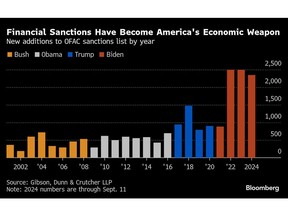
Experts said the move is an understandable one for Trump, who has suggested he’s less inclined to impose financial sanctions. In September, he described sanctions as having the potential to kill the dollar and “everything the dollar represents.” Tariffs, he says, can be used both as a negotiating tool and as a revenue-raising measure.
Tariffs offer the option to ratchet up or ratchet down the amount of the penalty, suggesting that Trump could increase the tariffs on countries that buy energy from Venezuela up to 30% or more if they continue to go against US policy, or slowly bring the percentage down if they make progress toward meeting US demands.
Advertisement 4
Article content
“Sometimes he views tariffs as a form of sanction,” said Josh Lipsky, the senior director of the Atlantic Council’s geoeconomics center. “He believes, and he’s been clear about this since the campaign, that financial sanctions lead to de-dollarization.”
Former President Joe Biden might have expanded the use of the tools of economic statecraft, Lipsky said in an interview. But Trump is “creating whole new tools.”
Treasury Secretary Scott Bessent has described Trump’s use of tariffs as falling into three buckets — a tool to gain leverage in negotiations, a revenue-generating measure to offset the cost of extending the 2017 tax cuts, and as a way to re-balance trade in the US’s favor.
Trump has shown interest in all three of those ideas, sometimes at the same time. Early in his second administration, he threated the country of Colombia with sanctions, tariffs, visa restrictions and a whole host of other penalties for refusing to receive deported migrants. Colombia’s government quickly backed down over fears of enduring a costly trade war with the US.
What Trump Aims to Do With Tariffs, Tariff Threats: QuickTake
Advertisement 5
Article content
That view was reinforced by one of the Biden White House’s practitioners of economic statecraft, who said in an interview prior to Trump’s Venezuela moves that the president likely prefers tariffs to sanctions because he sees them as a win-win instead of a win-lose.
“In Trump’s mind, the advantage of tariffs is that even if your target doesn’t cave and you have to impose them, at least you get some cash,” said Peter Harrell, the former senior director for international economics and competitiveness at the White House National Security Council.
—With assistance from Kevin Crowley and Fabiola Zerpa.
Article content

