


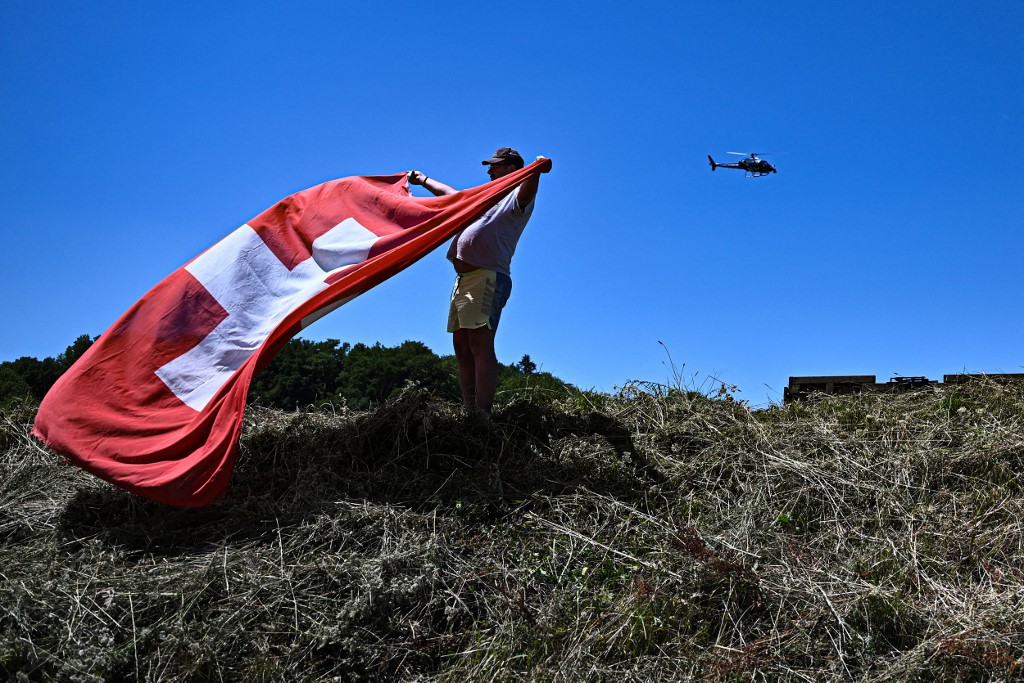
Neutrality has been the backbone of Switzerland’s very existence since the beginning of the 19th century. But given the events of the past three years, can the country still claim to be ‘neutral’?
In most people’s minds, the word “neutrality” is synonymous with Switzerland, in much the same way as cheese, chocolate, and watches.
In this sense, Switzerland may well be the world’s most famous neutral nation, which means it must remain impartial, not take sides in any international conflicts, and its forces can only be used for self-defence and internal security.
This has been Switzerland’s stance (both in theory and practice) since 1815, when great powers of Europe decided that the country would provide a convenient geographical buffer between quarrelling France and Austria, and its neutrality would be a stabilising factor in an unstable region.
READ ALSO: Why is Switzerland always neutral?
This policy had even protected the country from the Nazi invasion during World War II — though, according to one theory, Hitler spared Switzerland because he thought it would be useful to hide Nazi gold, and according to another, he believed attacking Switzerland would be too costly because every man was armed and trained to shoot.
READ ALSO: Why does neutral Switzerland need an army?
Be it as it may, geopolitical events that occurred since February 2022 — namely, Russian invasion of Ukraine — was a paradigm shift of sorts: it changed the way many Swiss viewed their neutrality.
Some concrete examples
As many commentators pointed out when the war started, it is easy to be neutral in peacetime, but values and attitudes often change when armed conflicts arise.
This is exactly what happened in Switzerland.
Sanctions
After Russian troops entered Ukraine on February 24th, 2022, Bern cited neutrality when it initially refrained from jumping onboard sanctions imposed on Moscow by the European Union.
But four days later, the government buckled to international pressure and adopted all the EU sanctions, prompting criticism from the rightwing factions that it was throwing neutrality to the wind.
However, the move, which the government insisted was “compatible” with its neutrality, was widely welcomed on the international stage.
It even earned a mention from then US President Joe Biden, who said in his State of the Union address, that “even Switzerland” was with those striving to hold Moscow accountable for its aggression.
Since then, Switzerland duly adopted all of 16 EU sanctions against Russia.
Advertisement
NATO
Prior to February 2022, it was virtually unthinkable that Switzerland would want to get closer to an international military alliance like NATO, precisely because its policy of neutrality forbids it.
But here too, the war in Ukraine has been a major game-changer: out of pure pragmatism, the Swiss government decided to participate in more NATO exercises and to develop better coordination between the Swiss army and the bloc.
Switzerland is even ready to accept, in some situations, its participation in the NATO’s ‘assistance clause’ — the principle of collective defence, implying that an attack on one member is viewed as an attack on all.
While some in Switzerland have been staunchly opposed to these moves (read more about this below), increasing proportion of the country’s population believe (like their government does) that, in view of the geopolitical risks, security should trump (no pun intended) neutrality.
The “Security 2022” study, conducted by the Swiss military academy and the Centre for Security Studies indicated that while the vast majority (89 percent) of respondents still back the principle of neutrality, the support has declined since the war in Ukraine began in February 2022.
“Only 58 percent of the Swiss population remains convinced that neutrality protects Switzerland from international conflicts, compared to 69 percent in January,” the survey showed.
Advertisement
Boosting the military
Prior to the Ukraine invasion, the budget for Switzerland’s army was pared down because there was no imminent risk to the country’s security.
But right after Russia’s invasion, the parliament and the Federal Council held an urgent debate on the readiness (or not) of Switzerland to withstand enemy attack, given that the army budget had been reduced in previous years to save money.
But in the immediate aftermath of the invasion, the then Defence Minister Viola Amherd called for a 2-billion-franc increase in the military spending to replace the country’s ageing fighter jets and re-equip ground troops.
As a result (and even despite the federal deficit that saw major cuts in many areas), the army was given 29.8 billion francs in total for the years 2025-2028 to bolster Switzerland’s defence.
While strengthening the country’s defence capabilities per se is not a sign of weakening neutrality, it is, nevertheless, a reflection of the threats that currently exist in Europe.
READ ALSO: US general advises Switzerland to ‘prepare for war’
Advertisement
Is everyone in Switzerland on board with the ‘weaker’ neutrality?
No.
Ever since the government started getting closer to NATO and sanctioning Moscow, certain groups have stepped up their defence of neutrality.
For instance, the sovereigntist organisation Pro Schweiz — closely connected to the right-wing Swiss People’s Party (SVP) — has collected more than enough signatures to launch a vote aimed at better anchoring Swiss neutrality in the country’s constitution.
They want to restrict non-military measures such as sanctions, to prevent any closer ties with NATO, and to rule out any military alliance except if attacked.
For its part, the Federal Council retorted that it is against adopting a tighter definition of Switzerland’s neutrality, insisting that it would seriously limit the country’s defence options.
“Enshrining a rigid understanding of neutrality in the federal constitution is not in Switzerland’s interests and would restrict its room for manoeuvre in foreign policy terms,” the government said.
“This would mean that sanctions could no longer be imposed on belligerent states and cooperation with military or defence alliances would be severely curtailed.”
On the other hand, a flexible application of Swiss neutrality had served the country well and was crucial to safeguarding its interests, it said.
The date for the neutrality referendum has not yet been set.
Advertisement
So, is Switzerland still a neutral nation?
At its very core it is, but it is no longer the kind of rigid neutrality that prevailed in the past.
In the last few years, the Swiss were forced to become more flexible and pragmatic, adopting their notion of neutrality to the political upheavals happening not that far from their borders,


