EPFL: a robot that changes shape to adapt to the terrain
Keystone-SDA
Generated with artificial intelligence.
Scientists at the Swiss Federal Institute of Technology Lausanne (EPFL) have developed a bioinspired robot capable of changing shape according to its environment.
This breakthrough, published this week in Science Robotics, represents a new approach to robotic locomotion, according to its authors.
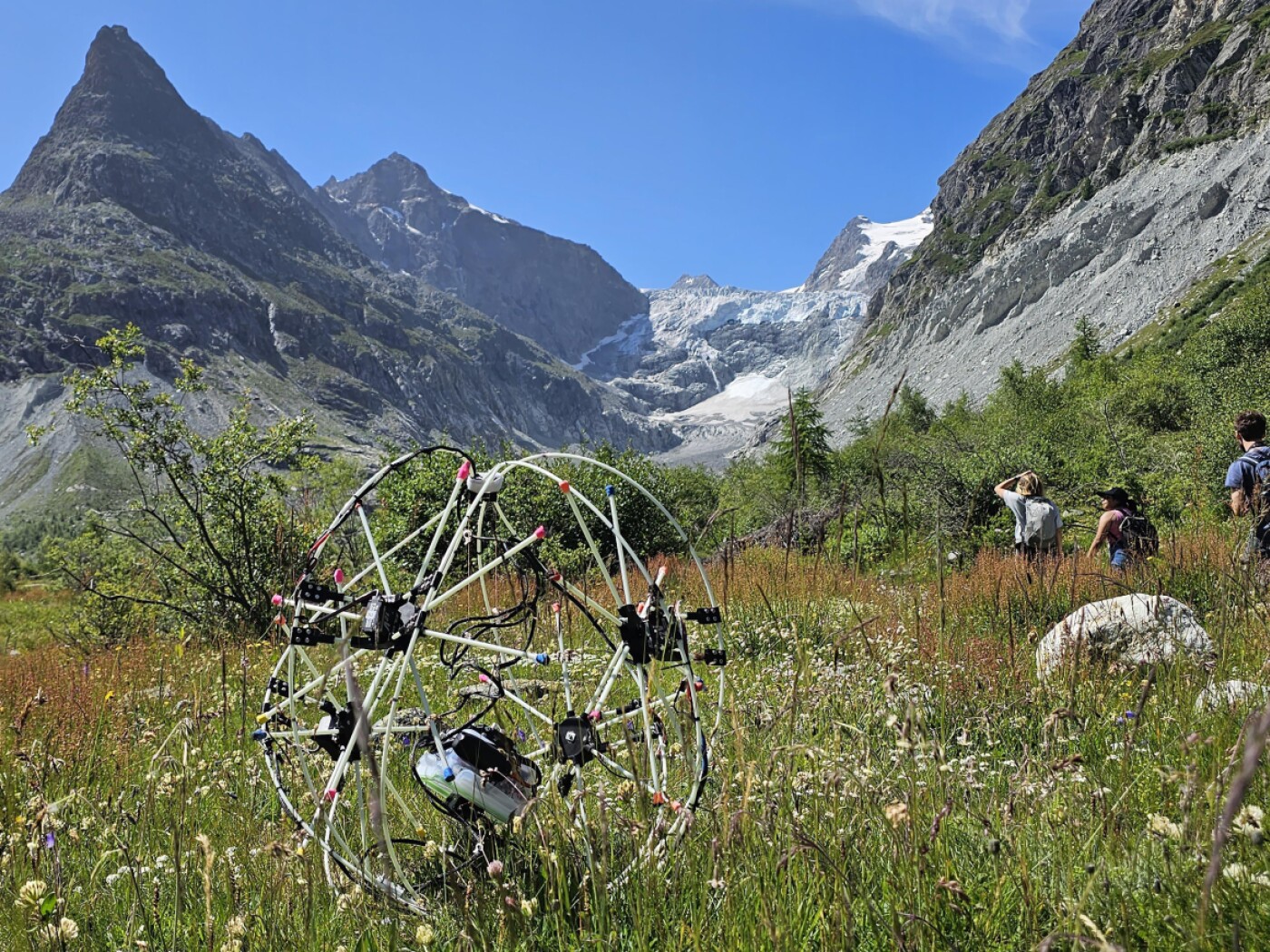
A team from the Faculty of Engineering at the EPFL has developed GOAT (Good Over All Terrains), a robot capable of moving through a variety of environments as deftly as animals by rapidly changing shape.
The machine can switch from a rover configuration to a spherical one as it moves. This enables it to move forwards, roll and even swim, while consuming less energy than a robot equipped with legs or arms.
External Content
“Whereas most robots calculate the shortest path from point A to point B, GOAT takes into account the mode of travel as well as the path,” explained Josie Hughes, who led the work, quoted in an EPFL release on Thursday.
“For example, instead of going around an obstacle such as a stream, GOAT can swim directly across it. If its path is hilly, it can roll downhill like a ball to save time and energy, then move forwards like a rover when it’s no longer advantageous to roll,” she added.
To design the robot, the scientists drew inspiration from animals such as spiders, kangaroos, cockroaches and octopuses. Constructed from inexpensive materials, the robot’s frame consists of two crossed elastic fibereglass rods, with four motorised rimless wheels.
Two winch-driven cables modify the frame’s configuration, eventually shortening like tendons to pull it tightly into a ball. The battery, on-board computer and sensors are contained in a payload weighing up to 2kg. This is suspended in the centre of the frame, where it is well protected.
Max Polzin, PhD student and first author of the study, explains that reconfigurability also enables GOAT to travel with minimal sensor equipment. Equipped only with a satellite navigation system and a device for measuring the robot’s orientation, GOAT carries no cameras: it doesn’t need to know exactly what’s in its path.
“Most robots that move over difficult terrain have numerous sensors to determine the status of each motor, but thanks to its ability to take advantage of its reconfigurability, GOAT doesn’t need complex sensors. It can exploit the environment, even with very limited knowledge of it, to find the path of least resistance,” Polzin said.
The device could be used for a wide range of applications, from environmental monitoring to disaster response and space exploration.
Translated from French by DeepL/ts
This news story has been written and carefully fact-checked by an external editorial team. At SWI swissinfo.ch we select the most relevant news for an international audience and use automatic translation tools such as DeepL to translate it into English. Providing you with automatically translated news gives us the time to write more in-depth articles.
If you want to know more about how we work, have a look here, if you want to learn more about how we use technology, click here, and if you have feedback on this news story please write to english@swissinfo.ch.
More
Group seeks home for historic Battle of Murten panorama painting
This content was published on
A group of enthusiasts is seeking a new home for the monumental historic “Battle of Murten” painting that depicts the victory of the Swiss cantons over the Duke of Burgundy in 1476.
Study reports 12 female CEOs in top 100 Swiss companies
This content was published on
More women are in management and on the board of directors at the largest Swiss companies than ever before. But they remain a clear minority, a new report shows.
Geneva to host conference on Middle East conflict on March 7
This content was published on
A conference on the situation of civilians living in the Israeli occupied territories will take place in Geneva on March 7, the Swiss foreign ministry has confirmed.
Swiss central bank chief rejects holding bitcoin in reserves
This content was published on
Swiss National Bank (SNB) President Martin Schlegel rejects the idea that the central bank should hold part of its reserves in bitcoin, as proposed by a people’s initiative.
The legal changes that come into force in Switzerland on March 1
This content was published on
On March 1, a number of legal changes come into force relating to self-driving cars, increased imports of grain and lower electricity usage costs. Here is an overview.
Swiss president condemns Russian aggression and calls for peace in Ukraine
This content was published on
Swiss President Karin Keller-Sutter has reaffirmed Switzerland’s commitment to a “just and lasting” peace in Ukraine, while condemning Russian aggression.