


KEYSTONE / Alessandro Della Bella
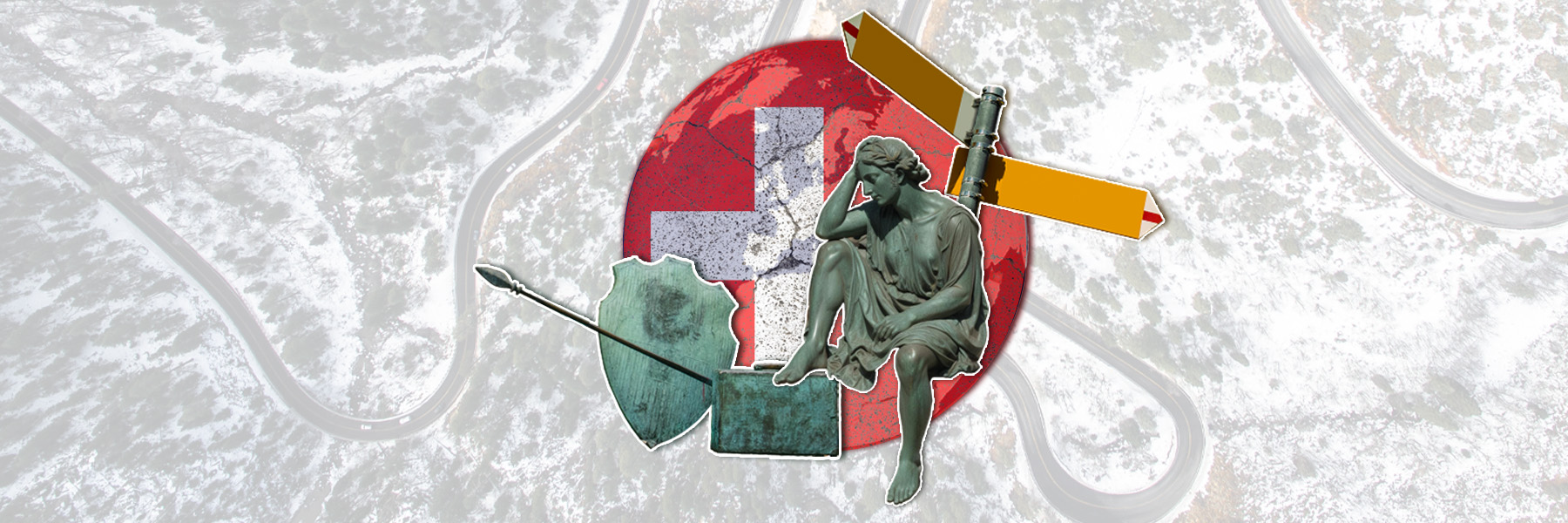
Current global challenges, such as the conflict in Ukraine, are putting pressure on Switzerland’s interpretation of neutrality. In an interview with Swiss public radio, RSI, historian Maurizio Binaghi traces the origins of this Swiss peculiarity.
“In polls, Switzerland appears to be a happy country,” says Maurizio Binaghi, historian and professor at Liceo di Lugano 1, in his interview with RSI. He notes that happiness is a recurring theme in Swiss history. “It reflects an anthropological shift in the Swiss people.”
Not always peaceful
However, Switzerland was not always associated with peace. In earlier centuries, the Swiss were known as fierce and almost invincible warriors, perceived in a “bestial and highly negative” light.
“Everything changed with the Thirty Years’ War in the 17th century,” Binaghi explains. “While Europe was devastated, the Swiss stayed out of the conflict. People abroad saw a country where the economy continued to function, society remained stable, and unique institutional mechanisms were in place. This is when the idea of a ‘happy’ country began to take shape.”
More
What does the future hold for Swiss neutrality?
Switzerland’s reputation for economic stability and social harmony is closely linked to its neutrality. “Neutrality, often viewed as the virtue of the weak, actually brings certain advantages,” says Binaghi. “These advantages have become a core part of the Swiss Confederation’s identity.”
Despite its peaceful image, Switzerland has participated in wars that contributed to its nation-building. “The narrative of a peaceful Switzerland is just that – a narrative,” Binaghi argues. “It creates the illusion of a nation destined to be at the heart of Europe, with its unique political and historical outlook.”
Unlike the United States, which initially declared neutrality during both world wars, Switzerland’s neutrality has been permanent since 1815, in both wartime and peacetime.
A policy of compromises
Switzerland’s neutrality was severely tested during the Second World War (1939–1945). “Neutrality was maintained,” says Binaghi, “but historians have long debated the cost of that neutrality and whether it truly represented impartiality.” According to Binaghi, maintaining neutrality requires legitimacy, which involves making compromises “not only during wars but also in peacetime.”
During the Second World War, Switzerland made several compromises with the Nazi-Fascist international order. “These compromises probably went beyond what was necessary,” admits Binaghi. Although the Bergier Commission – a group of independent experts who investigated Switzerland’s actions during the war – concluded that these compromises were necessary for survival, the Allies criticised Switzerland for not fully using its diplomatic leverage.
Neutrality challenged
“Today, in a rapidly changing international landscape, Switzerland faces new challenges regarding its neutrality,” Binaghi observes. Events such as the conflict in Ukraine have sparked debates about what neutrality means for the Swiss Confederation.
“The course of Swiss history, and its approach to neutrality, is fascinating,” Binaghi concludes. “It reflects the journey of a nation that sees itself as a community. But nothing is permanent – it will be interesting to see how this community evolves in the future.”
Translated from Italian using DeepL/amva/ts


