


Zimbabwe owes more than $21 billion in debt. Now, as the country struggles with a once-in-a-generation drought, ordinary people are paying the price.
Author of the article:

Published Feb 12, 2025 • 4 minute read
Article content
(Bloomberg) — Over the last quarter century, Zimbabwe has failed to pay $21 billion in debt.
Article content
Article content
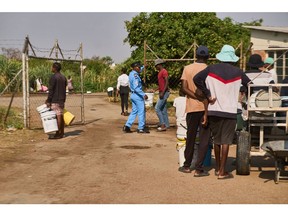
Now, as the country struggles with the impact of a once-in-a-generation drought, ordinary Zimbabweans are paying the price. A prolonged hot and dry spell caused by the El Niño weather phenomenon has ravaged southern Africa, withering crops and leaving 26 million people across seven nations hungry, according to the United Nations’ World Food Programme.
Advertisement 2

Article content
Zimbabwe has been hardest hit, with the corn crop falling by more than two-thirds from previous years. The WFP anticipates that about 7.6 million people will need help accessing food between now and May.
“We couldn’t harvest anything from our field. Even the melons failed to grow,” Bekezela Dube, a 32-year-old mother of four, told United Nations Assistant Secretary-General for Climate, Reena Ghelani, on a visit to the remote rural area of Maphisa. After more than two decades of economic turmoil, many Zimbabweans can’t afford imported food. And fatigue has set in among humanitarian donors.
That leaves multilateral lenders and development finance institutions as the country’s best hope for feeding roughly half its population. Yet unlike other countries — including neighboring Zambia, which has already received $1 billion from the World Bank and the International Monetary Fund to replenish its food supplies and hydropower-dependent energy system — Zimbabwe is locked out of adding to its debt.
Zimbabwe’s creditors include the World Bank, the African Development Bank, the European Investment Bank and the Paris Club, all of which have declined to provide emergency funds. The IMF said it is bound by rules that preclude it from making loans to a country already in default to related organizations.

Top Stories
Article content
Advertisement 3
Article content
“We don’t owe the IMF,” Zimbabwean Finance Minister Mthuli Ncube said in an interview. “So the expectation was maybe we could access some resources.”
In an interview last April, Abebe Selassie, director of the Washington-based lender’s Africa department, said what was happening in Zimbabwe “keeps me awake.’’
The recent freeze on aid disbursement by the US Agency for International Development threatens to make the situation worse. USAID is one of the largest backers of the World Food Programme’s operations in the country and as of last November was also working with UNICEF, the United Nations’ Children Fund, on programs in Zimbabwe to combat malnutrition.
The country’s economic troubles date back to 2000, when then-President Robert Mugabe encouraged subsistence farmers to invade and take over thousands of White-owned commercial farms as retaliation for colonial-era land seizures. While that won him support in an election year, tobacco and corn production subsequently crashed, bringing the country’s export income with it. US and EU sanctions imposed as a result of the land seizures deepened the slump. Major investors pulled out of the country, food shortages and hyperinflation followed, and Zimbabwe was left without enough foreign currency to pay its debts.
Advertisement 4
Article content
Zimbabwe has been trying to resolve its debt problem for years, but has so far repaid only $113 million to the World Bank, African Development Bank and the European Investment Bank. Since 2021, Zimbabwe has also made quarterly payments of $100,000 to each of the 16 bilateral creditors in the Paris Club. It owes that organization at least $4 billion.
In 2022, after plans involving bond sales and leveraging the country’s mineral resources failed, Zimbabwe enlisted African Development Bank President Akinwunmi Adesina and former Mozambican President Joaquim Chissano to negotiate with creditors. Toward the end of last year, it hired Global Sovereign Advisory, a Paris-based consultancy founded by a former Rothschild & Co. banker, and Kepler-Karst, a Madrid-based law firm which specializes in debt restructuring, to advise it on debt management, people familiar with the situation told Bloomberg at the time.
While Zimbabwe’s situation has some parallels, its crisis is the longest by far. Zimbabwe has been in default to the World Bank’s International Bank for Reconstruction and Development since 2000, while the only other country in the same position, Belarus, hasn’t paid its debts since 2022. Zimbabwe has also been in default to the World Bank’s International Development Association since 2000 while the others, Eritrea and Syria, haven’t paid arrears since 2012.
Advertisement 5
Article content
That, the World Bank said in a response to queries, means “the country is not eligible for direct IDA or IBRD financing to the government.’’
Myanmar is a rare example of a country that did exit a debt impasse, according to Martin Kessler, executive director of the Paris-based Finance for Development Lab, which helps African nations manage debt crises.
In 2013, Myanmar used a bridge loan from Japan to clear almost $1 billion of overdue debt to the Asian Development Bank and the World Bank. The two institutions then provided new loans to Myanmar, which used that money to repay Japan. Ncube proposed a similar arrangement in a 2019 interview with Bloomberg, suggesting that a bridge loan from the Group of Seven industrialized nations could be used to pay multilateral lenders. Nothing came of that proposal.
During a briefing at the World Economic Forum in Davos, Switzerland, this year, Ncube expressed optimism that Zimbabwe may soon find a way out. “I believe that during Trump’s era and time we expect to resolve our debt,’’ he said in a panel discussion. He gave no details as to how that might happen.
For now, the country is deep in its so-called “lean season,” and as of December the WFP had collected only a quarter of the $201 million it estimates it will need between now and the harvest in May. “We are expecting perhaps another $30 million, but even once it comes we are still in a precarious situation,” Barbara Clemens, the WFP’s Zimbabwe country director, said at the time.
That’s left millions of Zimbabweans worried about their next meal — and Ncube obsessing about debt.
“It’s an albatross around the economy,” he said.
Article content

