• Login
Saturday, March 7, 2026
Geneva Times
  • Home
  • Editorial
  • Switzerland
  • Europe
  • International
  • UN
  • Business
  • Sports
  • More
    • Article
    • Tamil
No Result
View All Result
  • Home
  • Editorial
  • Switzerland
  • Europe
  • International
  • UN
  • Business
  • Sports
  • More
    • Article
    • Tamil
No Result
View All Result
Geneva Times
No Result
View All Result
  • Home
  • Editorial
  • Switzerland
  • Europe
  • International
  • UN
  • Business
  • Sports
  • More
Home International

Baltic states unplug from Russia and join EU power grid

GenevaTimes by GenevaTimes
February 9, 2025
in International
Reading Time: 5 mins read
0
Baltic states unplug from Russia and join EU power grid
0
SHARES
0
VIEWS
Share on FacebookShare on Twitter


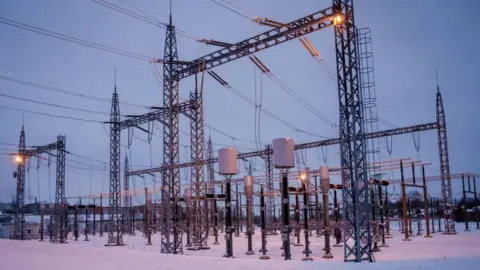
Getty Images A photo taken on February 8, 2025 shows the power substation in Rezekne, Latvia before the disconnection of the major power line between Latvia and Russia. Getty Images

The Baltic states of Estonia, Latvia, and Lithuania are now unplugged from Russia’s electricity grid and have joined the European Union’s network.

Plans for the move – which have been in the works since 2007 – were seen as essential for European security and had been brought forward after Russia’s full-scale invasion of Ukraine in 2022.

“Today, history is made,” EU chief Ursula von der Leyen told a ceremony in Lithuania’s capital. “This is freedom, freedom from threats, freedom from blackmail.”

Polish President Andrzej Duda, praised it as a “truly symbolic moment” that would make the region “more secure and resilient”.

“It is the final step towards emancipation from the post-Soviet sphere of dependence,” he added.

The so-called Brell power grid – which stands for Belarus, Russia, Estonia, Latvia, Lithuania – is controlled almost entirely by Moscow and has long been seen as a vulnerability for the three Baltic states.

Now Nato members, they have not purchased electricity from Russia since 2022, but their connection to the Brell grid left them dependent on Moscow for energy flow.

In her speech, Ms Von der Leyen warned that Nato must remain watchful of possible Russian retaliation.
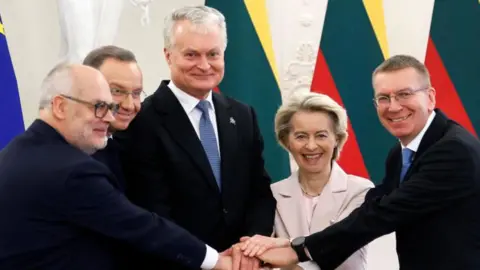
Getty Images (LtoR) Estonian President Alar Karis, Polish President Andrzej Duda, Lithuanian President Gitanas Nauseda, EU chief Ursula von der Leyen and Latvian President Edgars Rinkevics pose after addressing a press conference at the presidential palace in Vilnius, Lithuania on February 9, 2025. Getty Images

The ceremony was attended by Estonian President Alar Karis, Polish President Andrzej Duda, Lithuanian President Gitanas Nauseda, EU chief Ursula von der Leyen and Latvian President Edgars Rinkevics

Pointing to a recent spate of suspected sabotage incidents involving electricity cables and pipelines in the Baltic Sea, she said “there is a pattern, and we cannot ignore it.”

In the past 18 months, at least 11 cables running under the Baltic Sea have been damaged. In a recent case, a ship from Russia’s “shadow fleet” of oil tankers was accused of damaging Estonia’s main power link in the Gulf of Finland. The Kremlin declined to comment.

Lithuanian President Gitanas Nauseda called for sanctions on Russia’s shadow fleet, saying recent incidents were of “great concern”.

Nato has not directly accused Russia but responded by launching a new patrol mission of the region named Baltic Sentry.

In total, around 1.6bn euros (£1.33bn) was invested in the project to transfer the three nations onto the EU’s grid, with the funds largely provided by the EU.

The transition took place over two days, with three nations disconnecting from the Russian grid on Saturday morning, operating as an “energy island” for around 24 hours, and plugging into the EU grid on Sunday.

Ukrainian Energy Minister German Galushchenko hailed it as a “significant event for the whole of Europe”.

Read More

Previous Post

Super Bowl LIX commercials relying largely on comedy and nostalgia

Next Post

As FAANG stocks outperform Indian stocks, here’s how to ride the tech wave

Next Post
As FAANG stocks outperform Indian stocks, here’s how to ride the tech wave

As FAANG stocks outperform Indian stocks, here’s how to ride the tech wave

Leave a Reply

Your email address will not be published. Required fields are marked *

ADVERTISEMENT
Facebook Twitter Instagram Youtube LinkedIn

Explore the Geneva Times

  • About us
  • Contact us

Contact us:

editor@thegenevatimes.ch

Visit us

© 2023 -2024 Geneva Times| Desgined & Developed by Immanuel Kolwin

Welcome Back!

Login to your account below

Forgotten Password?

Retrieve your password

Please enter your username or email address to reset your password.

Log In
No Result
View All Result
  • Home
  • Editorial
  • Switzerland
  • Europe
  • International
  • UN
  • Business
  • Sports
  • More
    • Article
    • Tamil

© 2023 -2024 Geneva Times| Desgined & Developed by Immanuel Kolwin