


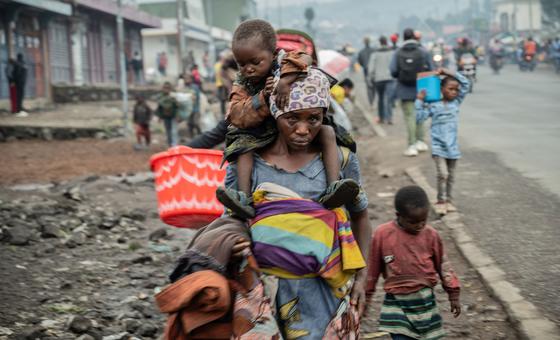
Jean-Pierre Lacroix briefed journalists at UN Headquarters on Friday, as the M23 rebel group and Rwandan Defence Force (RDF) continued their march toward the city of Bukavu, having taken control of the provincial capital, Goma, earlier this week.
“We are concerned not only as far as the eastern DRC is concerned, but if you look at the past, this has the potential of triggering a wider regional conflict,” he said.
“Therefore, it is of the utmost importance that all diplomatic efforts should be geared towards avoiding this and bringing about a cessation of hostilities.”
Protection a priority
Mr. Lacroix was speaking as the M23 were some 60 kilometres north of Bukavu and “seem to be moving quite fast.”
He provided an update on Goma, where the situation remains tense and volatile but calm is gradually being restored. Water and electricity are also up and running, though unexploded ordnance continue to present “a very serious obstacle to freedom of movement”.
The UN has a peacekeeping mission in the DRC, known by the French acronym MONUSCO, and several of its bases have been re-supplied which he said is critical as a “significant number” of people are also sheltering in these locations.
“The priority of the mission remains the protection of its personnel, assets, and, of course, the many civilians sheltering within its premises – civilians and disarmed combatants. All are being protected by MONUSCO in accordance with international humanitarian law,” he said.
He reported that the bases “are under significant pressure” when it comes to providing water rations, sanitation and other support to those inside.
Political engagement ongoing
Meanwhile, the MONUSCO leadership is increasing political engagement with the Congolese authorities. The Secretary-General’s Special Representative and Head of the mission, Bintou Keita, has held discussions with top officials, including the Prime Minister and the leaders of the army and police.
A joint Government-MONUSCO group has been established to coordinate on various issues, including in the security, human rights, humanitarian and communications spheres, as well as the legal status of the territories under the control of the M23 and the RDF.
Mr. Lacroix highlighted the “florescence” of diplomatic activities in response to the crisis, which includes two UN Security Council meetings, a summit by the East African Community (EAC), another by the Southern African bloc SADC, and a meeting of the African Union’s Peace and Security Council.
The European Union, along with the United Kingdom, the United States and others, have also weighed in.
“Up to now, this has not resulted in cessation of hostilities,” he remarked, noting that “the M23 and the RDF are currently progressing towards the south, towards Bukavu, and that is of course a matter of concern.”
Respect UN premises
The peacekeeping chief emphasized the need to ensure the safety and security of UN personnel and civilians, including those sheltering in MONUSCO bases, and respect for UN premises which are inviolable.
“We cannot stress this enough in the current circumstances where MONUSCO bases are under stress, but also in some cases they have been under threat,” he said.
He stated that “diplomatic engagement and activities need to continue” towards the ultimate objective of ending the violence.


