


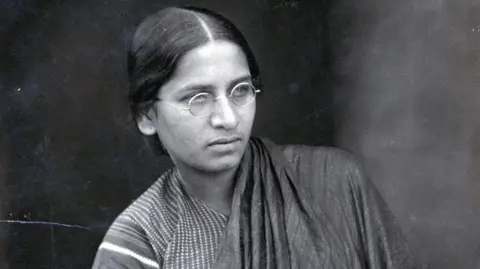
 Urmilla Deshpande
Irawati Karve led a life that stood apart from those around her.
Born in British-ruled India, and at a time when women didn’t have many rights or freedoms, Karve did the unthinkable: she pursued higher studies in a foreign country, became a college professor and India’s first female anthropologist.
She also married a man of her choosing, swam in a bathing suit, drove a scooter and even dared to defy a racist hypothesis of her doctorate supervisor – a famous German anthropologist named Eugen Fischer.
Her writings about Indian culture and civilisation and its caste system are ground-breaking, and are a part of the curriculum in Indian colleges. Yet she remains an obscure figure in history and a lot about her life remains unknown.
A new book titled Iru: The Remarkable Life of Irawati Karve, written by her granddaughter Urmilla Deshpande and academic Thiago Pinto Barbosa, sheds light on her fascinating life, and the many odds she braved to blaze an inspiring trail for the women, and men, who came after her.
Born in 1905 in Burma (now Myanmar), Irawati was named after the Irrawaddy river. The only girl among six siblings, she was doted on by her family and brought up in comfort.
But the young girl’s life took unexpected turns, resulting in experiences that would shape her as a person. Apart from strong women, Irawati’s life also crossed paths with empathetic, progressive men who paved the way for her to break barriers and cheered her on as she did so.
At seven, Irawati was sent to boarding school in Pune – a rare opportunity from her father when most girls were pushed into marriage. In Pune, she met RP Paranjpye, a prominent educationist whose family unofficially adopted Irawati and raised her as their own.
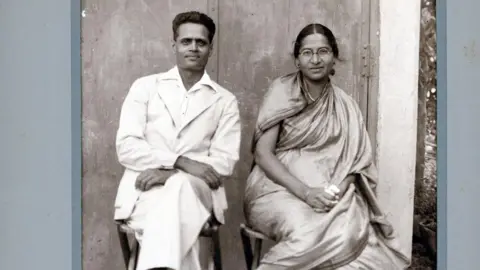
In the Paranjpye household, Irawati was exposed to a way of life that celebrated critical thinking and righteous living, even if that meant going against the grain of Indian society. Paranjpye, who Irawati fondly called “appa” or her “second father”, was a man far ahead of his times.
 Urmilla Deshpande
A college principal and staunch supporter of women’s education, he was also an atheist. Through him, Irawati discovered the fascinating world of social sciences and its impact on society.
When Irawati decided to pursue a doctorate in anthropology in Berlin, despite her biological father’s objections, she found support in Paranjpye and her husband, Dinkar Karve, a professor of science.
She arrived in the German city in 1927, after a days-long journey by ship, and began pursuing her degree under the mentorship of Fischer, a celebrated professor of anthropology and eugenics.
At the time, Germany was still reeling from the impact of World War One and Hitler had not yet risen to power. But the spectre of anti-Semitism had begun raising its ugly head. Irawati bore witness to this hate when she found out one day that a Jewish student in her building had been murdered.
In the book, the authors describe the fear, shock and disgust Irawati felt when she saw the man’s body lying on the footpath outside her building, blood oozing across the concrete.
Irawati wrestled with these emotions while working on the thesis assigned by Fischer: to prove that white Europeans were more logical and reasonable – and therefore racially superior to non-white Europeans. This involved meticulously studying and measuring 149 human skulls.
Fischer hypothesised that white Europeans had asymmetrical skulls to accommodate larger right frontal lobes, supposedly a marker of higher intelligence. However, Irawati’s research found no correlation between race and skull asymmetry.
“She had contradicted Fischer’s hypothesis, of course, but also the theories of that institute and the mainstream theories of the time,” the authors write in the book.
She boldly presented her findings, risking her mentor’s ire and her degree. Fischer gave her the lowest grade, but her research critically and scientifically rejected the use of human differences to justify discrimination. (Later, the Nazis would use Fischer’s theories of racial superiority to further their agenda and Fischer would join the Nazi party.)
 Urmilla Deshpande
Throughout her life, Irawati would display this streak of gumption combined with endless empathy, especially for the women she encountered.
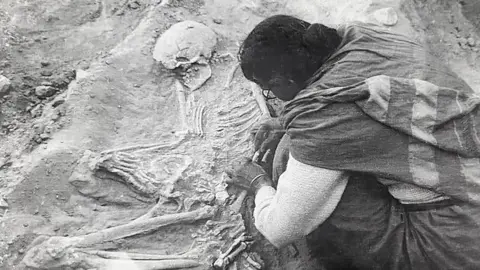
At a time when it was unthinkable for a woman to travel too far away from home, Irawati went on field trips to remote villages in India after returning to the country, sometimes with her male colleagues, at other times with her students and even her children, to study the lives of various tribespeople.
She joined archaeological expeditions to recover 15,000-year-old bones, bridging the past and present. These gruelling trips took her deep into forests and rugged terrain for weeks or months, with the book describing her sleeping in barns or truck beds and often going days with little food.
Irawati also bravely confronted societal and personal prejudices as she interacted with people from all walks of life.
The authors describe how Irawati, a Chitpavan Brahmin from a traditionally vegetarian upper-caste Hindu community, bravely ate partially raw meat offered by a tribal leader she wished to study. She recognised it as a gesture of friendship and a test of loyalty, responding with openness and curiosity.
Her studies fostered deep empathy for humanity, leading her to later criticise fundamentalism across religions, including Hinduism. She believed India belonged to everyone who called it home.
The book recounts a moment when, reflecting on the horrors inflicted by the Nazis on the Jews, Irawati’s mind wandered to a startling realisation that would forever alter her view of humanity.
“In these reflections, Irawati learned the most difficult of lessons from Hindu philosophy: all that is you, too,” the authors write.
Irawati died in 1970, but her legacy endures through her work and the people it continues to inspire.


