


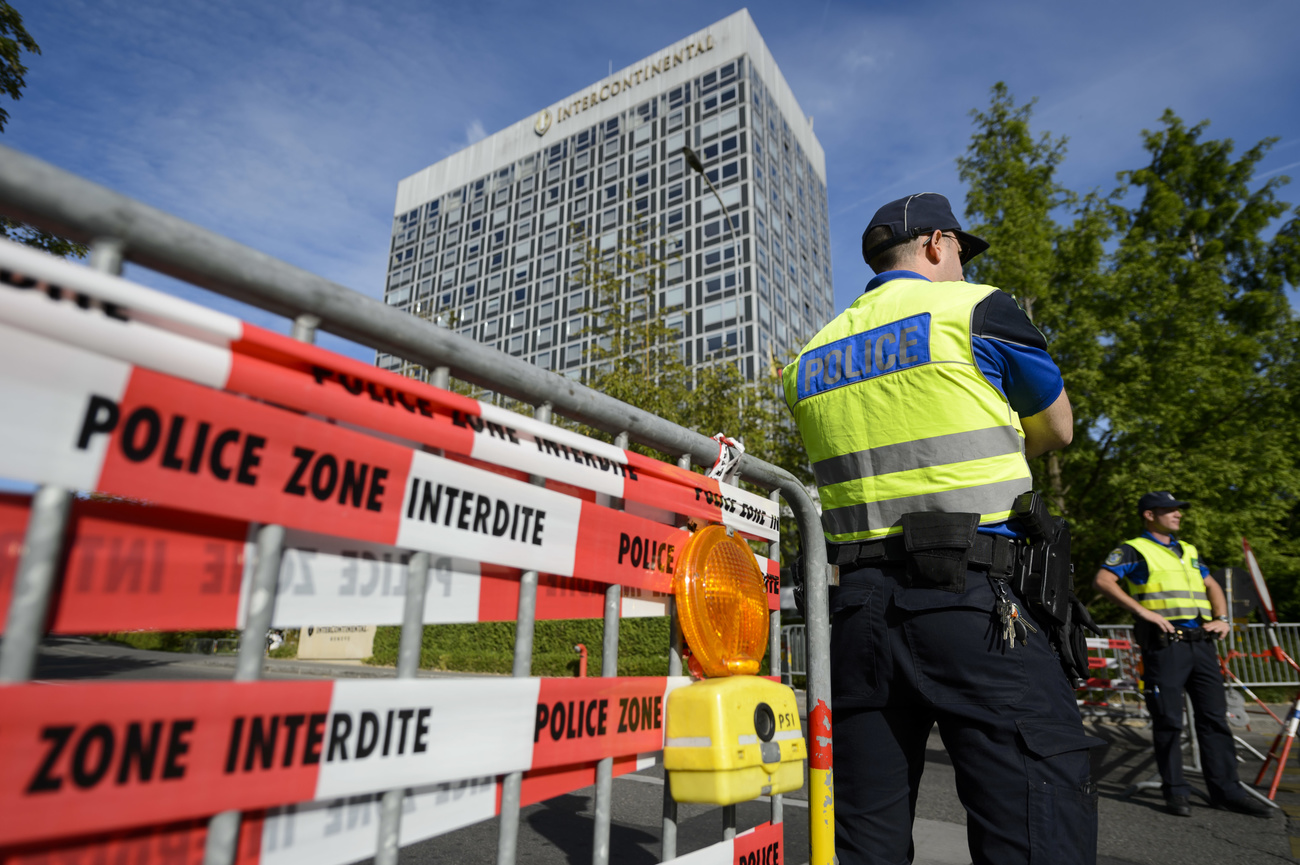
The police is blocking access to the Intercontinental Hotel in Geneva during a round of nuclear talks between the United States and Iran in 2015.
KEYSTONE/Laurent Gillieron
In a tense context and just one week before Donald Trump returns to the White House, Iranian, French, British, and German diplomats met earlier this week near Geneva. Iran’s nuclear programme was on the agenda, but prospects for future progress on this explosive issue remain slim.
The discussions – held at a secret location near Geneva – were described as “serious, frank, and constructive” by Iranian, French, British, and German diplomats on Monday evening, following the first of two days of talks. Representatives of these countries had already met in late November in the Swiss city. On Tuesday evening, Iran’s foreign minister added he had “sensed a serious willingness” from France, the United Kingdom, and Germany to resume negotiations on Iran’s nuclear program.
Both sides had agreed to frame the talks as “consultations” rather than formal “negotiations,” providing an opportunity for Iran and the European powers to address several topics, including the critical issue of Iran’s nuclear development.
But behind the diplomatic formalities lies a growing urgency. European nations are increasingly alarmed by rapid advancements in Iran nuclear programme. According to the International Atomic Energy Agency (IAEA) – the UN’s nuclear watchdog – Iran is now capable of enriching uranium to 60% purity, approaching the 90% threshold required for nuclear weapons. While France, the UK, and Germany have called on Iran to halt its “nuclear escalation,” Tehran claims it has a right to develop nuclear energy for civilian purposes.
At the same time, Iran faces mounting internal and external pressures. The country has been weakened by military setbacks inflicted by Israel on its regional proxies – such as Hezbollah and Hamas – and by the collapse of Bashar al-Assad’s regime in Syria. In addition, Tehran is grappling with a severe economic crisis. Against this backdrop, Iran is seeking relief from Western sanctions.
This urgency is heightened by looming deadlines. In October 2025, key provisions of the 2015 Joint Comprehensive Plan of Action (JCPOA), also known as the Iran nuclear deal, are set to expire. Notably, the “snapback” mechanism – allowing France, the UK, or Germany to unilaterally reinstate UN sanctions on Iran – will no longer be available to European powers after that date.
Relations between Iran and European nations, historically better than Tehran’s ties with Washington, which have been severed for 45 years, have deteriorated in recent years. This is largely due to Iran’s delivery of drones to Russia for use in the war in Ukraine and its crackdown on protests following the custodial death of 22-year-old Mahsa Amini, arrested for allegedly wearing “improper hijab”.
More
More
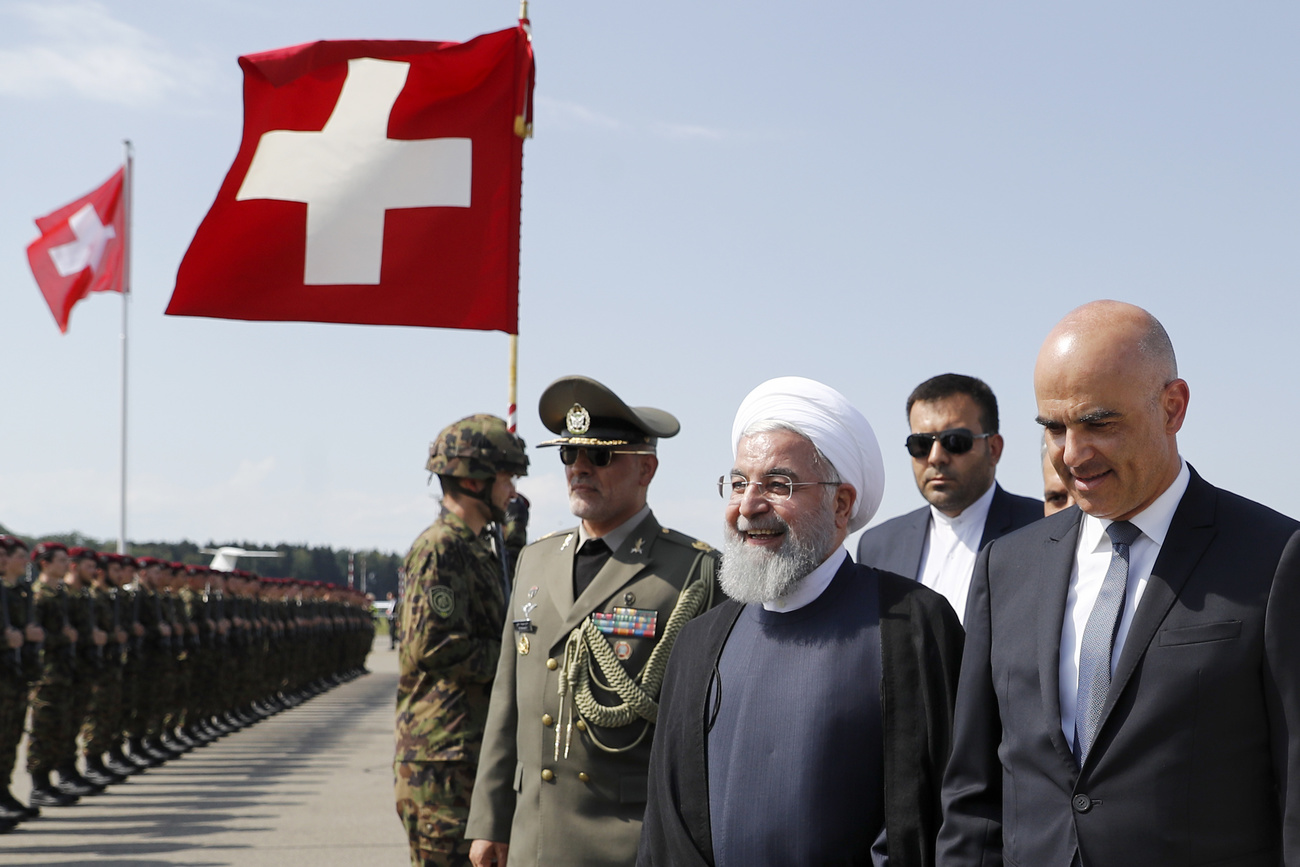
Iranian protests test Switzerland’s special status with Iran
The US missing from Geneva talks
But any new agreement will inevitably involve the United States, which was absent from the Geneva talks.
In 2018, under then-president Donald Trump, the US withdrew from the JCPOA – one of Barack Obama’s major foreign policy successes – with Trump arguing the deal was unfair. The agreement, also signed by France, the UK, Germany, China, and Russia, imposes restrictions on Iran’s nuclear programme in exchange for lifting UN sanctions. However, following the US withdrawal and the reinstatement of sanctions, Iran began to breach these restrictions.
“Today, everyone knows the agreement is obsolete,” says David Rigoulet-Roze, a researcher at the Paris-based Institute for International and Strategic Relations (IRIS). “It’s obsolete because, since its signing, Tehran has made exponential progress in uranium enrichment and stockpiling that no longer aligns with a civilian programme, according to the IAEA. It’s difficult to see how an increasingly nationalistic Iran could comply with the deal.”
The researcher adds that Iran’s potential acquisition of a nuclear weapon now hinges not on “technical questions but political decisions.” According to him, Iran’s weakened position may push it toward developing a nuclear deterrent.
More
More
What history tells us about sanctions
Future negotiations face significant obstacles
Since taking office last August, Iran’s new president, Masoud Pezeshkian, has repeatedly expressed a desire to resume talks with international partners.
“The president and his foreign affairs team would prefer to conclude an agreement with the new US administration. This may or may not include the European powers,” says Farzan Sabet, an expert on Middle East security at the Geneva Graduate Institute. “The Iranian government wants to obtain sanctions relief and reduce tensions with Washington to avoid military confrontation with the United States and being put in a position in which it feels compelled to develop nuclear weapons,” he adds.
The problem, the expert points out, is that the president is not the only decision-maker on the nuclear issue, as he depends on the position of other more powerful actors within the Iranian regime, particularly those of the Supreme Leader and the Revolutionary Guards.
“It is difficult to know if and how Iran’s real red lines have shifted on the nuclear and other important issues, especially in light of recent events that have led to an erosion of its security and influence,” says Sabet.
More
Opinion

More
Iran won’t compromise on nuclear issues unless forced
Uncertainty Looms with Trump’s Return
The return of Donald Trump to the White House on January 20 adds further uncertainty. Known for his hardline stance on Iran, Trump has surrounded himself with officials who share this approach. However, Trump also sees himself as a dealmaker and may be tempted to engage directly with Tehran, much as he did with North Korea during his first term.
Rigoulet-Roze acknowledges this possibility but warns of a dilemma. According to him, Trump could pursue negotiations while sidelining the Europeans, but he risks a conflict of priorities. He wants to be seen as a staunch ally of Israel, potentially supporting Israeli strikes on Iranian nuclear facilities, while simultaneously presenting himself as a peace advocate.
“What is certain is that if Donald Trump wants an agreement, it will be even more restrictive for Iran than the JCPOA. And the problem is that Tehran will not accept it,” says Rigoulet-Roze.
While prospects for another meeting between European powers and Iran appear positive, no date or location has been confirmed.
Edited by Virginie Mangin/ac


