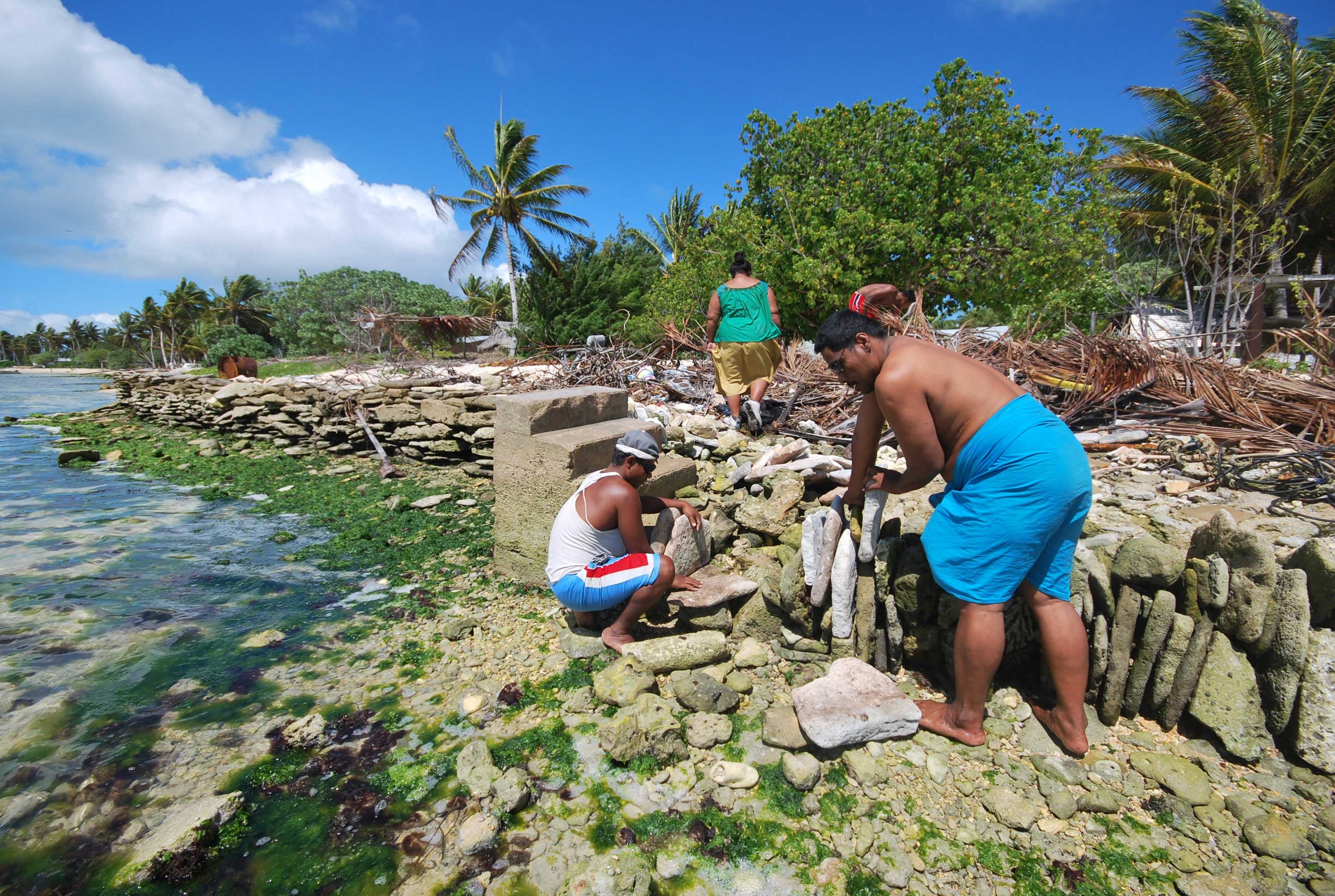
Residents of Kiritimati, a Pacific atoll, build a stone seawall to combat the rising sea level caused by the climate crisis.
Keystone-SDA
The tiny Pacific Island of Vanuatu wants the World Court in The Hague to weigh in on states’ legal obligations to fight climate change and take responsibility for their contributions to the warming planet. Here’s what you need to know about this potentially groundbreaking climate case.

What are the climate hearings all about?
Marathon hearings have been taking place this month at the International Court of Justice (ICJ), known widely as the World Court, in The Hague, the Netherlands, after years of campaigning by climate-vulnerable nations led by the Pacific Island state Vanuatu. The court has been asked to clarify international law with respect to climate change.
Vanuatu and other vulnerable nations say they disproportionately suffer the effects of climate change: increasingly intense storms, floods and rising sea levels. They want the wealthy polluting nations most responsible for climate breakdown to be held legally responsible and are pushing for fair financial support and compensation for irreversible loss and damage.
How did the case initiated by legal students from Vanuatu end up at the World Court?
Three years ago, Vanuatu announced a plan to seek a climate advisory opinion from the ICJ. Legal students from Pacific Island statesExternal link who came together to form an NGO – the Pacific Island Students Fighting Climate Change – were the initial driving force.
After intense lobbying, Vanuatu took the initiative to the UN General Assembly in New York. The global body finally approved a resolutionExternal link on 29 March 2023, taking inspiration from UN legal texts.
As a next step, the UN asked the ICJ, the highest world court for resolving international disputes, to come up with an advisory opinion on what obligations states have to tackle climate change and what the legal consequences could be if they fail to do so.

The climate hearings took place before a panel of 15 international judges at the International Court of Justice (ICJ) in The Hague, the Netherlands, between December 2-13, 2024.
Keystone-SDA
The ICJ hearings are historic – it’s the largest case in the court’s history in terms of the number of plaintiffs. Over 100 countries and organisations are testifying between December 2-13. The hearings will wrap up on December 13. A 15-judge panel will then deliberate on the submissions and arguments and an opinion is expected sometime in 2025.
What has happened in The Hague so far?
Experts have called the hearings a “David and Goliath battle” between rich nations urging judges to stick to current legal obligations and vulnerable states pleading for more.
“We find ourselves on the front lines of a crisis we did not create; a crisis that threatens our very existence”
Ralph Regenvanu, Vanuatu’s special envoy for climate change and the environment
“We find ourselves on the front lines of a crisis we did not create; a crisis that threatens our very existence,” declared Ralph Regenvanu, Vanuatu’s special envoy for climate change and the environment, at the start of proceedings. Responsibility for the climate crisis lies squarely with “a handful of readily identifiable states” that had produced most greenhouse gas emissions, he added.
Next up was the United States, the world’s largest historic greenhouse gas emitter. It argued against states being legally obliged to combat the climate crisis and dismissed the idea that the ICJ should propose that historic emitters be held responsible for past pollution. It said the current global climate rules – the UN framework convention on climate change (UNFCCC) and the landmark 2015 Paris Agreement and other existing non-binding treaties – were the best way forward.
Other major fossil-fuel economies and developed nations such as Australia, China, India, Saudi Arabia and Germany took a similar line, arguing against legal accountability or tampering with existing legal frameworks.

Climate protesters outside the International Court of Justice in The Hague on December 2, 2024.
Keystone-SDA
This “business-as-usual” approach has been sharply criticised by campaigners. “Once again, we witness a disheartening attempt by the US to evade its responsibilities as one of the world’s largest polluters,” said Vishal Prasad, director of Pacific Islands Students Fighting Climate Change.
Switzerland: ‘somewhere in the middle’
Switzerland – the world’s 13th largest emitter per capita for consumption-based CO2 emissionsExternal link – presented its position to the court on December 11, following an earlier written statementExternal link.
“Switzerland holds that it is not possible to attribute a quantifiable and specific obligation of reparation to each state,” a Swiss government official told the panel. The Alpine nation insists on adhering to the ‘polluter pays’ principleExternal link to guide political negotiations and court decisions, and for a collective response.
In its statement, Switzerland also stressed that carbon budgets and the allocation of CO2 emissions to states are political issues – not to be decided by international law to create obligations. It also argued that mitigation policy should not be subject to a human rights-based review.
Summing up, Corine Heri, a human rights and climate researcher at the University of Zurich, felt Switzerland’s position was “somewhere in the middle” of the spectrum of testimonies. While welcoming parts of their statement, she criticised the Swiss for disputing binding legal obligations for reparations or the compensation of loss and damage.
Sébastien Duyck from the Geneva-based Center for International Environmental Law (CIEL) said Switzerland had squandered an opportunity to present a “balanced and comprehensive framework” that encourages greater climate ambition.
More

More
Landmark ruling: Switzerland’s climate policy violates human rights
“It was clear that a strong motive underpinning Switzerland’s intervention was to gut meaningful climate rulings like the Klimaseniorinnen judgment. Switzerland wasn’t engaging in climate leadership; it was playing the system to avoid responsibility,” he told SWI swissinfo.ch.
In April, the Strasbourg-based European Court of Human Rights (ECHR) issued a landmark verdict in the KlimaSeniorinnen caseExternal link ruling that Switzerland was not doing enough to tackle climate change. The government has dismissed it, criticisingExternal link the judges’ broad interpretation of the European Convention of Human Rights regarding climate protection; it says Swiss policies are not inadequate.
Why is the ICJ case significant?
Climate litigationExternal link involving corporationsExternal link and states has been rising from Europe to Latin America and beyond. Climate court cases have more than doubled since 2017, according to the UNExternal link.
But there is a need for greater legal clarity. The ICJ is one of three international courts tasked with producing an advisory opinion on the climate crisis, alongside the international tribunal for the law of the sea (Itlos) and the inter-American court of human rights. The ICJ will take these two opinions into account, as well as significant court judgments, including the ECHR ruling on Switzerland.
More

More
International law adapts as climate court cases add up
The stakes are high, as money and reparations are central. Developing countries have been left frustrated by the money handed down to combat the effects of climate change – the most recent example being the $300 billion annually by 2035 pledged at the COP29 in Baku.
What will happen as a result of the climate opinion?
Advisory opinions from the ICJ are not binding, yet they are legally and politically significant. While it won’t directly force wealthy nations into action to help struggling countries, it would be more than a powerful symbol, say experts. The ICJ’s opinion will probably be cited in climate change-driven lawsuits around the world.
Sébastien Duyck reckons an ICJ opinion will have a strong impact.
“It will serve as a legal precedent and give guidelines for all the other legal and political bodies working on issues of climate justice and climate-related international cooperation,” he told Swiss public radio, RTS.
Corine Heri said the climate hearings and advisory opinion were a “crucial moment” that will be hard for states to ignore.
“The opinion will clarify what international law requires, and how different areas of international law relate to each other,” she told SWI swissinfo.ch. For instance, does human rights law or customary international law require more from states than the Paris Agreement or UNFCCC?
“It will reduce the range of legal arguments that are considered feasible – potentially making it impossible to argue that climate change and especially mitigation of greenhouse gas emissions is a purely political matter that should only be discussed in the context of international COP negotiations, and not in the courtroom,” said Heri.
Much will depend on the actual final text, but potentially this will “provide a tool for climate-vulnerable developing states to use in pushing for reparations”, the law researcher said.
Edited by Veronica De Vore
More