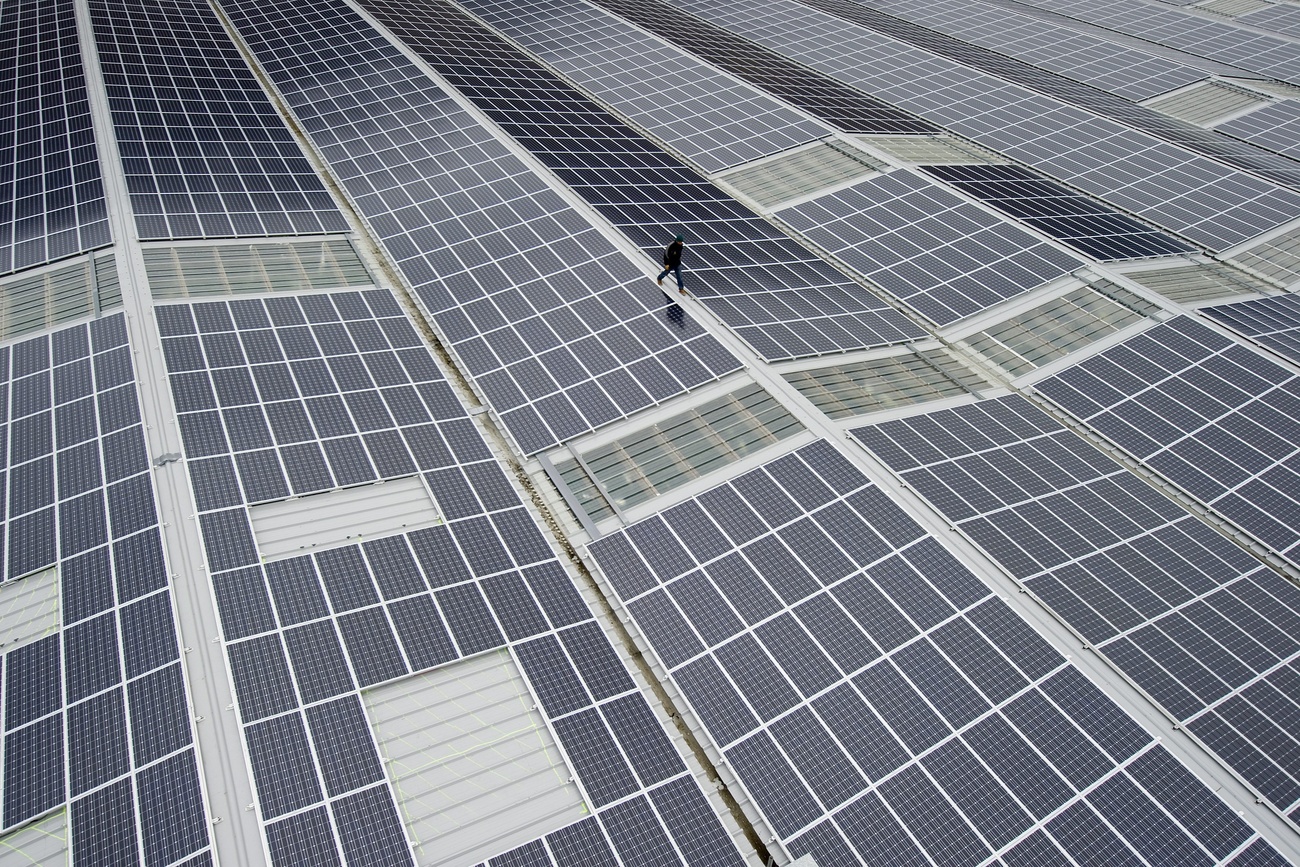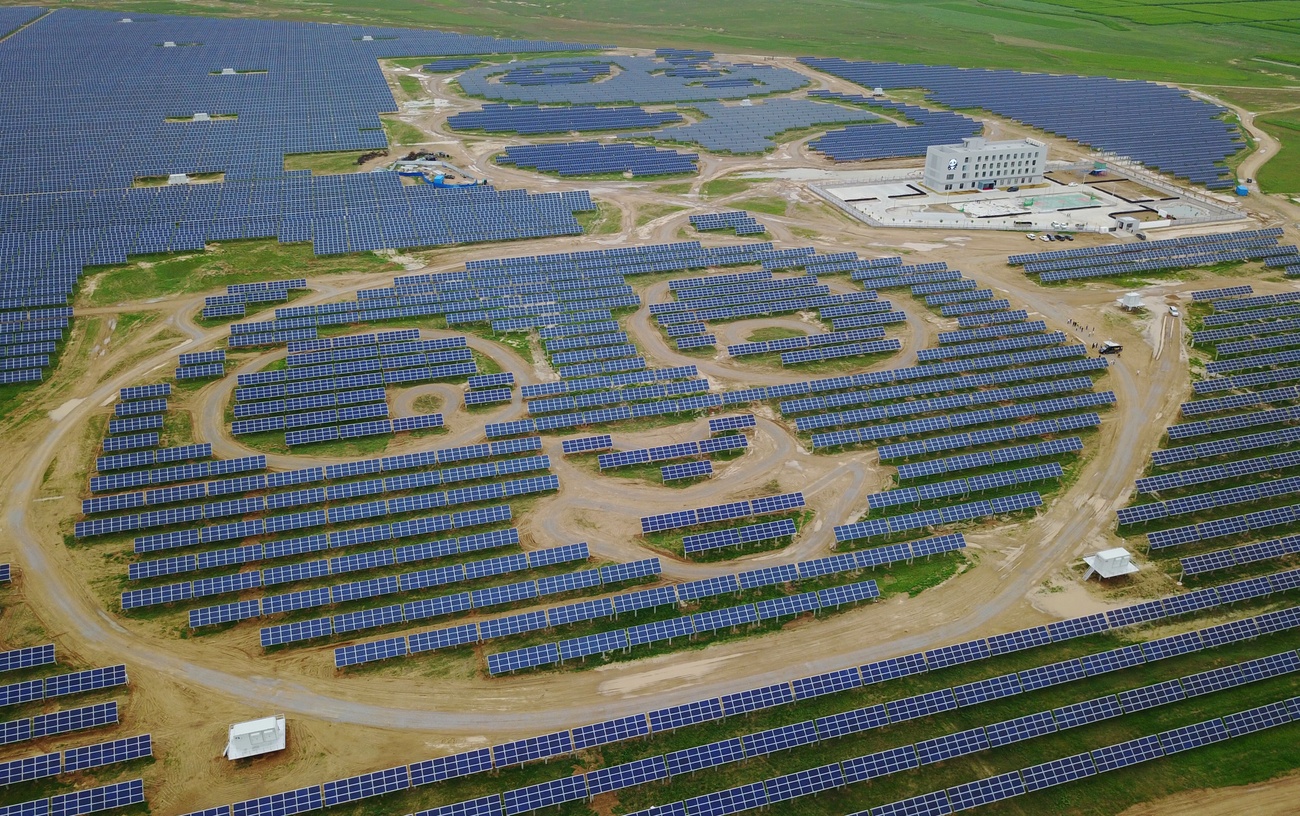
China has become a solar power giant and is now dominant across every stage of the global supply chain. An aerial view of the Datong Panda Power Plant in Datong, Shanxi Province of China,
Keystone-SDA
European firms are struggling in the face of stiff competition from China’s giant solar industry. Swiss solar energy expert Christophe Ballif discusses the serious ongoing challenges – and opportunities – of China’s solar supremacy, and he explains why Switzerland’s niche sector still has a bright future.

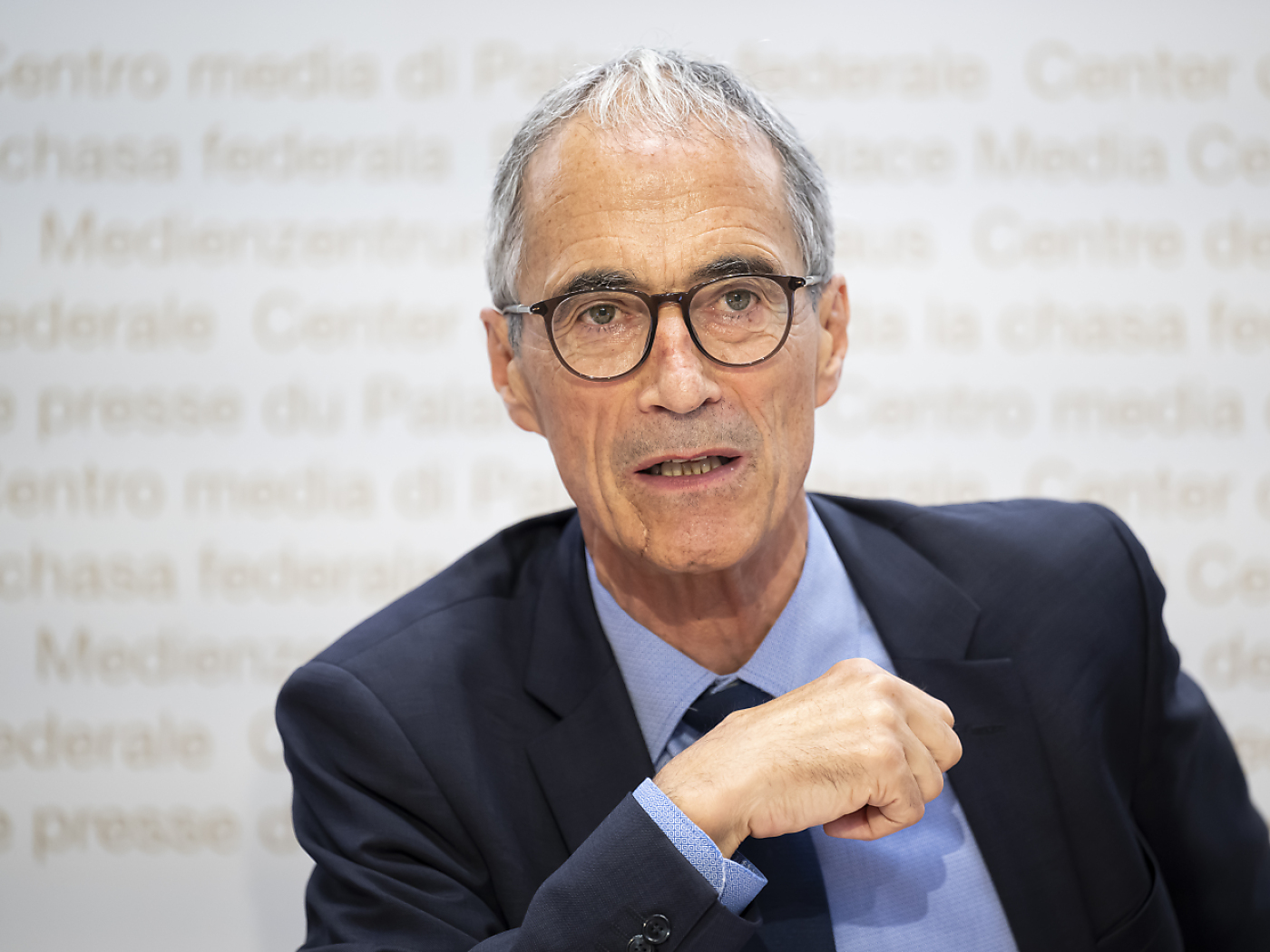
Christophe BaliffExternal link has devoted his career over the past 30 years to solar technology research and innovation. He directs both the Swiss Federal Institute of Technology Lausanne (EPFL) Photovoltaics Laboratory, and the photovoltaics (PV) laboratory of the Swiss Centre for Electronic and Microtechnology (CSEM), both based in Neuchatel.
SWI swissinfo.ch: The Swiss solar panel maker Meyer Burger is one of the few European solar panel manufacturers left after the market was saturated with cheaper Chinese imports. But last month it announced that its future looked uncertain after its biggest customer pulled outExternal link. What’s your view on the Meyer Burger crisis. Does the firm still have a future?

Christophe Baliff is director of both the Swiss Federal Institute of Technology Lausanne (EPFL) Photovoltaics Laboratory and the photovoltaics (PV) laboratory of the Swiss Centre for Electronic and Microtechnology (CSEM).
EPFL
Christophe Ballif: Clearly they will need to secure customers rapidly. Otherwise it will be extremely difficult for them to continue in their current form.
But I really hope they find a solution. Meyer Burger is one of only a few Western companies offering proprietary solar cell technology with excellent performances. It still has a lot of valuable intellectual property. It has new technologies in the pipeline, which the group has developed with Swiss partners like CSEM.
Photovoltaics will probably be the major electricity source of the century and a major energy source, used massively in the future to make hydrogen for steel, ammonia and fertilisers, for instance. So, it’s necessary to keep some technology in Western hands.
But we must accept that the situation is very challenging. In a market like Europe where there are no or low trade barriers against Asian products, no quotas for European products, and where only small, scattered state support is put in place – contrary to what was expected after the announcements made about the EU’s Net-Zero Industry Act – you can’t fight against what’s happened in China over the past two or three years.
SWI: What do you mean?
C.B.: In the past three years China has invested around $100 billion (CHF88.5 billion) in the solar module supply chain in manufacturing equipment and related buildings alone. This has led to huge overcapacity; there are too many production lines. In one year, the price of a PV module has been divided by three.
Chinese industry is very good at lowering the costs and adopting all the latest elements in their production lines, as they are under pressure to compete with other Chinese companies. Their mainstream products can evolve faster, for instance making larger solar cells with slightly higher efficiency by modifying quickly their production equipment. It’s very hard to compete on equal terms.
SWI: Meyer Burger’s outgoing chief, Gunter Erfurt, has accused European politicians of being ‘too afraid of China’ and ‘not prepared to protect the European solar industry against unfair competition’. Do you agree?
C.B.: He’s right. Solar is a strategic industry. The same goes for batteries or electric cars. These are all assets that are necessary for the energy transition.
More

More
Groundbreaking solar railway project gets back on track
There’s a realisation that because of China’s huge investment, the size of its solar industry, which is 50 times bigger than that of any other country, and its level of automation, it will make lower-cost products. But for resilience reasons, you need to keep at least a fraction of manufacturing in Europe.
You can’t depend 100% on China, especially considering the risks of geopolitical conflicts. At least European countries have now realised that this is an issue, and the newly agreed EU’s Net-Zero Industry Act allows a country to support some industry sectors.
SWI: But there’s an upside to China’s solar dominance, isn’t there?
C.B.: The positive point is that Chinese firms can now make energy assets very cheaply. As they need to survive, they become very good very quickly, learning how to reduce material and energy inputs, while increasing performance.
China can now supply the world with all the assets required to make the energy transition in a reasonable timeframe (25-30 years). They have enough capacity to provide batteries for the equivalent of 100 million cars per year and batteries that are useful to manage the grid. They could manufacture 1,500 gigawatts (GW) of solar panels per year. These capacities are 2.5 to 3 times greater than global demand today. And to support its industry China is installing massively solar and wind power, and electric cars.
More

More
Construction starts on first large-scale solar park in Swiss Alps
And of course, China needs to export because it has created these gigantic industries. They will push many countries to adopt clean technologies. In one sense, this is rather good news for the planet, and you can trust the Chinese to make the energy transition much more than the US or other parts of the world.
SWI: You have said that the Swiss solar industry benefits from an interesting industrial structure with Swiss firms ‘doing things differently and better’. What do you mean exactly?
C.B.: It’s not a big industry here. You have lots of companies that offer what I would call niche or speciality products. No two companies are the same. They are always a mixture of innovation, special intellectual property and niche market opportunities.
INDEOtec offers solar cell processing tools for laboratories;
Stäubli makes high quality connectors for photovoltaic modules and systems;
3S Swiss Solar Solutions manufactures PV modules for buildings;
Freesuns specialises in solar tiles for roofs;
Solaxess offers special films that can modify the appearance of PV modules;
Climacy combines roof insulation with integrated solar cells;
Solarwall specialises in PV façades;
Insolight and Voltiris offer agrovoltaic solutions for the agricultural sector;
Studer Innotec provides power electronics;
Homsphere offers optimised energy systems for buildings and local districts;
LightSeeds manufactures lightweight photovoltaic products from recyclable products.
SWI: Is the Swiss solar sector sufficiently supported by the Swiss government and authorities?
C.B.: The installation of PV systems in Switzerland has seen strong growth in the past few years. Ideally the number of new installed systems should be around 2GW per year in Switzerland. But it is not clear if this will continue because of the likely strong erosion in the minimum payback price for solar electricity.
On the technology, manufacturing side, clearly Switzerland has no industrial policy towards supporting solar or clean-tech companies. There was some reasonable level of support for innovation but that is starting to disappear largely because of the Gaillard savings plan (see story below).
More
More
Swiss finance expert defends austerity measures
And that’s a real disaster. The Federal Council has proposed to cut all pilot and demonstration projects where they were co-financing around half. This amounts to CHF23 million ($26 million) a year. They want to cut it to zero, which we all find unacceptable.
They are also cutting the little funding that the Swiss Federal Office for Energy had for advanced research projects in the field of energy. There will also be a likely cut in the Swiss Innovation Agency (Innosuisse) programme, which supports technology transfer from the academic world to industry. Many companies, associations and engineers are upset, not only in the solar field.
It’s very sad that the Swiss government doesn’t seem to realise that they are doing many things that go against the interests of the energy transition, technology development, potential market deployment and the clean-tech economy. This must be said very clearly. It’s a very bad situation.
Edited by Balz Rigendinger/ts
More