


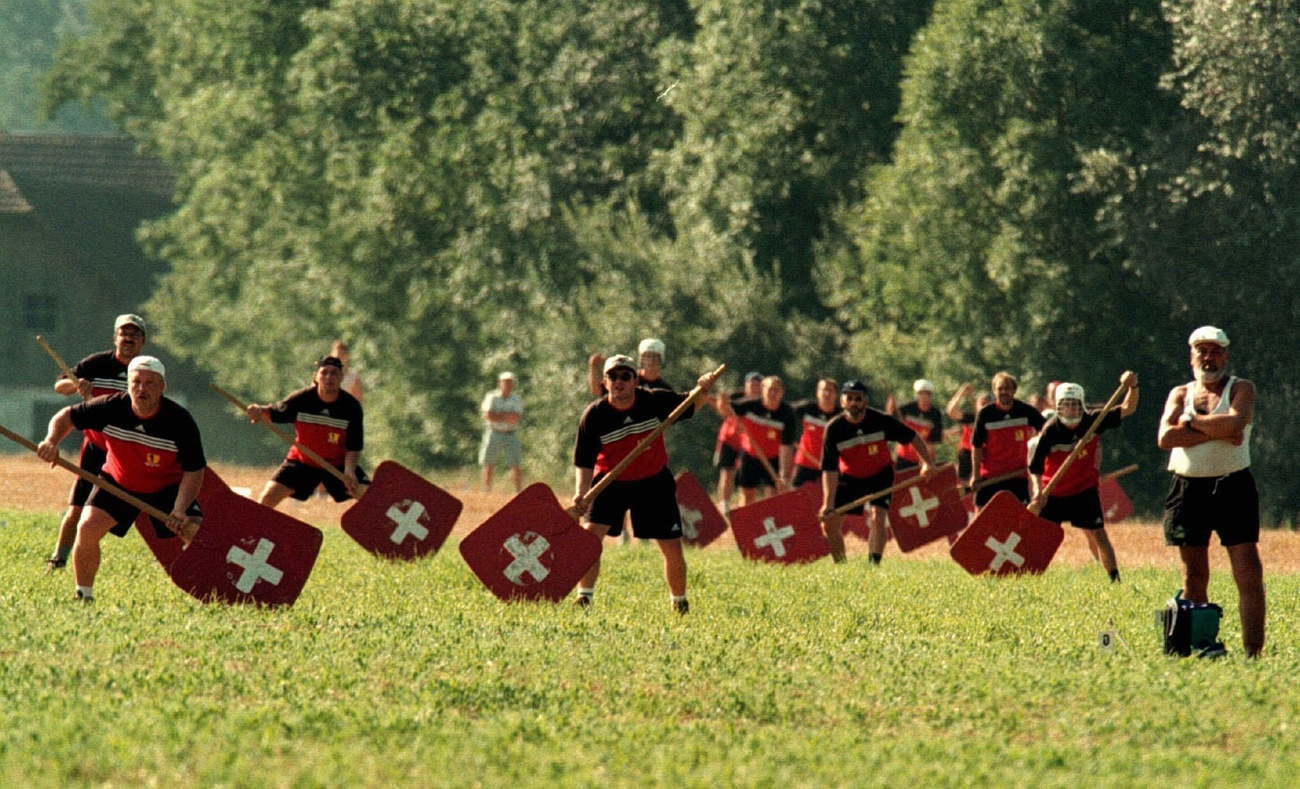
A defending side at the 1998 Intercantonal Hornussen Festival.
Keystone
If a plastic puck being fired at you at up to 300km/h isn’t your cup of tea, maybe give the Swiss sport of Hornussen a miss. But if you want to take part in a 400-year-old tradition sometimes known as “farmers’ golf”, strap on a helmet and give it a go!
Hornussen is actually one of three Swiss national sports – the others being Schwingen (wrestling) and Steinstossen (stone-throwing) – and it invariably generates stunned reactions from people seeing it for the first time. “Looks like something out of a cartoon”, “This game looks awesome! Why isn’t this an Olympic sport?”, “More exciting than curling” were some of the many comments to a video on Hornussen we made a few years ago:
External Content
While comparisons are often made between Hornussen and golf, the only real similarity is that a player whacks a stationary object as far as possible. As the Swiss Historical Dictionary explainsExternal link, various versions of an object-whacking game were popular in central Switzerland, especially in and around Emmental, in the early 17th century. The opponents had to stop these objects – often bones or roots – with some sort of shield, which they would either hold or throw in the air.
“The fact that hits to the body and head were originally scored particularly highly establishes a connection with older war games in which the board had a shield function,” the historical dictionary says.
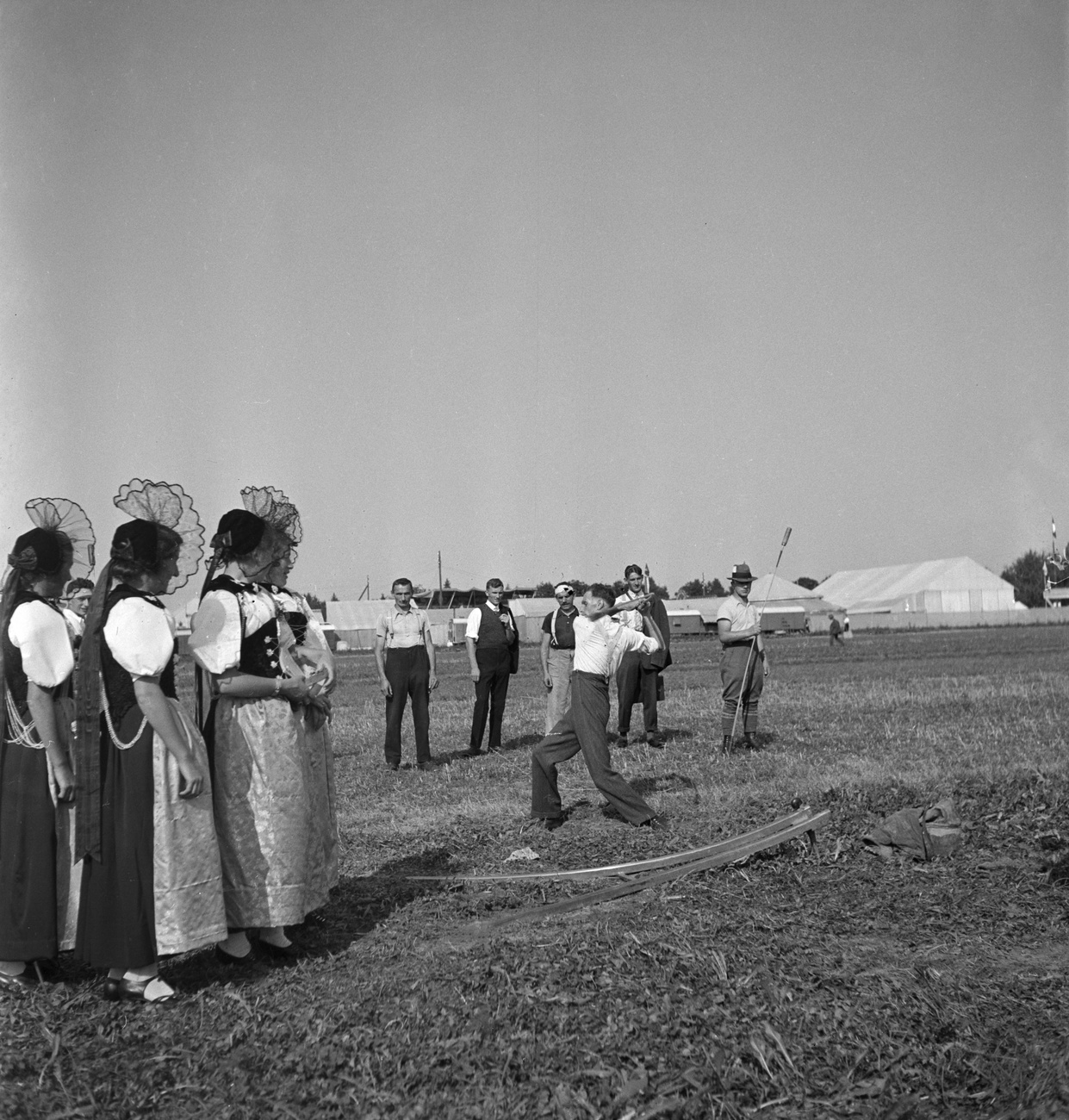
Fans at the 1936 National Hornussen Festival get closer to the action than I would.
Keystone
Initially it was mainly a game for young farmers, who would meet in the late summer and autumn to play on harvested fields against farmers from other villages. Such events apparently enabled the players to pit their strength against each other and to regulate disputes between villages. “Despite playful attempts at arbitration, the Hornussen games were often followed by wild brawls,” according to Switzerland TourismExternal link.
Today agricultural disagreements are settled by other means, but Hornussen remains popular in German-speaking cantons, especially Bern (the need for large fields limits it to rural areas).
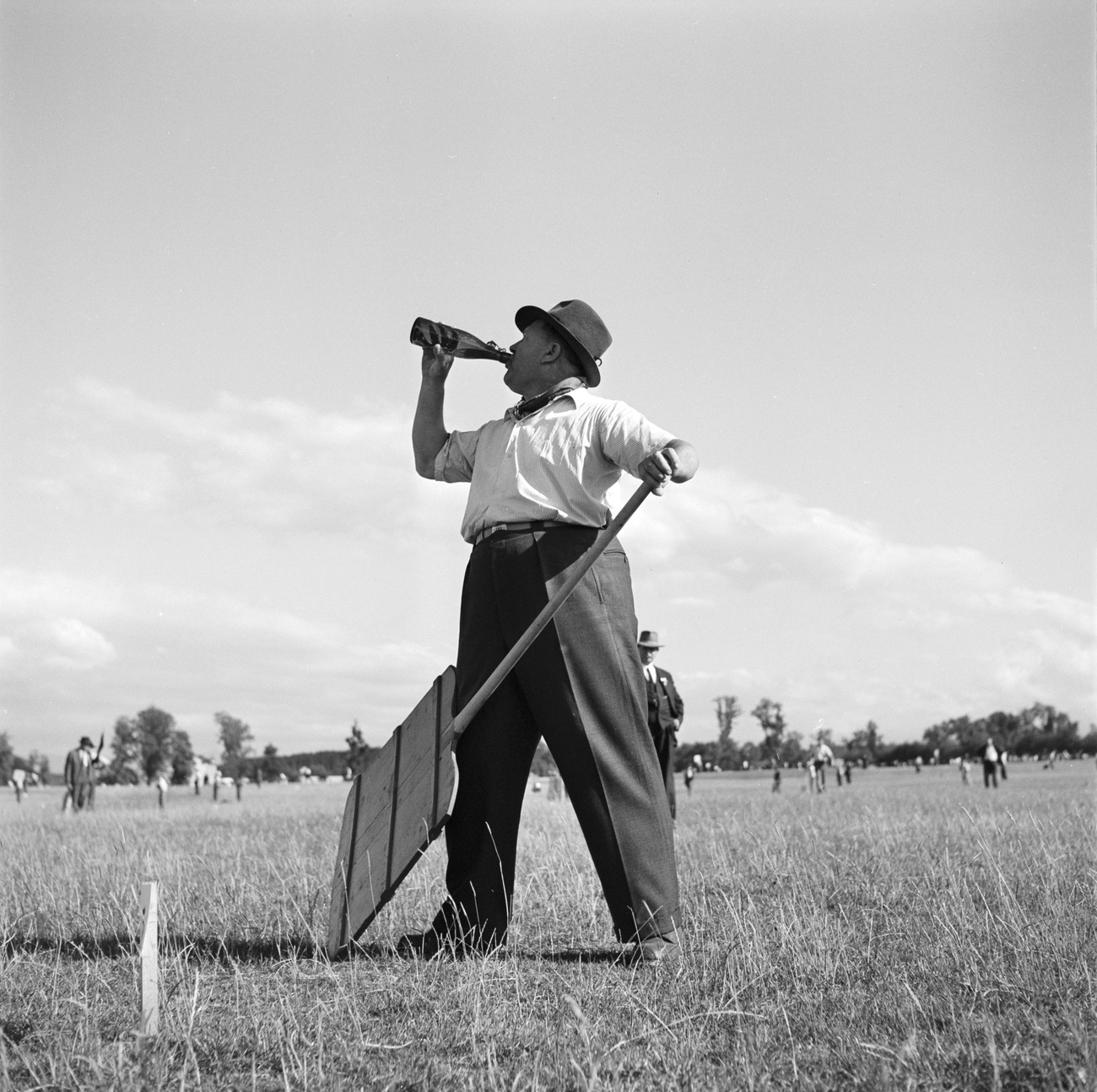
All top athletes know the importance of staying hydrated. Here at the 1952 National Hornussen Festival.
Keystone
Tactical Nouss
So what is Hornussen? In a nutshell, it involves two teams of 16-20 players taking turns to hit, defend, hit, defend. Hitting requires each team member to use a three-metre whiplike rod with a wooden block at the end to launch a plastic puck (the Hornuss or Nouss) resting on a raised ramp as far as possible into a marked-out field. As the puck whistles through the air, it sounds a bit like a hornet, which in Swiss German is a … Hornuss.
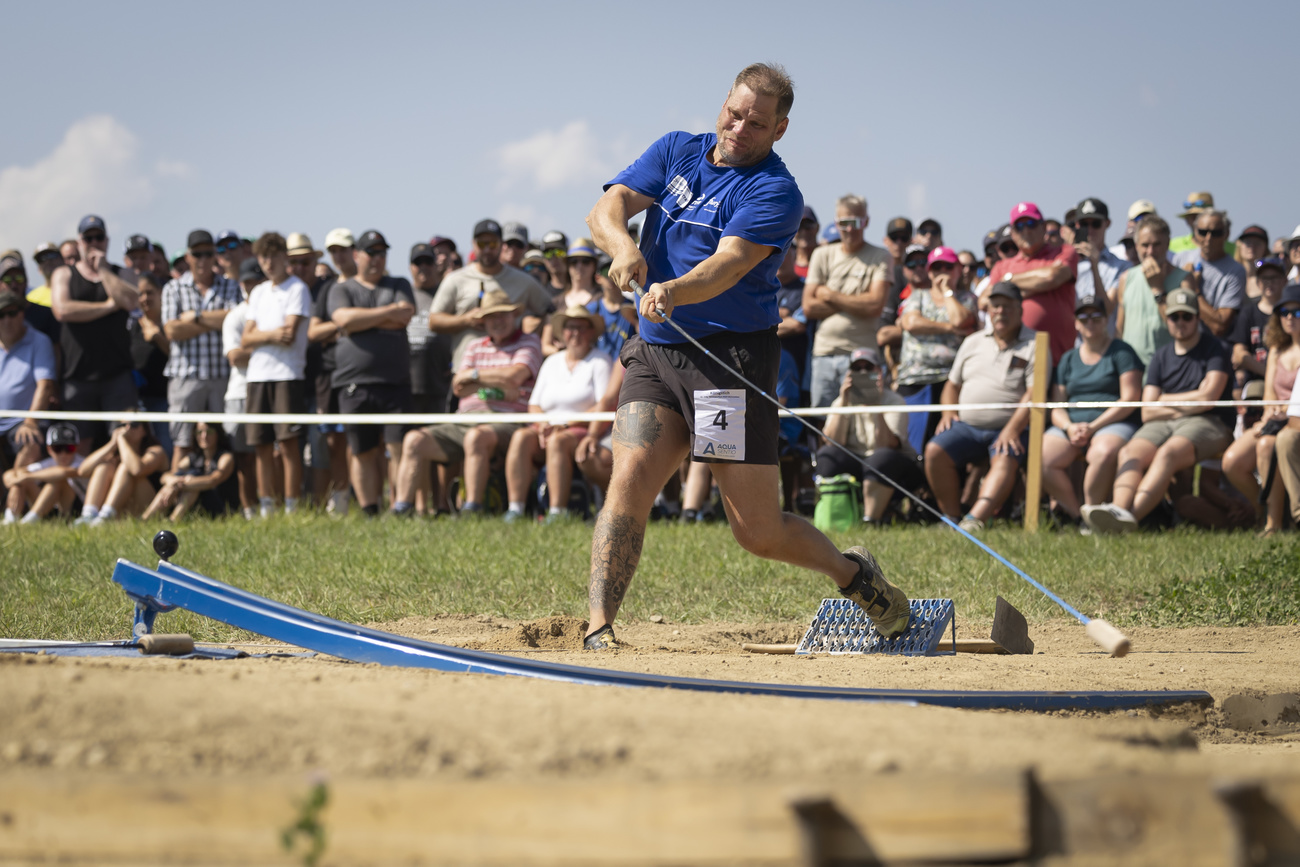
Stefan Studer, who won the individual prize at the 2024 National Hornussen Festival, shows how it’s done.
Keystone / Peter Klaunzer
The further the Nouss travels beyond 100 metres (300 metres is certainly possible), the more points the batting side gets – but only if the Nouss hits the ground directly. The defending team will try to spot the puck and intercept it using wooden boards. The team with the fewest penalisation points (in other words the most interceptions) wins. Hornussen thus favours defensive teamwork over individual skill, reflecting the Swiss trait of not standing out.
“Team spirit, mutual support and courage are the prerequisites for safely deflecting the approaching hornet,” says the Federal Hornussen Association, which was founded in 1902. Successful defence “requires the defenders at the front of the field to react quickly to low-flying objects, while good eyesight, good judgement of the trajectory and sprinting ability are required at the back of the field”.
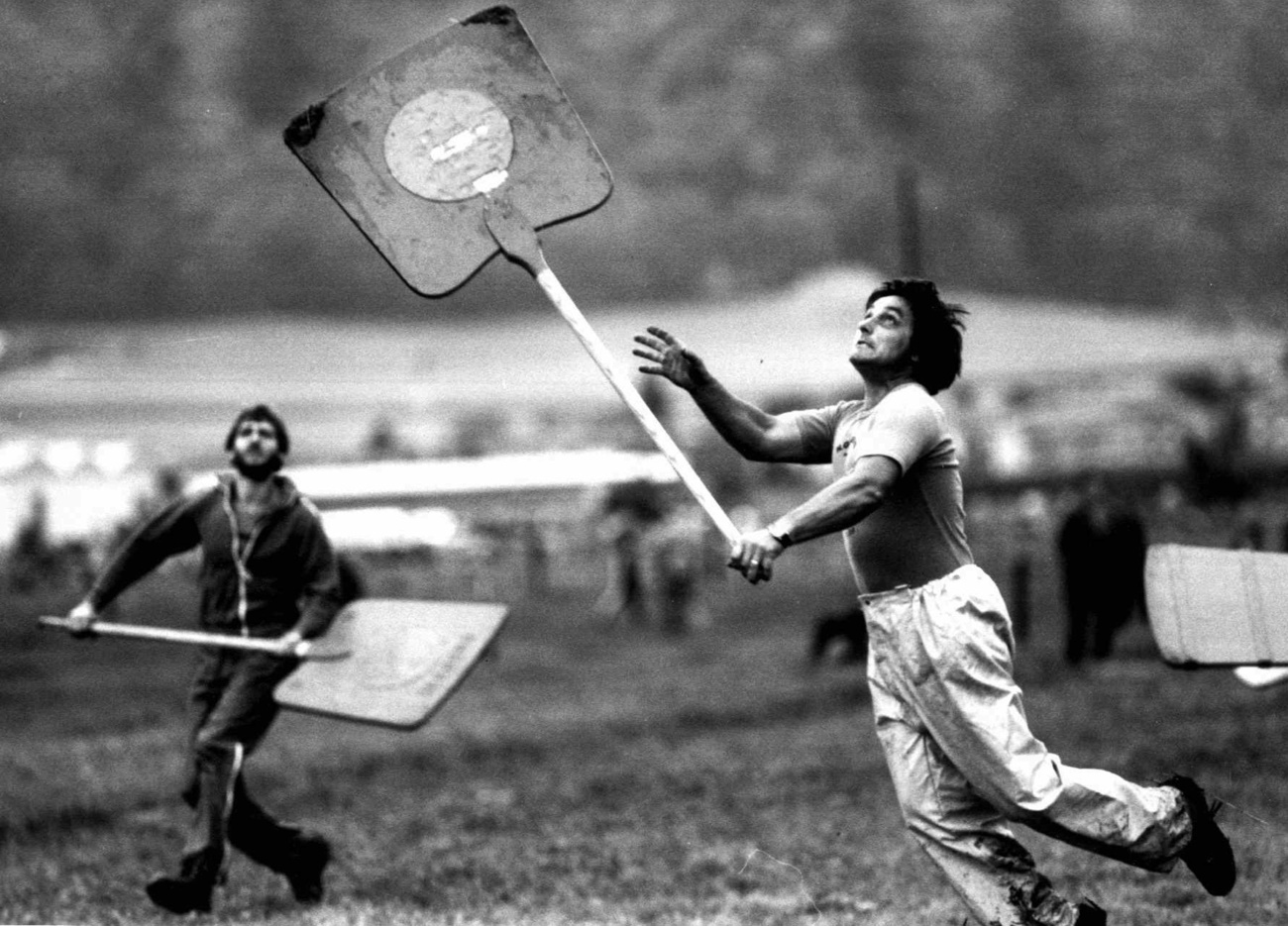
Eyes on the prize in 1988.
Keystone
Weighing 78g (a golf ball is 46g), with a diameter of 6cm and travelling up to 300km/h, a Nouss can do serious damage. In 2016 a study by Bern’s Inselspital (university hospital) said that although injuries from Hornussen are rare – the hospital’s emergency room said it dealt with about two cases a year – when they happen, they are bad: “usually broken jaws, cheekbones, noses or other parts of the face”. Lacerations and severe eye injuries were also characteristic of Hornussen injuries, it said.
None of the players involved in the accidents was wearing a helmet, the study pointed out. The Inselspital said compulsory head and face protection could go a long way towards preventing such injuries. Although younger players have to wear helmets – and some older ones choose to – a 68-year-old referee was hit by a Nouss last yearExternal link and died from his injuries.
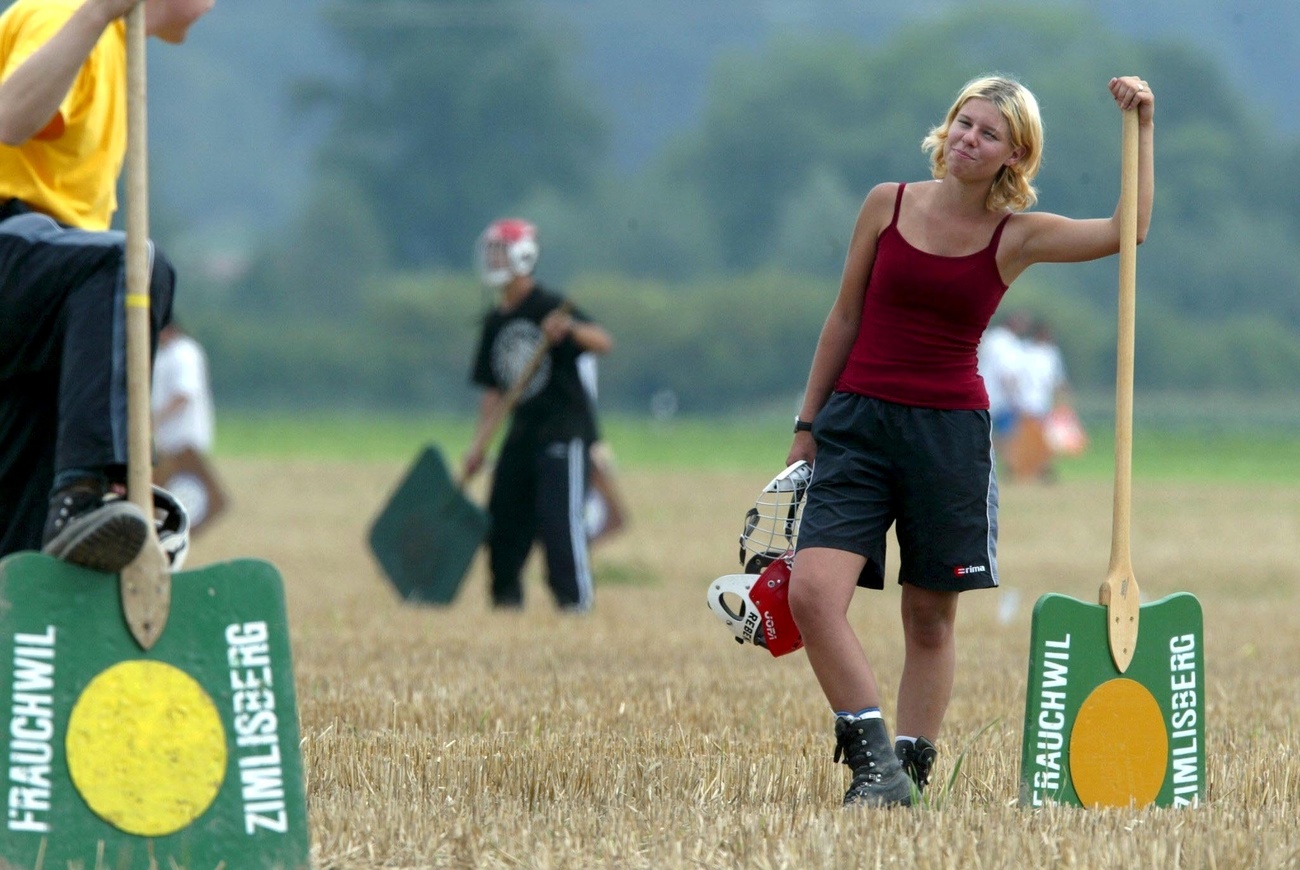
A competitor, with helmet, at the 2002 National Hornussen Festival. Teams comprise all ages and genders.
Keystone
‘Women and men, young and old’
That’s the bad news. The good news is that unlike for Schwingen or Steinstossen you don’t need to be built like a mountain to have a chance. “Strength, size, agility and intensive training are important factors in achieving great distances,” says the Federal Hornussen Association.
In this respect Hornussen has similarities with “long drive” golf tournamentsExternal link, where the top players are also rarely massive. Indeed if you could imagine a crowd of people at a long drive tournament trying to catch the ball, you’re getting towards Hornussen.
So what do you do if you want a game? “Anyone who’s interested should just go along to their nearest Hornussen fieldExternal link and have a go,” the Federal Hornussen Association told SWI swissinfo.ch. “A training session for beginners is usually free.”
There are currently 156 clubs dotted around Switzerland (mostly in canton Bern) and about 6,000 registered players, a tenth of whom are women. “Women and men, young and old, all play in the same team,” the association explained. Only in the top league, the NLA, are there all-male teams.
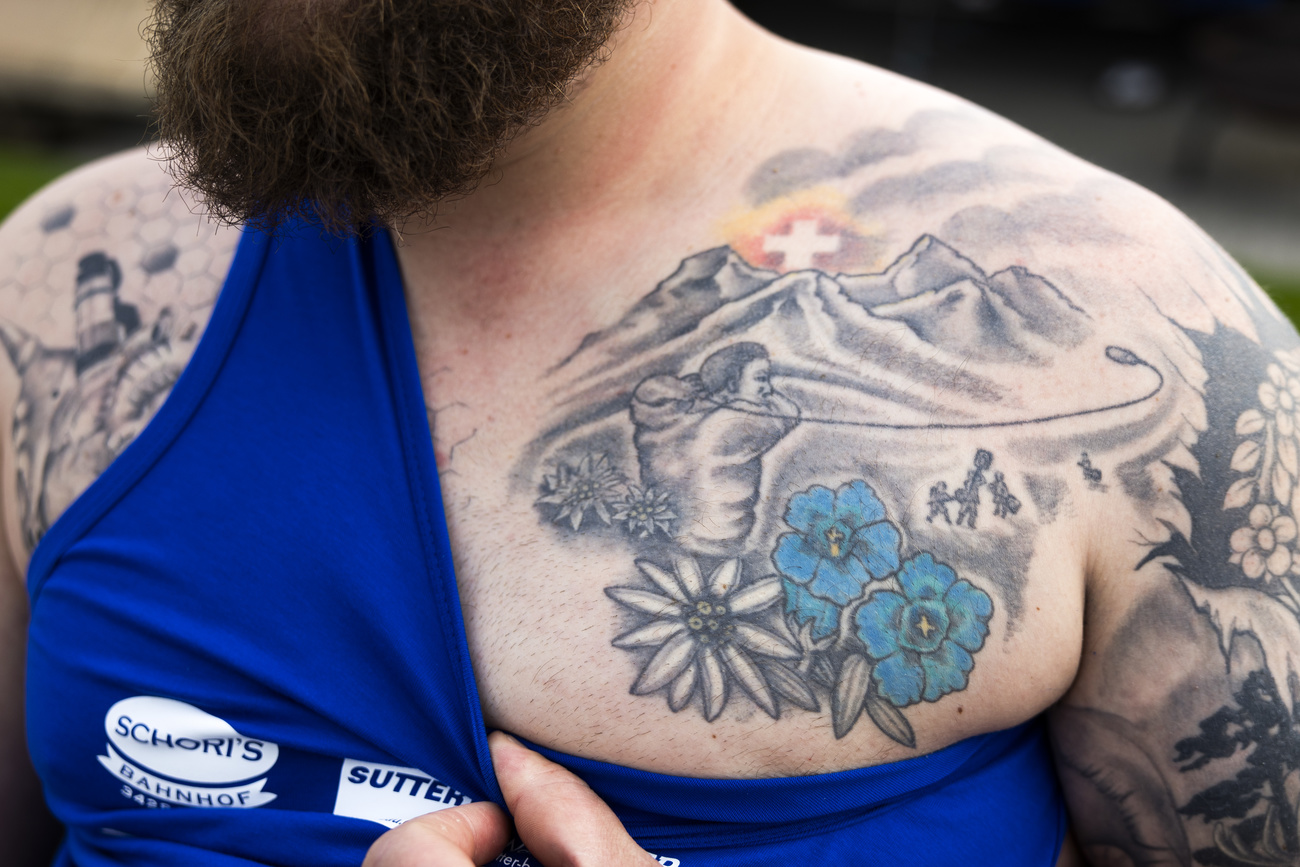
Don’t judge a book by its cover, but this guy’s probably Swiss.
Keystone / Peter Klaunzer
The National Hornussen Festival takes place very three years, and with the next one set to be held in Emmental in August 2027, you’ve got plenty of time to get into shape.
Here are some highlights from the recent National Hornussen Festival 2024:
External Content
Edited by Samuel Jaberg/gw


