
It doesn’t get much more Swiss than this: an alphorn player in traditional costume on a meadow overlooking Lake Lucerne.
Keystone / Urs Flueeler
For most people, the alphorn is inextricably linked with Switzerland. However, it didn’t originate in the Alpine country – and neither did most instruments typical of Swiss folklore. Only one instrument can be described as truly Swiss, reckon musicologists.
The alphorn is a symbol of Switzerland’s image abroad, like the cuckoo clock. But – spoiler alert! – neither is authentically Swiss. The famous “Swiss cuckoo clock” that hangs, whirrs and chimes in most souvenir shops in Geneva or Lucerne originated in the Black Forest of Germany.
Getting back to music, the disillusion and disappointment is likely to be just as great when it comes to the alphorn, promoted as a symbol of Switzerland and its popular culture. But there’s nothing to suggest that this instrument originated in Switzerland, say musicologists.
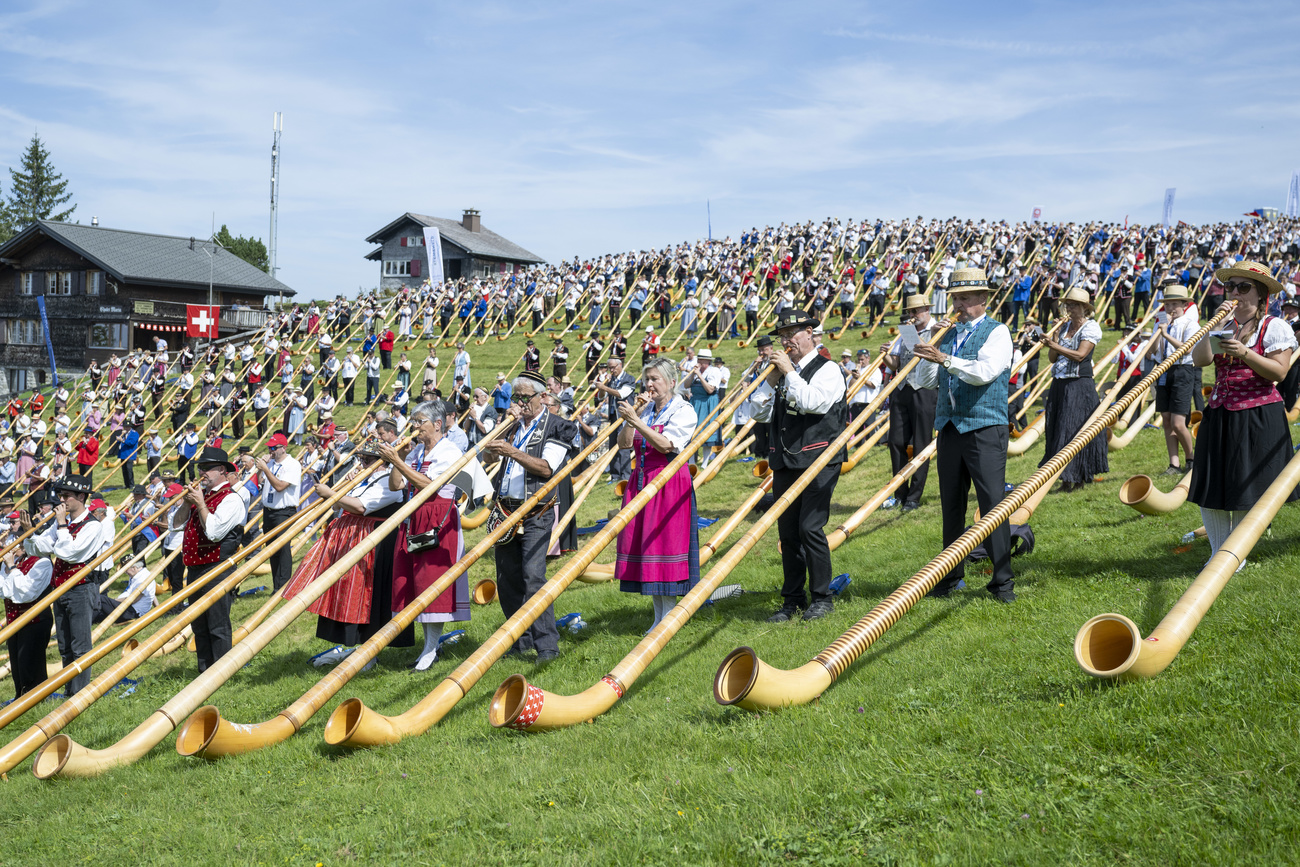
A total of 1,006 alphorns playing at the same time: this world record was set on August 31, 2024, on the Klewenalp meadow in canton Nidwalden.
Keystone / Urs Flueeler
“The history of the alphorn is long, and its origins are difficult to establish,” points out the Lausanne School of Music. “The instrument was certainly inspired by the horns or trumpets that arrived in Europe from Central Asia with the herds of nomadic shepherds.”
It’s a long way from the steppes of Central Asia to the mountains of Switzerland. So how did the horn become so dear to the hearts of the Swiss?
In the past, this instrument was used – like yodelling – as a means of communication in the valleys of Alpine countries, for example to sound the alarm or to call the population to church. It was this traditional if naive image that made it so successful. The alphorn had the good fortune to fit in perfectly with the image of “pastoral people” that Switzerland wanted to project during the Romantic era.
“The alphorn almost totally disappeared as an instrument used by Swiss shepherds,” says Switzerland TourismExternal link. “It was only with the Romanticism of the 19th century and the revival of folklore and tourism that the alphorn experienced a renaissance and even became a national symbol.”
More
More
Alphorn players break ranks to hit new notes
Foreign origins
All the instruments that are emblematic of Swiss folklore are in fact local adaptations of instruments from abroad. Starting with the famous little Schwyz accordion, the star of Swiss folk groups, which has Austrian origins. Developed in canton Schwyz in 1886, it’s just one of the many variations on the diatonic accordion invented in Vienna in 1829, which subsequently spread throughout Europe.
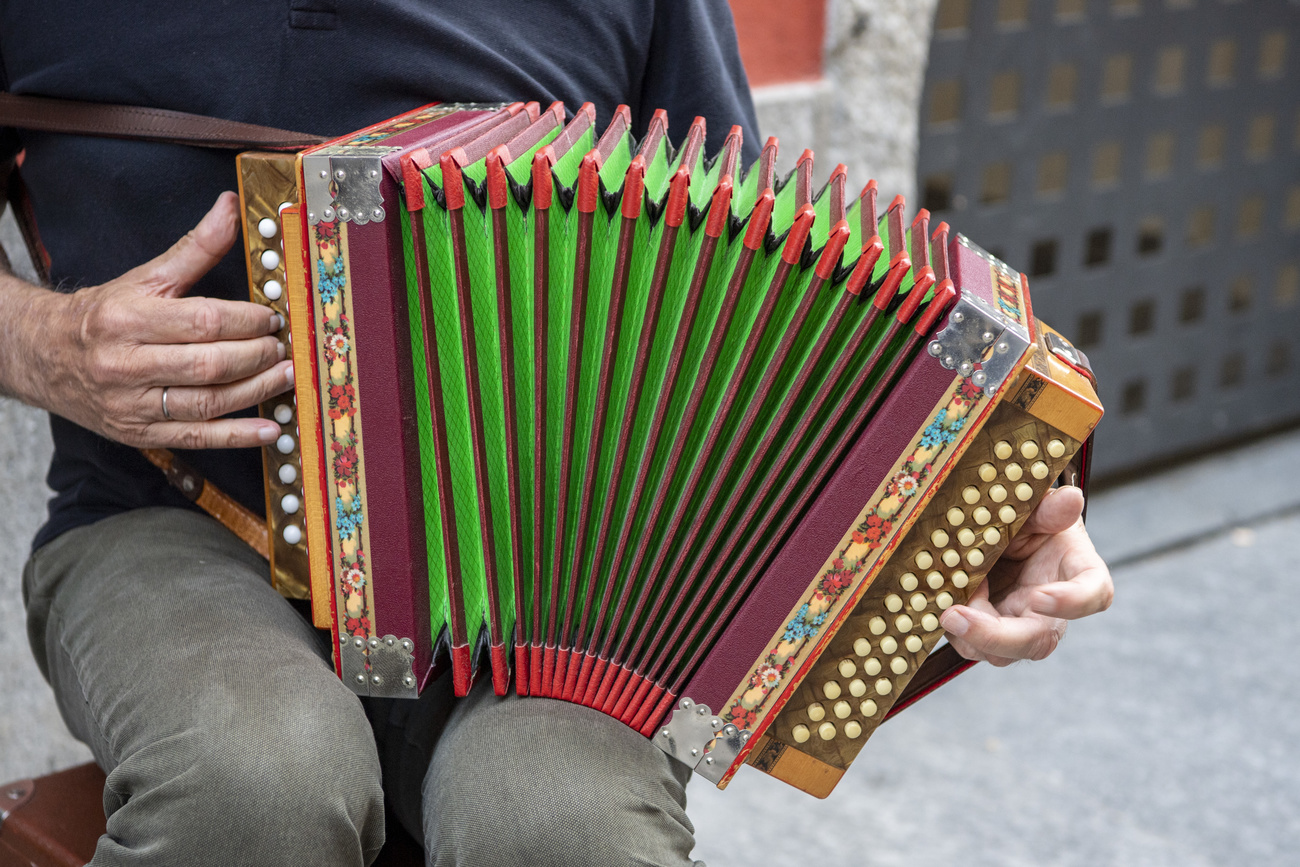
The Schwyz accordion is the instrument of choice for any Swiss folk group.
Keystone / Urs Flueeler
Zithers have also been very popular in traditional Swiss music. So much so, in fact, that there is a museumExternal link dedicated to them in canton Bern.
More

More
From the cute to the horrific: Switzerland’s weirdest museums
The best-known member of this family of instruments is the Hackbrett (literally “chopping board”), also known as a dulcimer, which is still widely used in Appenzell folklore. Its existence was already noted as far back as 1447 in the city of Zurich, where a fine for disturbing the peace was imposed on someone who played it at night.
Despite going back centuries in Switzerland, the Hackbrett is not Swiss. Several theories exist as to how it came to be in Switzerland, but musicologists agree that it originated in Eastern Europe. In fact, the Hackbrett has cousins far and wide in the family of plucked table zithers, notably in Hungary, the UK and even China.
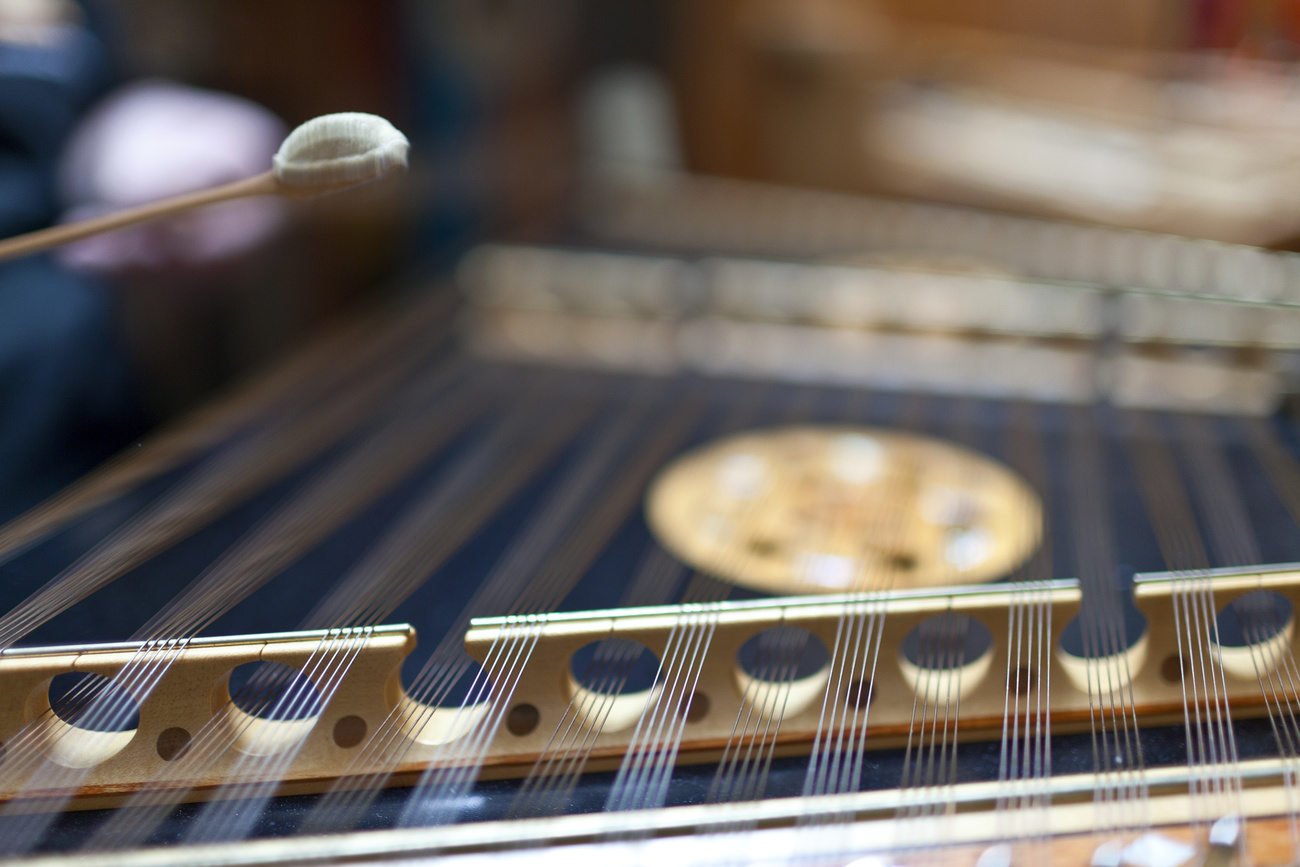
The Appenzell hackbrett has 125 strings (five per note), which are struck with mallets. The soft side of the stick gives a piano-like sound, while the wooden side produces a sound similar to that of the harpsichord.
Keystone / Gaetan Bally
A simple bowl
So does an authentic Swiss instrument actually exist? The good news is that our search will not be in vain. The one uniquely Swiss instrument, found nowhere else in the world, is the Appenzell Talerschwingen.
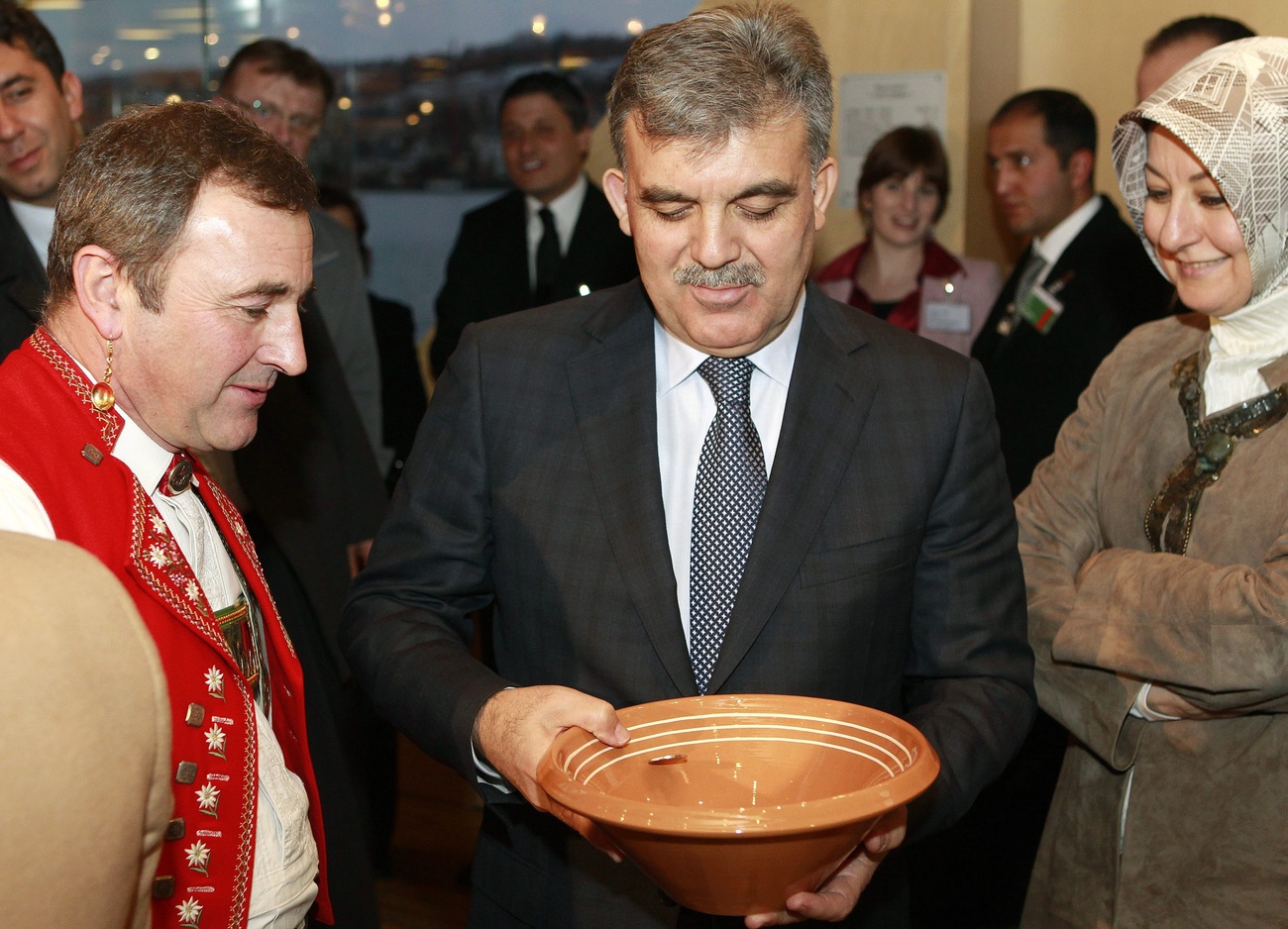
Turkish President Abdullah Gül tries his hand at Talerschwingen during a state visit to Switzerland in 2010.
Keystone
This involves spinning a coin in a clay bowl, which produces a sound that varies according to the size of the bowl and is used to accompany yodelling. Nowadays, of course, it’s no longer a thaler that is spun but a five-franc coin, preferably from before 1967, when they were still silver, which is apparently important for the sound.
Yodelling and Talerschwingen in action:
External Content
It’s a very rudimentary way of producing a sound, sniff critics. But the very simple and modest nature of this instrument is perhaps the most in tune with the spirit of a “pastoral people”.
Adapted from French by DeepL/ts
More
More