“People here are sending a clear signal: they don’t want Donald Trump’s policies to come to Switzerland,” said Wermuth.
Keystone / Gian Ehrenzeller
Generated with artificial intelligence.
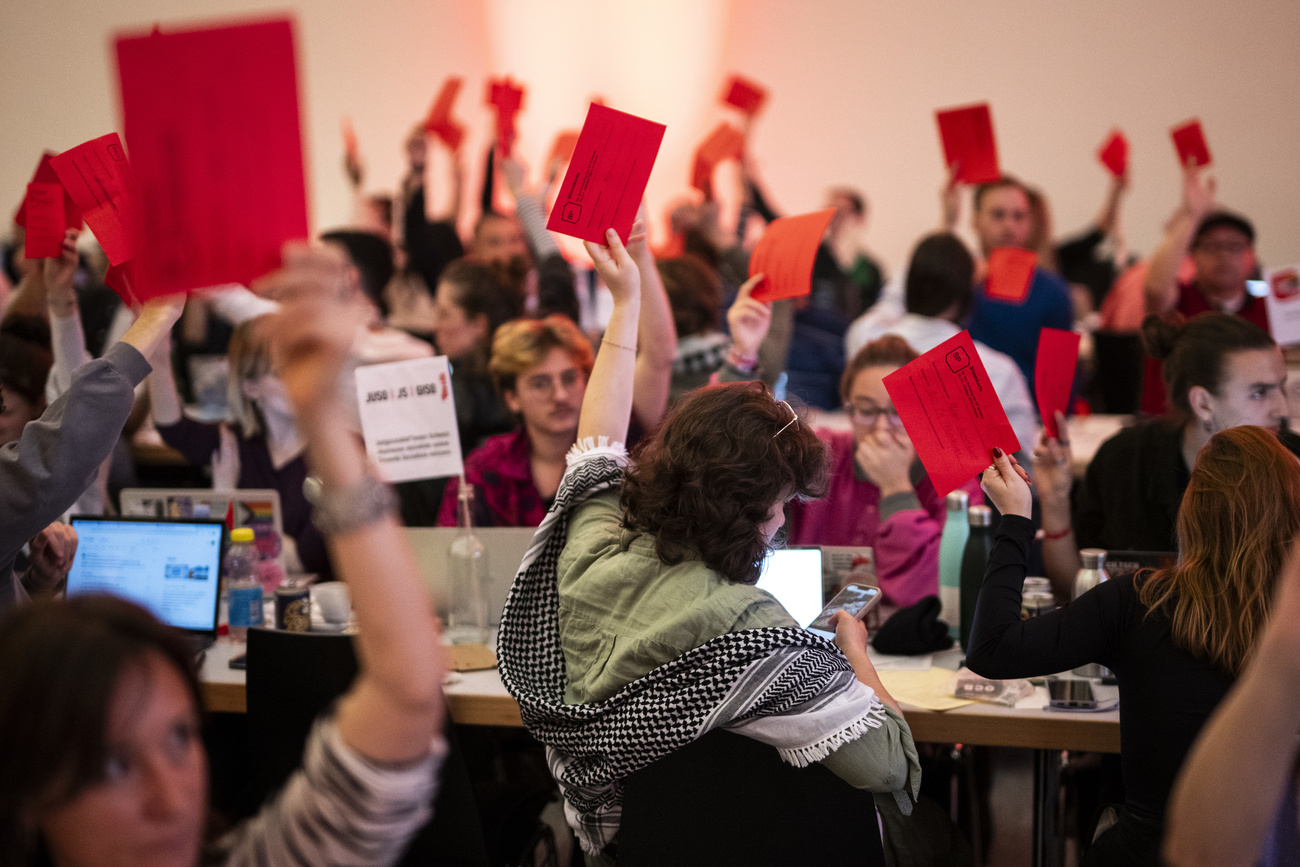
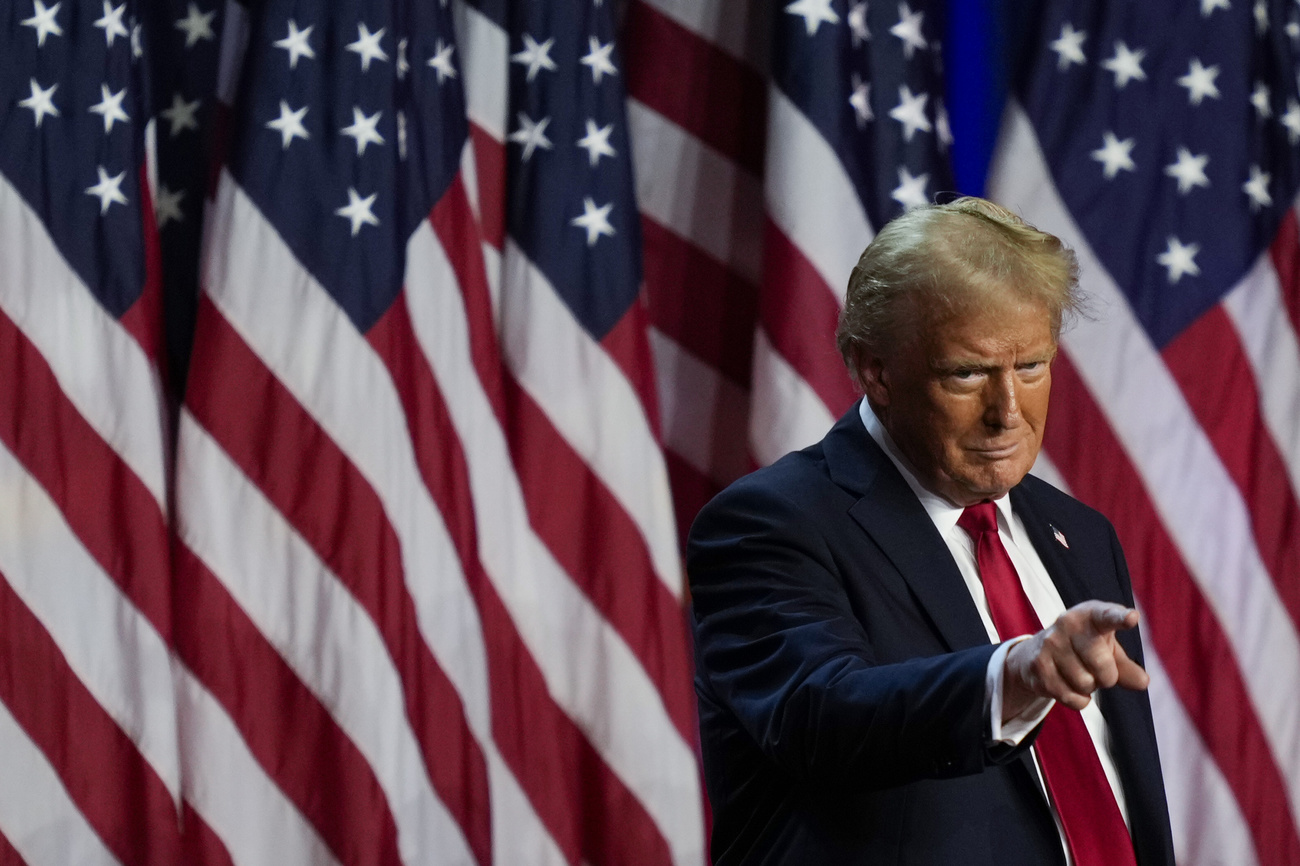
The election of Donald Trump in the United States has had a direct impact on the Social Democratic Party in Switzerland. In the space of three days, the party says it has welcomed around 1,000 new members, a record number.
This influx is “totally surprising and represents the highest number of new members recorded over a few days since we have been able to track developments,” party co-president Cédric Wermuth told Swiss public television RTS on Saturday.
“We’re going to see a hardening of the right in Switzerland too, and people here are sending a clear signal: they don’t want Donald Trump’s policies to come to Switzerland,” said the parliamentarian.
Throughout the week, the Social Democrats were active on social networks, making direct reference to Trump to motivate its supporters to become party members.
This “Trump effect” seems to be confined to the Social Democrats and the Green Party, which recorded around 100 new memberships. On the right of the political spectrum, there was no rush for membership cards.
A quarter of Swiss voters would have voted for Donald Trump
“This election shows that the ideas, attitudes and values of conservative parties can become mainstream and that they are in tune with the times. They can appeal to a lot of people, and that also has an influence on Switzerland,” says Cloé Jans, an analyst at gfs.bern.
In fact, compared with other European countries, a quarter of Swiss voters would have given their vote to Trump. This is significantly more than in Scandinavia and Switzerland’s neighbouring countries, according to a Gallup poll carried out ahead of the US presidential election and reported by Tamedia newspapers. The survey was conducted among 41,000 adults in 43 countries.
In Switzerland, 61% of respondents supported Kamala Harris. In Denmark, only 4% were in favour of Trump, compared with 7% in Finland and Norway, 11% in the Netherlands, 13% in Germany and France, 16% in Austria and 18% in Italy. On the other hand, support for Trump was high in Eastern Europe: in Serbia, Hungary and Bulgaria, almost half of those questioned would have voted for the billionaire.
Translated from French with DeepL/gw
This news story has been written and carefully fact-checked by an external editorial team. At SWI swissinfo.ch we select the most relevant news for an international audience and use automatic translation tools such as DeepL to translate it into English. Providing you with automatically translated news gives us the time to write more in-depth articles.
If you want to know more about how we work, have a look here, if you want to learn more about how we use technology, click here, and if you have feedback on this news story please write to english@swissinfo.ch.
More
Popularity of sustainable investment waning in Switzerland
This content was published on
Green investments are slowing down in Switzerland, as for the first time in years, more money flows into traditional funds than into sustainable ones.
Switzerland should get closer to NATO after Trump victory: Centre Party president
This content was published on
Gerhard Pfister wants closer ties with NATO, given president-elect Donald Trump’s pronouncements, which could have a negative impact on Swiss security.
Swiss village Brienz to be evacuated due to rockslide risk
This content was published on
Local authorities announced that up to 1.2 million cubic metres of rock could move towards the mountain village of Brienz. The municipality is preparing a preventive evacuation.
Swiss businesses losing billions due to Temu and Shein
This content was published on
Swiss businesses are losing billions of francs a year as a result of the spread of Chinese online platforms Temu and Shein, says the director of the federation of Swiss retailers.
Number of Swiss armed forces exceeds specified limit
This content was published on
The Swiss armed forces had an effective headcount of around 147,000 as of March 1, 2024. This exceeds the upper limit of 140,000 specified in the army organisation by 5%.