


 EPA
EPAIt is now “virtually certain” that 2024 – a year punctuated by intense heatwaves and deadly storms – will be the world’s warmest on record, according to projections by the European climate service.
Global average temperatures across the year are on track to end up more than 1.5C above pre-industrial levels, which would make 2024 the first calendar year to breach this symbolic mark.
These high temperatures are mainly down to human-caused climate change, with smaller contributions from natural factors such as the El Niño weather pattern.
Scientists say this should act as an alarm call ahead of next week’s UN climate conference in Azerbaijan, COP29.
“This latest record sends another stark warning to governments at COP29 of the urgent need for action to limit any further warming,” says Liz Bentley, chief executive of the Royal Meteorological Society.
Global temperatures have been so high through the first 10 months of 2024 that only an implausibly sharp drop in the final two months would prevent a new record from being set.
In fact, it is likely that 2024 will end up at least 1.55C hotter than pre-industrial times, according to data from the European Copernicus Climate Change Service.
“Pre-industrial” refers to the benchmark period of 1850-1900, which roughly equates to the time before humans started significantly heating up the planet, for example by burning large amounts of fossil fuels.
The projection means that 2024 could surpass the current record of 1.48C, which was set only last year.
“This marks a new milestone in global temperature records,” says Samantha Burgess, deputy director of Copernicus.
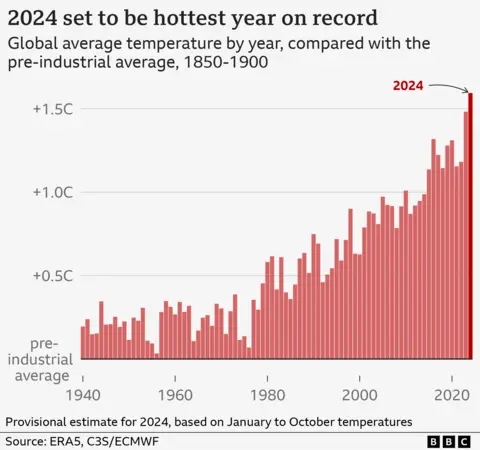
This would also represent the first time that a calendar year has passed 1.5C of warming, according to Copernicus data.
This would be symbolic, because almost 200 countries pledged to try to limit long-term temperature rises to that level under the Paris climate agreement in 2015, hoping to avoid some of the worst impacts of climate change.
If the 1.5C limit is breached, that does not mean the Paris goal has been broken, because it refers to average temperatures over a period of 20 years or so, in order to smooth out natural variability.
But every year-long breach brings the world closer to passing the 1.5C mark in the longer term. Last month, the UN warned that the world could warm by more than 3C this century based on current policies.
The specifics of 2024 also offer cause for concern.
Early 2024 warmth was boosted by the natural El Niño weather pattern. This is where surface waters in the east tropical Pacific Ocean are warmer than usual, which releases extra heat into the atmosphere.
This latest El Niño phase began in mid-2023 and ended around April 2024, but temperatures have remained stubbornly high since.
Over the past week, global average temperatures have set new records for the time of year every day, according to Copernicus data.
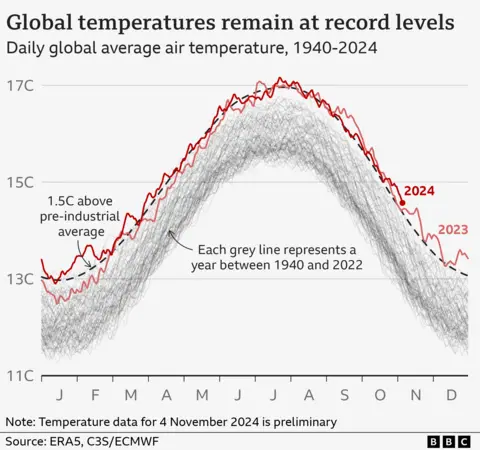
Many scientists expect the opposite, cooler phase, La Niña, to develop soon. This should, in theory, lead to a temporary drop in global temperatures next year, although exactly how this will play out is uncertain.
“We will watch with interest what happens going into 2025 and beyond,” says Ed Hawkins, professor of climate science at the University of Reading.
But, with levels of greenhouse gases in the atmosphere still rising quickly, scientists warn it is likely only a matter of time before new records are set.
“The warmer temperatures [are making] storms more intense, heatwaves hotter and heavy rainfall more extreme, with clearly seen consequences for people all around the world,” says Prof Hawkins.
“Stabilising global temperatures by reaching net zero emissions is the only way to stop adding to the costs of these disasters.”


