


SRF
Almost half a million Swiss have emigrated to the US. Some have left their mark there.
According to estimates, around 460,000 Swiss nationals have made the journey across the Atlantic since the 16th century. Probably the first Swiss to arrive on what is now American soil was Diebold von Erlach from Bern. In 1564, he landed in what is now the state of Florida.
It is also known today that Swiss emigrants were involved in the construction of Jamestown in 1608. This town in Virginia was the first permanent settlement of the English in North America. Where exactly these Swiss came from can no longer be traced from the sources, as historian David Aragai explains. “But they were already on the ground in the British colonies of North America at this early stage.”
However, emigration was not a mass phenomenon at the time, emphasises Aragai. On the one hand, it was individuals, typically merchants, who were involved in the Atlantic trade and were therefore partly connected to the slave trade. On the other hand, there were (religious) groups that left Switzerland for North America between the 16th and 18th centuries: Anabaptists, Mennonites, etc. And this is how Swiss national Jakob Ammann left visible traces in the US without ever having been there himself.
Jakob Ammann: Founding father of the Amish
Little is known about Jakob Ammann’s life today. He was probably born in 1644 in the Simmental valley in Bern and joined the Anabaptist movement a good three decades later. Its followers were persecuted at the time and punished with banishment, imprisonment or even execution.
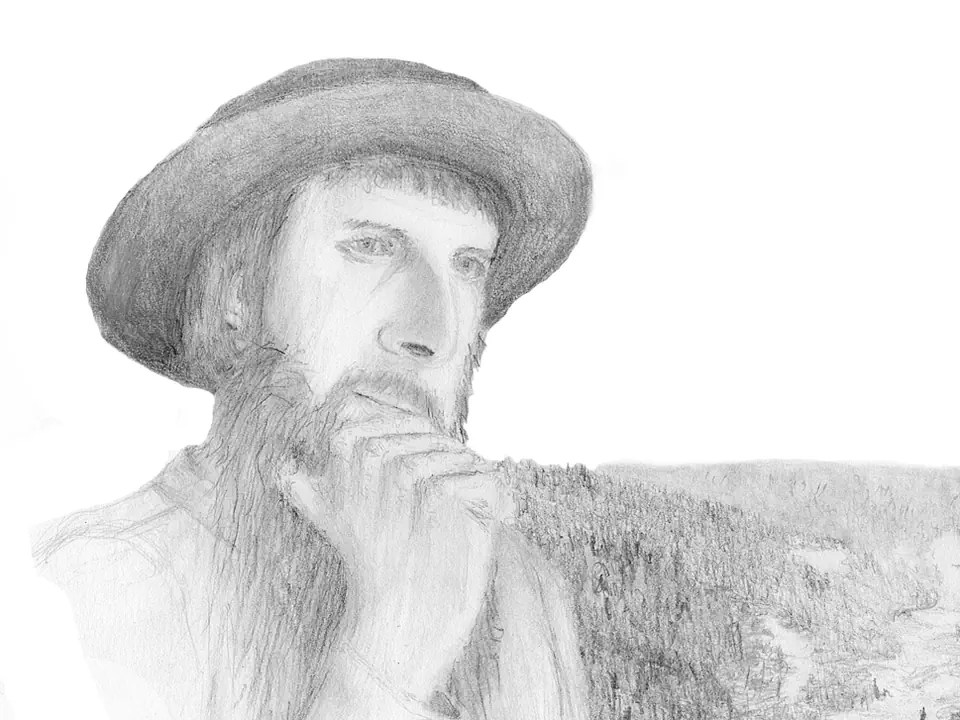
Jakob Ammann: The Anabaptist preacher from Bern is considered the founding father of the Amish.
Wikipedia
Ammann became the leader of an Anabaptist congregation. He preached particularly strict rules of faith: “These included a strong separation from the rest of society. Or that the men wear beards and the women wear bonnets,” says publicist and historian Helmut Stalder. In his book Verkannte Visionäre. 25 Schweizer Lebensgeschichten (25 Swiss life stories), he writes about Jakob Ammann, among others.
Ammann’s strict rules of faith led to a conflict with other representatives of the Anabaptist movement in Switzerland. A break occurred in 1693. “From then on, Ammann’s followers were called Ammansche Leut or Amische Leut,” explains Stalder. Ammann built up an Anabaptist community with them, mainly in Alsace in north-east France, where they were less exposed to repression.

A small group of Amish, the Swiss Amish, still speak a language that even founding father Ammann would have understood over 300 years ago: Shwitzer, which originated from Bernese German.
Getty Images/Classicstock/J Irwin

Reuters/Jason Reed

The Amish immigrated in the 18th century and initially had a few thousand members. Today, over 300,000 people belong to the religious community. They live in around 500 settlements spread across 32 states – but mainly in Pennsylvania, Ohio and Indiana.
Getty Images/Mark Wilson
What happened next to Ammann can no longer be traced in detail today. His traces are lost in Alsace around 1712.
Ammann’s community, the Amish, however, continued to exist. They emigrated to North America from the 18th century onwards. There, they still uphold Ammann’s religious rules today and are an unmistakable part of life in some regions.
When mass emigration begins
While for a long time it was individual groups or persons, Swiss emigration to the US increased sharply in the middle of the 19th century. Between 1851 and 1880, the American authorities registered over 75,000 people from Switzerland. And in the following ten years or so, another 80,000 Swiss emigrated to the US.
The wave of emigration was triggered by various factors, says historian Aragai. “One reason is simple: poverty in Switzerland. At first, it was mainly poor people who made the journey.” It was not uncommon for them to be encouraged to leave Switzerland by their home community – in some cases they were even supported financially.
There was another other important reason. “The young United States opened its borders to settlers back then. Their aim was to colonise what are now the states of the East Coast and the Midwest,” says Aragai. Emigrants from Switzerland and other European countries made their way there in far greater numbers than ever before.

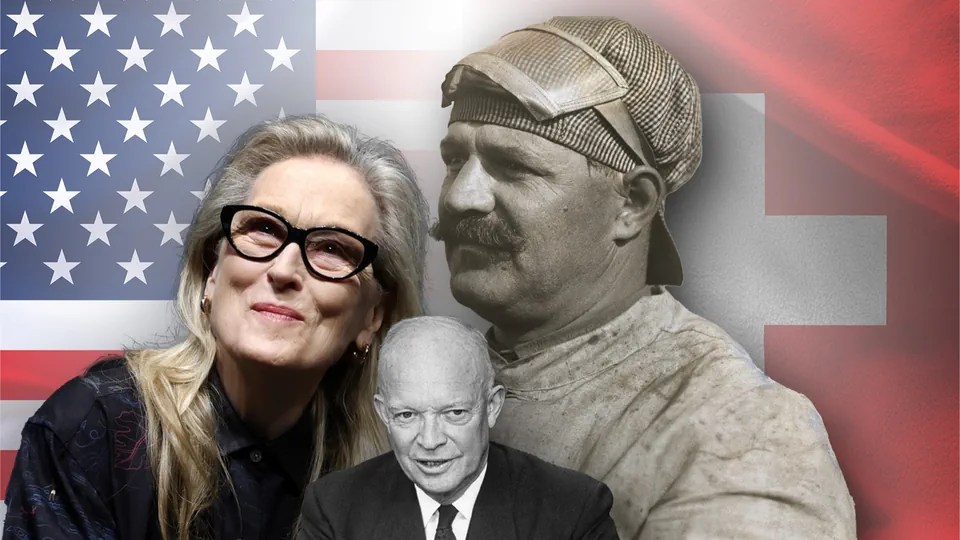
The descendants of Swiss emigrants have made it to the Oval Office: genealogists have identified Swiss ancestors in three of the 46 US presidents to date. The ancestors of President Herbert C. Hoover (in office from 1929 to 1933) came from Oberkulm in canton Aargau. They emigrated to America under the name “Huber”.
Keystone/AP Photo

Dwight D. Eisenhower (in office from 1953 to 1961) was a World War II general and commanded D-Day. He was twice elected to the White House with great distinction. Eisenhower’s Swiss roots come from his mother Ida Stover. Her ancestors (who were still called “Stauffer”) can be traced back to Eggiwil in the Emmental.
Imago/Everett Collection

Barack Obama (in office from 2009 to 2017) was the first African-American to be elected president in US history. His ancestors on his mother’s side can be traced back to Switzerland. One of Obama’s great-grandparents is said to have come from Ried near Kerzers in the canton of Fribourg.
Keystone/Pablo MArtinez
However, people did not settle on uncolonised land back then, but on indigenous land. “The people were allocated their land partly through state programmes. They were sometimes unaware or simply indifferent to the fact that it had previously been taken away from the indigenous population,” says Aragai. This problem has been increasingly addressed in Switzerland in recent years. One example of this is the Swiss citizen Johann August Sutter.
It was during this period that larger cities began to form in the Midwest and the west of the US, inhabited by European and Swiss immigrants. Emigration from Switzerland also increasingly became a matter of course. “At some point, everyone knew someone who was already living in the USA,” explains Aragai.
One person who also moved to the US to find his fortune there was Louis Chevrolet.
Louis Chevrolet: a success story with a tragic end
Chevrolet was born in La Chaux-de-Fonds in canton Neuchâtel in 1878. He was the son of a watchmaker and grew up in poor circumstances. As a teenager, he worked as a bicycle mechanic in Burgundy, from where he moved to Paris. There he trained as a mechanic at various car manufacturers.

Louis Chevrolet made a career as a racing driver in the early 20th century. His name later became a global brand.
Getty Images/Bettmann
However, the 20-year-old already had his sights set on the US and saved up for the journey to America. After a stopover in Montreal, Chevrolet arrived in New York in 1901, where he joined the car manufacturer Fiat in 1902. The breakthrough came three years later: Chevrolet set a world record in a test race in a Fiat.
“From then on, Chevrolet was not only a mechanic, but also a racing driver. He enjoyed successes on all kinds of racetracks,” says Stalder. In his book about misjudged Swiss visionaries, he also analyses Chevrolet’s biography and claims that “Chevrolet was the star of the racing scene back then.” American businessman William Durant became aware of the Swiss emigre and the two founded the Chevrolet Motor Car Company in Detroit, Michigan, in 1911.
Although Chevrolet himself gave his name to the car brand, he only held a few shares. This proved to be his undoing two years later: following a dispute over the direction of the company, Chevrolet fell out with partner Durant. He left the company in 1913. From then on, he received no money from the company bearing his name.
Chevrolet then tried his hand at other projects and companies, but with little success. And so it was that he returned to Chevrolet in the 1930s. “The irony of the story is that from then on he worked as a simple mechanic at the company that produced cars under his name,” says Stalder. Several million “Chevys” had already rolled off the production line by then.
Chevrolet died in 1941 at the age of 62. Millions of cars bearing his name are still on US roads today. Chevrolet is present in around 80 countries and is one of the largest car brands in the world.
World wars and economic crisis
The wave of Swiss emigration to the US then took a sharp turn in the 20th century. The two world wars and the global economic crisis in between were mainly responsible for this. It was only afterwards that Swiss nationals were once again lured to the United States in somewhat larger numbers – not least because of the American dream. Since then, the number of emigrants to the USA has stabilised, says historian Aragai. “However, the huge numbers of the 19th century are no longer being reached.”
Nevertheless, Swiss emigrants continue to leave their mark on the US – above all through their now numerous descendants. However, it is difficult to estimate the number of Americans with Swiss ancestry. Many today cannot trace their ancestors back to the 18th century. In addition, Swiss ancestors were often mistaken for German, French or Italian, especially in older documents.

There are also numerous personalities with Swiss roots in Hollywood. Meryl Streep is one of the most influential and successful actresses. In the course of her career, she has played over 80 roles in film and TV – and received over 600 nominations for film awards. Streep’s great-grandfather comes from Kern’s OW.
Keystone

Renée Zellweger presents her Oscar.
2 / 3
Legend:
Renée Zellweger’s surname comes from her father Emil Erich, who originally comes from Au SG. He emigrated to the USA after the Second World War. Zellweger became world famous primarily through her role in “Bridget Jones”. In 2003 she won an Oscar for her supporting role in “Cold Mountain”.
Keystone

Meryl Streep in a portrait photo1 / 3
Legend:
There are also numerous personalities with Swiss roots in Hollywood. Meryl Streep is one of the most influential and successful actresses. In the course of her career, she has played over 80 roles in film and TV – and received over 600 nominations for film awards. Streep’s great-grandfather comes from Kern’s OW.
Keystone/Sebastian Nogier
Renée Zellweger presents her Oscar.
2 / 3
Legend:
Renée Zellweger’s surname comes from her father Emil Erich, who originally comes from Au SG. He emigrated to the USA after the Second World War. Zellweger became world famous primarily through her role in “Bridget Jones”. In 2003 she won an Oscar for her supporting role in “Cold Mountain”.
Keystone/Jordan Strauss
Cyndi Lauper at a performance.
3 / 3
Legend:
The singer and actress Cyndi Lauper has enjoyed international success with hits such as “Girls Just Want to Have Fun” and “Time After Time”. Her albums have sold over 50 million copies. Her father comes from Germany and Switzerland.
Keystone
However, the estimate is around 1.2 million Americans with Swiss roots. Among them are a number of celebrities, whether in politics, show business or sport.
In addition, there are still new Swiss nationals seeking their fortune in the US. According to the Swiss Federal Department of Foreign Affairs (FDFA), almost 84,000 people with a Swiss passport lived in the “land of opportunity” last year. And one or two of them will probably leave a lasting mark there.
David Aragai is a historian, district archivist in Oberegg in canton Appenzell Inner Rhodes and research assistant at the Museum Heiden in canton Aargau. In recent years, he has worked on several projects on Swiss emigration to North America and the transnational history of Switzerland.
Adapted from German by DeepL/ac


