


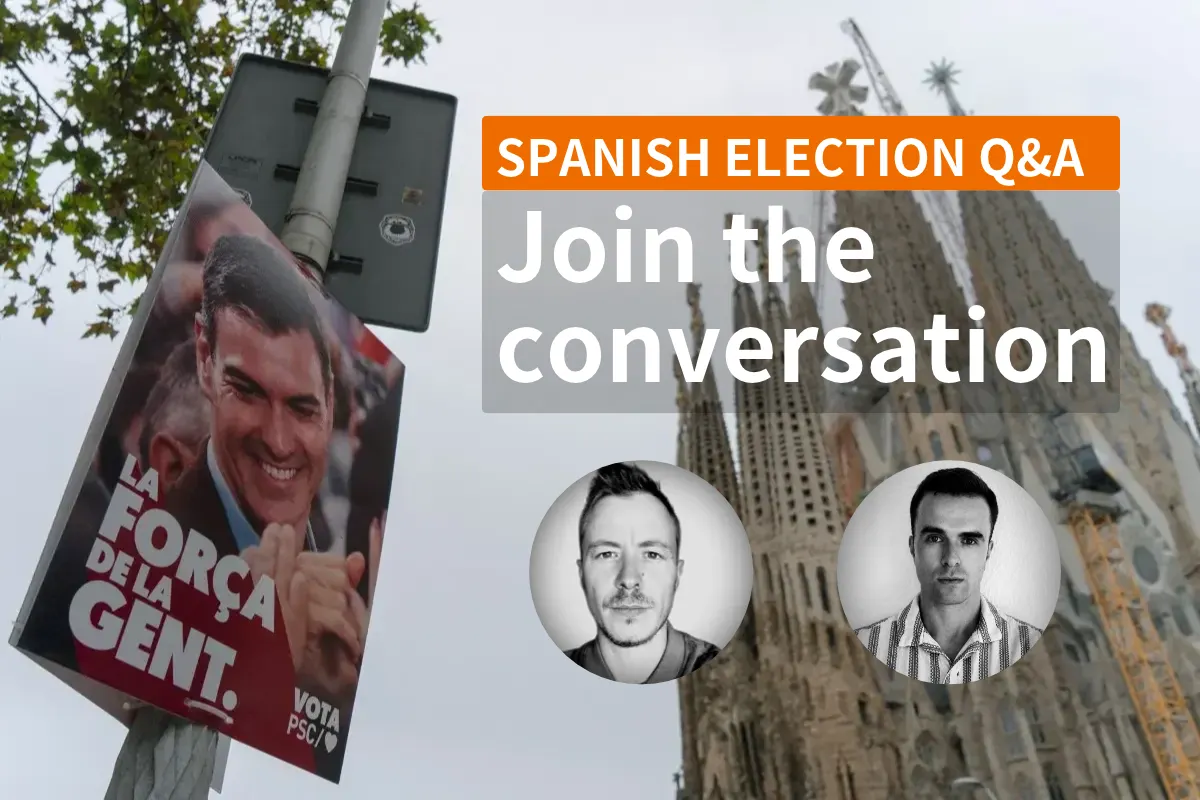
Spanish voters look set to elect a right-wing government on Sunday which would bring a dramatic change to the country. The Local Spain’s Alex Dunham and Conor Faulkner answer reader’s questions about the pivotal vote.
The team at The Local Spain had a live Q&A on Friday to answer reader’s questions on Sundays vote.
Readers have been sending us questions over the past days, whether in a survey, by email on the site or on Facebook.
Thanks to all those who have sent in questions, you can find the answers in the article below or in the comments section at the bottom of the page.
Let’s start with a common question that was asked by a reader on Facebook. “Why is Spain shifting to the right?”
A: That’s a complex one. Perhaps a more accurate question is “why are Spaniards shifting more to the far right?”, as it’s Vox that is seeing a bigger increase in voter share compared to the 2023 election (according to the polls) than their potential coalition partners, the centre-right PP.
Many Spaniards aren’t happy with the ruling Socialists’ immigration policies and their handling of the crises in Ceuta and El Hierro.
Given the general mood of discontent over spiralling rents and the rising cost of living as a whole, Vox and Abascal have known how to galvanise many Spaniards with their promises of ‘Spaniards first’, and by blaming migrants for making it harder to find a home, see the doctor, access benefits, and so on.
There are of course many other reasons why the current Spanish government isn’t as popular at home as it is abroad – Spain’s booming economy not translating into higher purchasing power for ordinary citizens, numerous corruption scandals involving Sánchez’s family and entourage, the amnesty he offered Catalan separatists who attempted to break away from Spain etc
As for the PP, some in Spain see them as part of the political status quo (sometimes referring to them together with the Socialists as ‘PPSOE’) and therefore not as capable of enforcing radical changes as Vox.
Q: A question we’ve been getting is – how is Spain’s electoral system different to the UK’s and US’s?
A: Spain and the UK are both parliamentary monarchies, albeit with different electoral systems.
Spain uses proportional representation and seats are allocated using the D’Hondt method.
Governments can require parliamentary support, depending on whether it gains a governable majority, which in recent years in Spain has led to coalition governments or informal parliamentary pacts.
The Spanish system is about securing that governable majority in the Congress of Deputies — that is, 176 seats. But, as we’ve seen during the Sánchez era, governments can function without that absolute majority.
In the UK, the first-past-the-post majoritarian system decides the government in a less proportional and more ‘winner takes all’ style. Voters elect one MP in each constituency across the country and the party able to have a majority of MPs elected to the House of Commons forms the government.
The United States, on the other hand, uses a Presidential system different to both Spain and the UK.
Voters do elect representatives in individual districts and senators by state, but, unlike in Spain and the US, the President is elected separately through the Electoral College.
Q: We’ve had several readers on Facebook asking how the new wealth tax Sánchez has proposed to introduce if re-elected is different from the ones Spain already has.
A: Sánchez proposed just a few days ago a Zucman-style wealth tax. It differs fundamentally from Spain’s existing levies by targeting only ultra-high-net-worth individuals with fortunes exceeding €100 million and stripping away the tax exemptions that currently shield major estates.
So while Spain already enforces a regional wealth tax starting at €700,000 and a state-level ‘solidarity tax’ on Large Fortunes for assets over €3 million, the existing frameworks allow top earners to drastically reduce these levies through family business exemptions and a combined income-and-wealth tax cap.
The new measure, inspired by French economist Gabriel Zucman’s minimum tax model, aims to establish a strict effective floor with no loopholes or regional rebates, ensuring centimillionaires (that’s what you call someone with more than 100 million) pay taxes on their real net wealth.
Oh, and unlike the 2022 solidarity tax which was primarily designed to harmonise fiscal rules across regions like Madrid and Andalusia, this new levy is projected to raise an additional €2 billion annually strictly earmarked for social programmes like public housing, pension protections, and a new universal child-rearing allowance.
Q: We’ve got a comment rather than a question from Spanish reader Juan Barquita, who on the subject of Spain’s economy says:
“Headline GDP does not pay the rent, defend national borders, keep trains safe, or restore trust in public institutions. Economic growth matters, but it cannot serve as a smokescreen for administrative failures and lack of accountability. A country should be judged by whether its citizens can afford a dignified life, feel safe, and trust those who govern them.”
Q: Luke in Spain asks – How might those of us here on digital nomad visas be impacted by PP and/or PP-Vox if they win? (Such as changes to digital nomad visas themselves, to renewal requirements, to the timeline from visa to application for permanent residency to application to citizenship, etc)
A: It’s a good question. From what they’ve said so far, the PP certainly has no problem with digital nomads — or wealthier foreigners in general bringing their money to Spain.
In terms of citizenship, looking at the manifestos of both the PP and Vox, we can expect there to be tougher requirements (perhaps on minimum language requirements or time spent in the country) for citizenship and perhaps residency too. The PP has even talked of attracting millions of digital nomads.
READ ALSO: Do Spain’s conservatives want to attract millions more digital nomads?
How this will manifest itself on a policy level depends, of course on: whether the Spanish right wins; and, if it does, how strong of a performance Vox has and the influence it can exert on the PP in government.
Q: Can a party not win the most votes overall but still form a government?
A: In the multi-party politics of the 2020s, this almost always means blocs.
Sánchez’s Socialists, for example, came second in 2023 but he managed to put together a coalition and reach the magic number.
The Spanish system is all about securing a governable majority in the Congress of Deputies — that is, 176 seats.
Q: There’s a lot of interest online after last night’s debate about who the favourite is now according to the polls.
A: Unfortunately, the last day polls could be held in Spain was Monday November 23rd, so we can’t capture the mood following Thursday night’s heated debate. 40db places the PP as the leading force with 31.8 percent of the vote, 1.5 points below the figure it achieved in the last general election in 2023.
The PSOE would trail by just 0.9 points (30.9 percent overall), meaning Sánchez’s party could be the first party but will likely not secure the numbers needed to form a government.
Far-right Vox is forecast to secure around 17.3 percent of the vote, almost five percentage points more than in 2023, when it received the support of 12.4 percent of voters.
To the left of the PSOE, neither the Frente Amplio (5.7 percent, including regional coalitions) nor Podemos (1.1 percent) have made any headway throughout the campaign and trail Vox by a significant margin, making the right-wing majority more likely.
Most pollsters predict the Spanish right-wing bloc, the PP and far-right Vox.
Q: Several readers have asked – When will we know the election results?
A: As polling stations officially close at 8pm, we may have some early provisional results from 9pm, if the counts follow the same timetable as in 2023.
It’s difficult to give an exact time for the overall result, mainly as the duration of the count depends on size and population of each locality. However, based on previous elections, we could get an accurate estimate over the nationwide picture by around 11pm.
We’ll have a clearer idea of who the next government of Spain will be on late-Sunday night going into Monday morning.
Q: Similarly, people are posing the question – When will we know the final result?
A: For the full confirmed election result, we must wait until the final count on Friday December 4th, when the votes of overseas residents are counted.
Of course, depending on the results, we may see a period of negotiations as each bloc tries to put together a governable majority, something that could further delay the final outcome.
Q: Nancy Ashford, an artist, designer and social care worker in the UK asks – “I just wonder why many Catalans seem to have become more rightwing politically, when historically, I recently found the majority, as of 20 years ago, were anti Franco & distinctly anti fascist?”
A: Of course, you’re right that a long anti-facist tradition exists in Catalonia, particularly in Barcelona, but it’s also worth remembering that the Catalan separatist movement has always contained right-wing parties and elements too, whether in the modern day with centre-right Junts per Catalunya or bourgeois Catalan business leaders in the early-20th century wanting greater control of their money.
Catalonia isn’t immune to the rightward drift we’ve seen in politics across Europe and the world in recent years. The rise of far-right Aliança Catalana and its anti-immigrant rhetoric is one example.
Q: Leonard in Asturias asks – Are the media pressing PP and VOX to tell us what legislation they will jointly be able to vote for after the election?
A: The Spanish media has stepped up its questioning of the opposition parties during the election campaign, but it’s true to say that a lot of the media attention in the last eight years has been on Sánchez and his many scandals and crises.
It’s also a widely-held criticism by some in Spain that the Spanish right has had little to offer policy-wide beyond anti-Sanchismo.
As for what the PP and Vox will vote for after the election — should they win — you can read our breakdown of manifesto pledges here and both parties have pleaded similar policies in terms of stricter migration controls and increased citizenship requirements.
You’ll find more answers to questions in the comments section below.
Be sure to tune in on Sunday when we’ll bring you the results of the election that will have a huge impact on the future of Spain.


