


Towers of ice are rising above mountain villages in Kyrgyzstan that may hold the key to reversing the depopulation of the country’s highlands.
“I’ve traveled throughout all the mountain villages of Kyrgyzstan and what I saw was climate migration, especially among young people,” Matraim Jusupov, a water management expert, told RFE/RL from his base in Bishkek. “The natural glaciers are already disappearing and people can no longer cultivate their irrigated land.”
“We decided to create ‘artificial glaciers'” in an effort to provide water year round to mountain settlements, he explained. “We want the villagers, especially the young people, to be able to stay. When there’s water, they can work their land and earn an income.”
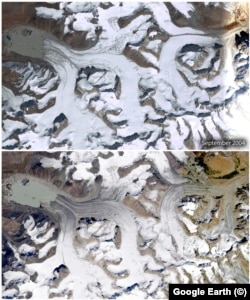
Satellite images from September 2004 (top) and September 2026 show the receding of glaciers around Petrov Lake (top left). The alpine waterway is situated some 3,700 meters above sea level in the east of Kyrgyzstan.
Artificial glaciers are made by channeling water from high mountain streams downhill through underground pipes to a shaded, cold location near a village. The difference in elevation generates enough pressure to force the water up vertical pipes fitted with a nozzle resembling a garden sprinkler. Through winter, the resulting spray of water freezes in the air, or after settling on the frigid surfaces below, growing slowly into a mound of ice.
In spring and summer, the ice tower gradually melts, with the water channeled into a reservoir that can be accessed by villagers, helping to supplement natural water supplies.
Natural glaciers in the Kyrgyz Range of mountains have lost nearly a third of their volume over the past 50 years, with similar melt rates reported in other alpine regions of the Central Asian country.
Glaciers have historically provided a lifeline for mountain communities by accumulating vast quantities of compacted snow and ice through the freezing months of winter that is gradually released by melting over spring and summer.
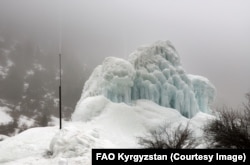
An artificial glacier near the village of Sumbula in western Kyrgyzstan photographed in March 2026.
Jusupov says the first artificial glaciers in Kyrgyzstan were made in 2016 in the mountainous Naryn region.
That happened soon after the water preservation technique was pioneered in the mountains of India.
“At first I didn’t pay much attention to it. People in the villages were already doing it on their own but a system would work for a year and then stop,” the water expert recalled.
Jusupov, who works with the Food and Agriculture Organization of the United Nations (FAO), recently authored guidelines for building artificial glaciers that were adopted by Kyrgyzstan’s Water Resources Ministry in October.
Around 40 artificial glaciers are currently in place throughout Kyrgyzstan, and plans are now underway to roll out the initiative to hundreds of mountain settlements.
The cost of installing each glacier ranges from $3,500 to $10,000, depending on factors including the distance needed to pipe water from mountain streams and size of the reservoir to hold the meltwater.
The capacity of each artificial glacier varies widely, but in one area of Kyrgyzstan some 1.5 million cubic meters of ice was reportedly accumulated by seven artificial glaciers in a single winter.
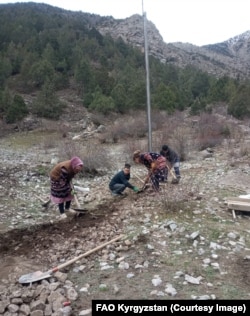
Kyrgyz villagers dig a trench for underground piping to a water sprinkling pole (in the background).
Locals from mountain villages where glaciers were installed have reported mixed results.
“The benefits of artificial glaciers are very significant.” Mederbek Karimov, the head of the Sumbula municipality in southwest Kyrgyzstan, told RFE/RL’s Kyrgyz Service. “I want to expand the program further. This year, God willing, we’re planning to install another seven or eight.”
In the village of Gaz, in the west of the country, a recent attempt to install an artificial glacier may have failed due to its placement.
“It grew quite large, but it didn’t have much of an effect,” Rustam Matkarimov, the head of the village, said.
“It formed well, but then melted almost immediately. It may have been built at too low an altitude, and it didn’t deliver the desired results,” he told RFE/RL. “It seems it should have been constructed higher up in the mountains in a colder location.”
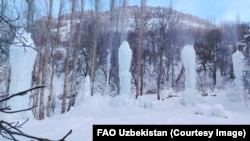
Ice towers near a mountain village in the Kashkadarya Region of Uzbekistan.
Jusupov says his trips to oversee the construction of artificial glacier systems in Kyrgyzstan, which sometimes involve scaling mountain paths for hours on horseback, have brought him face-to-face with the scale of the problem confronting locals living in the Kyrgyz highlands.
Above one mountain village. he says, at an altitude of 3,300 meters, “I saw the last natural glacier disappearing. There was so little left of it. Do you understand? Locals told me ‘in a year we’ll be left without water.'”
The Kyrgyz water preservation initiative is sparking interest elsewhere in Central Asia.
The results of a trial of ice towers installed near a mountain village in southeast Uzbekistan in November was unveiled at the COP31 climate change conference, and there are plans to roll out systems elsewhere in the country.


