


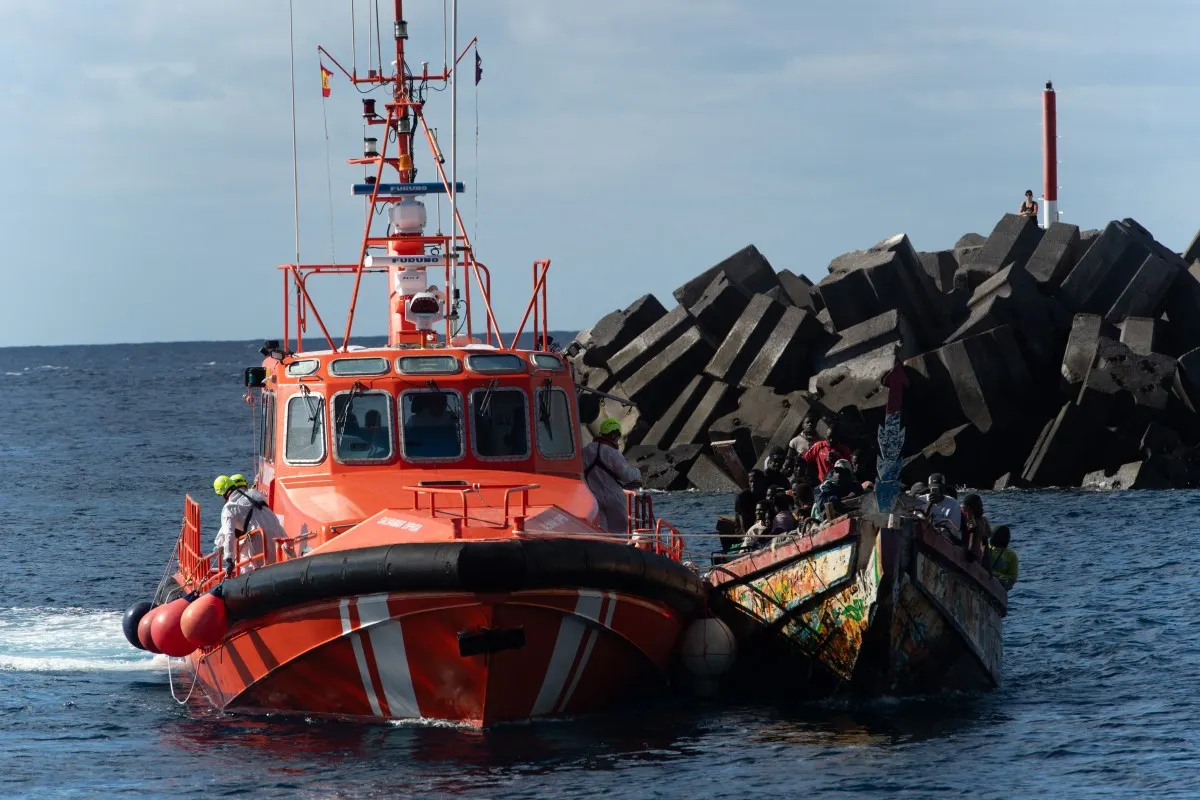
The death toll from a migrant boat rescued off Spain’s Canary Islands has risen to 14, a government minister said on Saturday, a day before an election dominated by immigration.
The tragedy comes as a surge of arrivals from west Africa has put humanitarian resources under strain in the Canaries, particularly in its smallest island, El Hierro, where an emergency has been declared.
“Last night it was confirmed that 14 migrants died in the boat that arrived in El Hierro” on Friday, Territorial Policy Minister Angel Victor Torres said on X, raising a toll of between eight and 10 provided by rescuers.
The Spanish government delegation in the Atlantic archipelago also confirmed 14 deaths to AFP.
An AFP reporter saw a rescue vessel bring the migrants’ wooden boat on Friday night to the port of La Restinga, where several corpses covered in blankets were taken off on stretchers.
Spanish maritime rescue service Salvamento Maritimo had said six seriously injured migrants had been taken from the boat to El Hierro by helicopter.
Another 84 people were brought to La Restinga on a rescue vessel, while one person chose to stay on the migrant boat, suggesting that it had initially carried more than 100 people.
The right-wing opposition, which leads in most polls, has attacked Socialist Prime Minister Pedro Sanchez for his outspoken defence of more open immigration policies ahead of Sunday’s general election.
They say Sanchez has encouraged dangerous irregular immigration and failed to protect Spain’s borders.
Critics point to the Canary Islands and to Ceuta, the Spanish territory in north Africa where tens of thousands of migrants crossed from Morocco in July.
Spanish policy is likely to change after the election if the main conservative Popular Party can achieve a majority in coalition with the far-right anti-immigration Vox.
The trip from west Africa to the Canary Islands is one of the world’s deadliest migration crossings and a main gateway to Europe alongside Mediterranean routes to Greece and Italy.
Thousands of migrants attempt the journey each year in overcrowded boats, braving rough seas, strong currents and long distances.
In the year to November 15, 24,364 people reached the Canary Islands, reversing a downward trend that saw 14,690 migrants arrive in the same period of 2025, according to interior ministry figures.


