

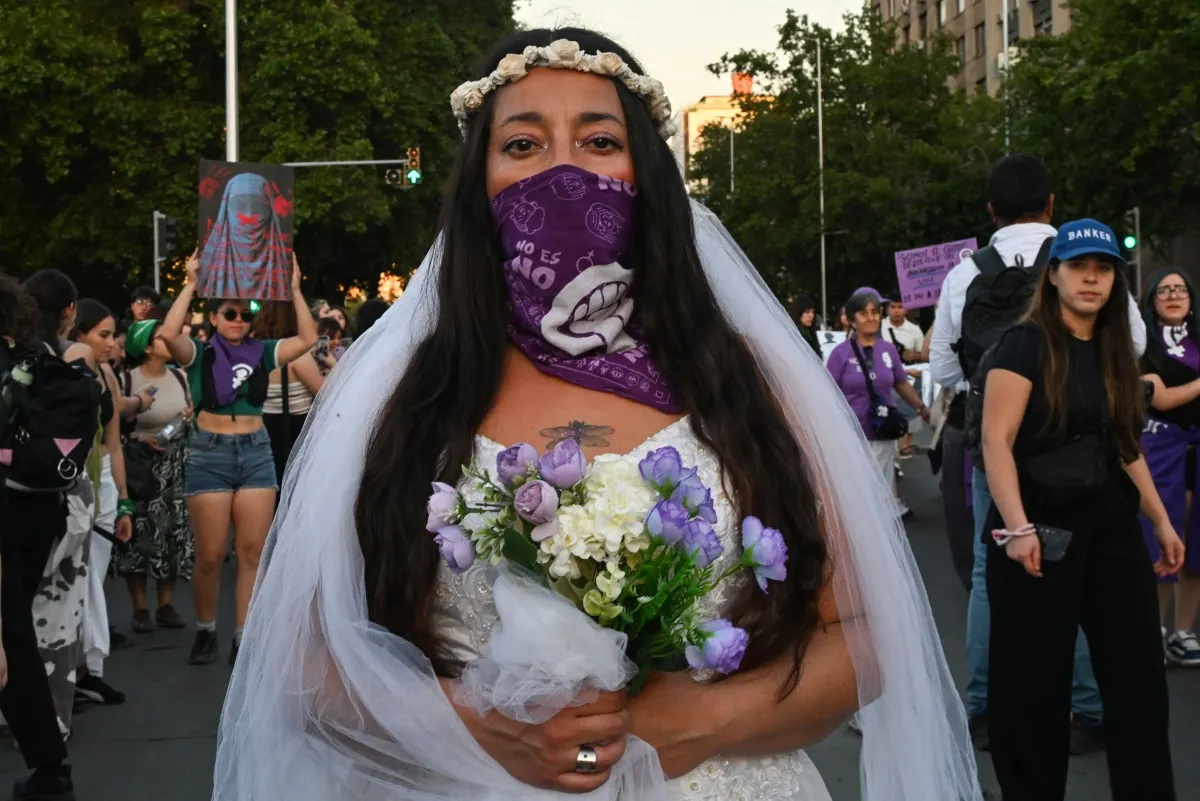
Thousands of people marched through Madrid on Wednesday to defend Spain’s protections against violence against women, as Socialist Prime Minister Pedro Sánchez warned that a right-wing victory in this weekend’s election could reverse years of progress.
The protesters, mainly women of all ages, beat drums and chanted feminist slogans as they made their way through the streets of the Spanish capital.
“The right hates us”, “Women free from violence” and “Touch one of us, and you answer to all of us” were among the signs on display.
“We are at a turning point in the fight against gender-based violence. We have everything to lose” in this election, Marta, a 33-year-old graphic designer, told AFP.
Polls suggest the conservative Popular Party (PP) will win the most seats in Sunday’s early general election but fall short of a parliamentary majority, leaving it reliant on far-right Vox to govern.
Vox has called for the repeal of Spain’s landmark 2004 law against gender-based violence, arguing that it has criminalised men and left women unprotected.
The party rejects the concept of gender-based violence as a distinct form of violence rooted in gender inequality, arguing that legislation should instead address domestic violence regardless of the victim’s sex.
The 2004 law, passed under a previous Socialist government, recognised gender-based violence as a human rights violation for the first time, becoming a model for other countries.
It laid the groundwork for a range of new support measures for women, including specialised courts, free legal assistance and the prosecution of offenders even when victims had not filed a complaint.
Courting women’s votes
Inma Fajardo, a 63-year-old retired nurse who went to the protest with her granddaughter, said she feared the right will “scrap” the law if it comes to power after the vote.
“I think a lot could be lost if the right wing comes to power,” she added.
The number of women killed by current or former partners has fallen since the law was introduced.
Spain recorded 48 such killings last year, compared with 71 in 2003, the year before the landmark law was passed, according to official figures from the Ministry of Equality.
Sánchez said Spain had undergone a “structural transformation” in tackling gender-based violence, but warned in a TV interview earlier on Wednesday that the far right was seeking to reverse that progress by “downplaying” the problem.
A self-described feminist, Sánchez has made winning the votes of women a central plank of his campaign, warning that a PP-Vox government would threaten their rights.
He has appeared at rallies wearing a T-shirt bearing the slogan “La fuerza de las mujeres”, meaning “The strength of women”.
Over the past two decades, Spain has been at the forefront of efforts to advance women’s rights in Europe, making progress on access to abortion, equal pay and tackling sexual violence.
‘Move forward’
Noa Fernández, a 22-year-old social education student, said she worried a PP-led government would lead to a reversal in women’s advances, citing the party’s vow to eliminate the equality ministry as an example.
“When it comes to gender-based violence and legislation, we need to move forward, not backwards,” she told AFP.
“And if there is a change of government, things could potentially get worse”.
Although the PP has resisted Vox’s calls to repeal the 2004 law, concessions made to the far-right party in regions where the two govern together have fuelled concern among feminist organisations that protections for women could be rolled back.
Two separate demonstrations were held in Madrid, reflecting divisions within Spain’s feminist movement over issues including transgender rights and prostitution.
They were called to mark the International Day for the Elimination of Violence against Women.
One was organised by the more established Comisión 8M, the other by the Movimiento Feminista de Madrid.
Marches were also held in other Spanish cities, including Barcelona, Seville and Valencia.
Article by Daniel Silva


