


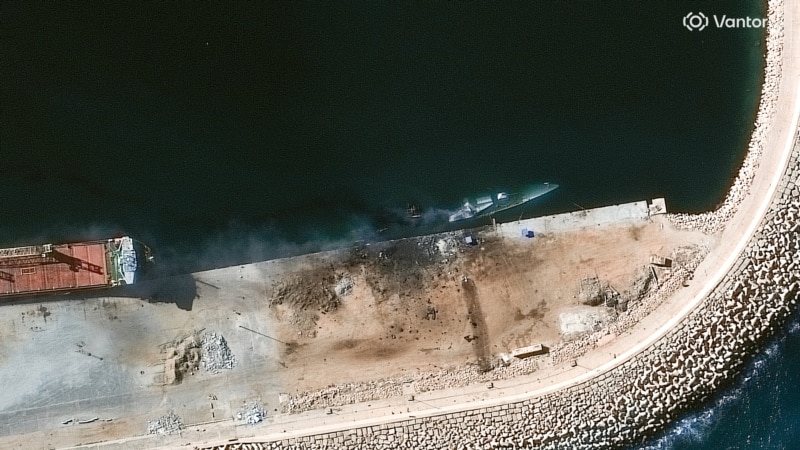
Ukrainian President Volodymyr Zelenskyy has said that the country’s security services struck two Russian vessels off the coast of Libya: a warship that sank in Benghazi harbor and a cargo ship used to transport weapons across the Mediterranean Sea.
Earlier, authorities of the eastern-based Libyan government said that a suspected sea drone had caused an explosion aboard a Russian vessel docked at a naval base near Benghazi on November 22, injuring 10 Russian and Libyan crew members.
Seven Ukrainian-made naval drones were involved in the “Ukrainian operation” off the Libyan coast, targeting a Russian corvette and the cargo vessel, Zelenskyy said in a post on X on November 23.
“Despite all the enemy’s efforts to counter the attack, the Russian corvette Merkury was sunk,” he said, adding that “it’s one of their newest ships, commissioned in 2023, during the full-scale war.”
There was no immediate response from the Russian side.
In a social media post, Denys Sienik, Ukraine’s top diplomat in Washington, wrote: “Something has happened to a Russian naval vessel and a cargo ship reportedly transporting military equipment off the Libyan coast.”
“One thing is clear: these vessels will no longer be serving the Russian war machine,” he added without further elaboration.
Ukraine forces have often used sea drones and missiles to target Russian warships and naval facilities in the Black Sea and have recently struck Russian ships in the more-distant Baltic Sea.
In December 2025, Ukraine said it had struck a Russian-linked oil tanker with aerial drones in the Mediterranean, although the exact location was not clear.
In March 2026, Moscow accused Ukraine of attacking a Russian LNG tanker with naval drones launched from the Libyan coast. Kyiv did not comment on that strike.
But an attack in North Africa, if confirmed, would demonstrate an enhanced ability for Kyiv to wreak havoc upon Russian military shipping.
Early on November 23, the UN mission in Libya (UNSMIL) expressed “serious concern” over the drone attacks, calling for “an immediate, independent and transparent investigation.” It did not assess blame.
Satellite Images
Satellite imagery provided by Vantor also indicated the vessel was the Merkury, a Russian Navy corvette, or small warship, according to Reuters.
Imagery showed that most of the vessel had capsized, with only its bow remaining visible above water. Smoke was rising from part of the ship, with debris scattered along the pier.
Reuters also reported the hit on the other ship on November 22. Two Libyan military sources told the news agency that a Maltese-flagged commercial vessel was hit by a sea drone off the Benghazi coast.
Libyan naval forces rescued the crews from both ships, Reuters reported, citing sources, who also said the country’s naval and air forces intercepted more than 20 drone boats off the coast late on November 22.
Libya has a divided political structure consisting of two rival authorities competing for legitimacy. The western-based government in Tripoli — the Government of National Unity (GNU) — has been working with the UN to establish a single ruling authority.
The eastern-based faction in Benghazi has established a rival administration led by a separate prime minister and cabinet.
Russia Seeks Presence
Russia has sought to use the divisions in Libya to establish a major presence in the North African nation.
The eastern government condemned the suspected attack as a violation of Libya’s sovereignty and a threat to maritime security. It stressed that Libya was not a party to the war between Russia and Ukraine or to any armed conflict beyond its borders.
“The Libyan government will not allow Libyan ports, territory, or territorial waters to be turned into an arena for settling scores or exporting international conflicts,” it said in a statement.
The rival government in Tripoli said it was alarmed by “risks posed by involving civilian ports and facilities in activities linked to external conflicts.”
The Tripoli government also warned that hosting foreign forces and granting them access to national facilities invites the spillover of external conflicts.


