Photo: Google Earth/2026 Planet Labs Inc. All Rights Reserved. Reprinted by permission. (©)
Recent satellite imagery of Azerbaijan’s Nagorno-Karabakh region and surrounding areas shows the massive scale of an ongoing construction blitz, even as displaced locals remain reluctant to return to the war-haunted territory.
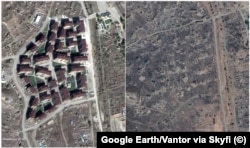
Apartment complexes in Jabrayil seen (left) in November 2026. The same site, is seen — dotted with destroyed buildings — in August 2021.
Azerbaijani military offensives to retake the territories from ethnic Armenian forces ended with their complete recapture in 2023. Baku has poured some $15 billion into rebuilding these places to kickstart its “Great Return” program for Azerbaijanis who fled the First Karabakh War of 1988-94.
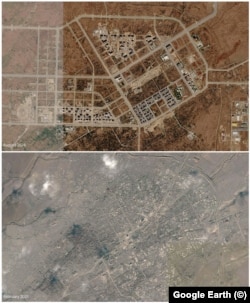
A kilometers-long development underway on the site of the city of Aghdam, photographed in August 2026. The second photo — taken in February 2021 — shows the site of the ruined city, which was home to 28,000 people before the First Karabakh War. The city became a ruined ghost town amid the conflict and its subsequent capture by ethnic Armenian forces.
The Great Return program aimed to resettle 140,000 internally displaced people (IDPs) in the recaptured territories by the end of 2026. But with that deadline approaching, Baku claims that only 41,000 have returned. RFE/RL could not independently verify that figure, as it is still difficult for foreign journalists to access the area independently.
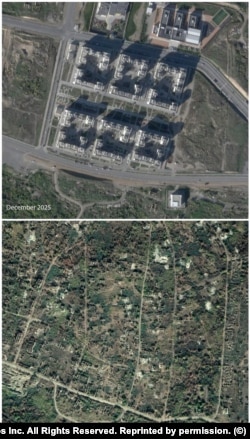
Apartment blocks in Fuzuli seen in December 2025. An earlier November 2019 image shows the same site when it was dotted with overgrown ruins.
Farid Guliyev has interviewed several Azerbaijanis who were displaced by the First Karabakh War. The associate professor of political science at the American University in Dubai says Baku’s goal of enticing 140,000 internally displaced people (IDPs) to the recaptured territories by the end of this year was probably overly ambitious due to ongoing complications, such as landmines in the area, as well as multiple social factors.
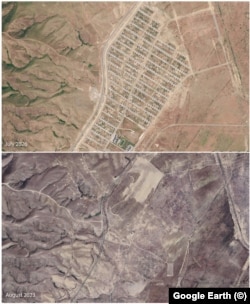
Rows of newly-built houses in Khidirli, a village nestled against the foothills of the Karabakh Range in the Aghdam district, seen in July 2026. The location stood abandoned until August 2023.
“The targets do not fully account for how much the lives of displaced people have changed over the past three decades,” Guliyev told RFE/RL. “Many IDPS, particularly younger ones, have become integrated into urban life in Baku and other cities and may be reluctant to relocate.”
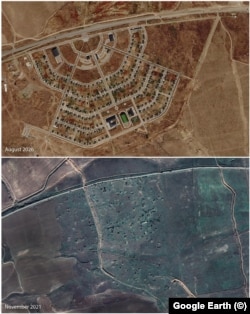
A newly constructed village in Azerbaijan’s Aghdam District photographed in August 2026, and the same territory, showing ruined buildings and military trenches, in November 2021.
Aytaj Amirjanli, an IDP who recently moved back to Nagorno Karabakh, told RFE/RL’s Azerbaijani Service in September that many of those who did return are leaving once more after struggling to find work.
“Our refugees and internally displaced people are all unemployed. Most have already locked up their homes and gone back to Baku,” she said, adding, “if I can’t put food on the table there, what am I supposed to do?”
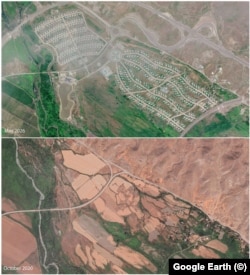
Agali, a “smart village” in the Zangilan District, seen in May 2026. An image from October 2020 image shows farmland and a small collection of houses before the massive development was built.
Additionally, Guliyev says, many IDPs may be reluctant to lose the state handouts allocated to them, including monthly food allowances of around $35 per person.
“Returning may mean losing some of these benefits, while employment opportunities in the recovered territories remain uncertain,” he said.
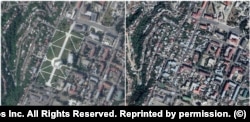
An August 2026 photo (left) shows Victory Park, a memorial that was carved through a suburb of Khankendi, the largest city in Nagorno-Karabakh. At the bottom right of the April 2020 photo, the circular footprint of the Holy Mother of God Cathedral in Khankendi can be seen. The Christian landmark was demolished by Azerbaijan in April 2026. Khankendi is known as Stepanakert by Armenians.
Almost the entire ethnic Armenian population of Nagorno-Karabakh fled to Armenia in September 2023 after Baku launched its military offensive, which brought the breakaway region under Azerbaijani control. Nagorno-Karabakh is internationally recognized as part of Azerbaijan but was populated by around 100,000 ethnic Armenians up until 2023.
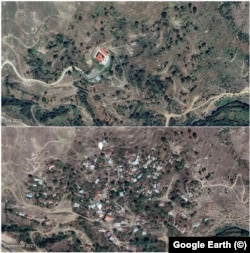
A mosque seen on the site of the erased village of Dasalti in July 2025. The village included a historic church and was home to several ethnic Armenian families before its recapture by Azerbaijani forces in 2020.
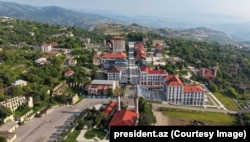
A reconstructed area of the town of Shusha in Nagorno-Karabakh, seen in an image released by Baku in July 2026.
In response to reports of Khankendi’s Holy Mother of God Cathedral being demolished in early 2026, Elnara Akimova, a member of the Azerbaijani parliament, told RFE/RL’s Azerbaijani Service that Baku “protects religious and historical monuments on its territory as a state policy, and has never intended to destroy religious heritage.”