

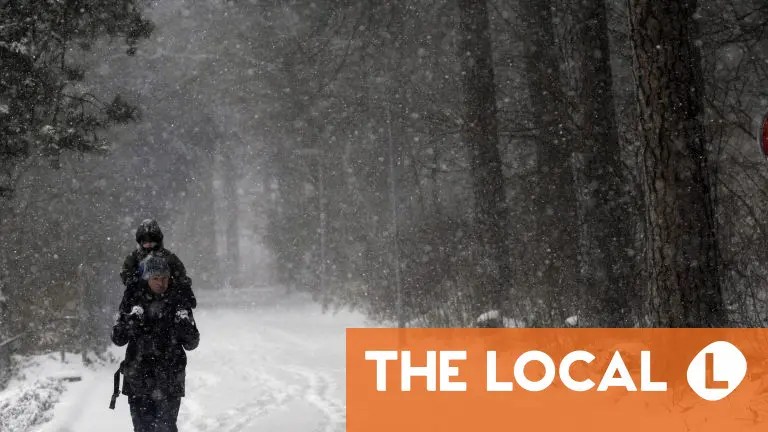

There has been talk of a “winter of the century” coming to Switzerland. But what do forecasters say in their early season predictions?
The concern around a cold winter is linked to an unusual change high above the North Pole: the polar vortex, a ring of powerful winds that normally helps keep the Arctic’s coldest air in the far north, has weakened unusually early this year.
When the vortex weakens or shifts, some of that cold air can move south, and it can also affect winds closer to the ground up to a week or two later. These changes can influence which air masses reach Europe: milder air from the Atlantic or colder air from the Arctic.
Don’t miss our journalists’ daily news roundup from Switzerland
The timing is unusual, as Britain’s Met Office says the vortex has weakened in November before but never this early in the month, Reuters reports, so scientists are still investigating why the vortex has weakened so early.
So should Switzerland prepare for weeks of freezing temperatures? Not necessarily.
A weakened polar vortex can raise the risk of colder weather, but it is not a winter forecast on its own, as other weather patterns can strengthen or counteract its effect.
The Reuters report also notes that roughly two-thirds of sudden stratospheric warming events, a more dramatic disturbance that can weaken the vortex, are followed by colder and drier conditions in northern and northwestern Europe.
That gives meteorologists a reason to watch the situation, not a two-in-three forecast that Switzerland will, in fact, have a cold winter.
The seasonal outlooks currently point in a different direction, as the Copernicus Climate Change Service forecasts a wetter-than-average winter across most of Europe, saying that above-average temperatures are more likely across much of the continent, though the outlook is less clear in the north-east.
For Switzerland, MeteoSwiss’s seasonal outlook gives a broad picture for December to February, rather than a day-to-day prediction, and Swiss authorities caution about forecasts’ limitations and reliability. After all, seasonal averages can hide big swings; a freezing spell in January would not necessarily contradict a relatively mild winter overall.
If the wetter pattern reaches Switzerland, the lowlands could get more grey, rainy days. But higher up, some of it could fall as snow if temperatures are low enough. While snowy weeks are still possible, there’s a higher chance of a relatively mild winter rather than a ‘deep freeze’.
So we should all be fine with a warm drink… for now.


