


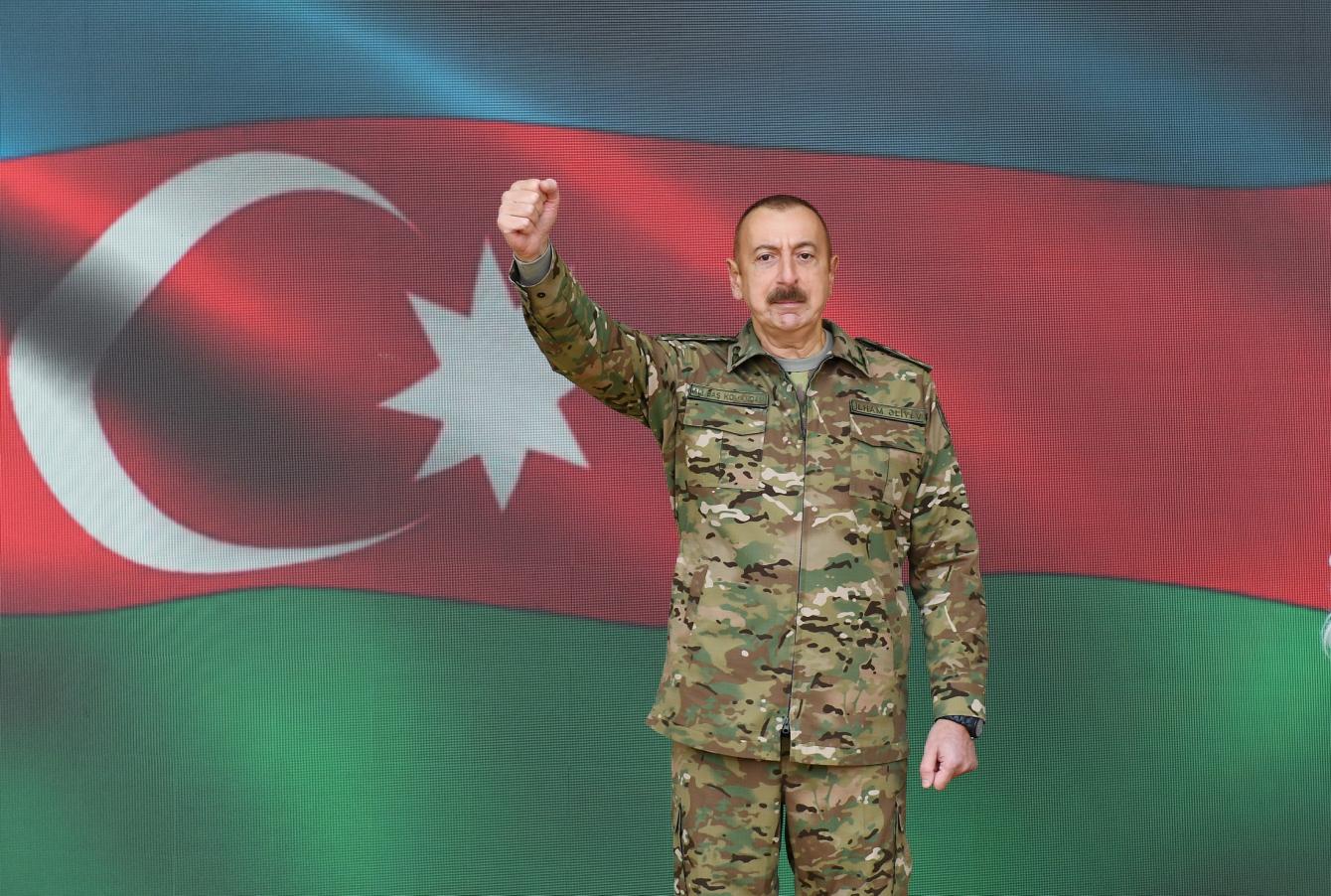
BAKU, Azerbaijan, November 8. Azerbaijan is
celebrating Victory Day. Six years ago, on November 8, 2020,
Supreme Commander-in-Chief and President of Azerbaijan Ilham Aliyev
announced the liberation of Shusha.
Today, it is clear that Azerbaijan did not simply win a war. It
brought to an end a conflict that had been considered insoluble for
30 years. As recently as 2019, Karabakh was cited as an example of
a problem with no solution in sight – and seemingly no prospect of
one in the future. President Ilham Aliyev, however, had a different
view.
To understand the scale of this achievement, one need only look
around the world. Cyprus has remained divided since 1974. The Annan
Plan, on which the international community spent years of work, was
rejected in a 2004 referendum, and the island has remained divided
by a demarcation line ever since. Transnistria has been frozen in
conflict since 1992, while Abkhazia and the Tskhinvali region have
remained unresolved since the early 1990s. The Minsk agreements on
Donbas were intended to provide a diplomatic solution but proved to
be little more than a pause before a major war. Serbia and Kosovo
signed agreements in Brussels and Washington but have yet to
establish normal relations. India and Pakistan have spent decades
fighting over Kashmir, periodically exchanging strikes, with
neither side able to secure victory or reach an agreement. Ethiopia
and Eritrea signed a peace deal in 2018, for which Ethiopia’s prime
minister received the Nobel Peace Prize, yet the region was plunged
into war again just two years later.
In all these cases, influential politicians, major powers, and
respected mediators were involved. Some relied on negotiations,
only to see them turn into an endless process without results.
Others relied on force, which brought temporary gains that could
not be consolidated. Almost no one managed to see the process
through to the end.
The Karabakh conflict required solving three distinct
challenges, each of which would, on its own, be considered a major
achievement in a political career.
The first was military. It was not enough simply to win the war;
it had to be won before the international community could intervene
and prevent the achievement of its objectives. The 44 days of
fighting in 2020 were the culmination of 17 years of preparation –
in the military, economic and diplomatic spheres, as well as in
relations with Türkiye, Russia, the West, and neighboring
countries. The war began when Azerbaijan was ready for it and ended
when its main objectives had been achieved. Knowing when to stop is
a skill no less rare than knowing how to win.
The second challenge was bringing the conflict to a definitive
end. After 2020, armed formations and a Russian peacekeeping
contingent remained in Karabakh. Many believed at the time that
this status quo would persist for years. The anti-terrorist
measures in September 2023 lasted less than a day, and by spring
2024, the peacekeepers had left Azerbaijani territory. The
country’s sovereignty was fully restored, with no gray areas or
“special arrangements” remaining.
The third challenge was diplomatic – and perhaps the most
difficult. Military victory almost always creates the conditions
for another conflict: the defeated side harbors resentment, seeks
revenge, and waits for circumstances to change. This was the case
with Germany after World War I and with dozens of other local
conflicts that followed. Ilham Aliyev did what victorious leaders
rarely do: he turned victory into a negotiating position, and that
negotiating position into peace. On August 8, 2025, the leaders of
Azerbaijan and Armenia signed a Joint Declaration at the White
House in the presence of the US President, while the two countries’
foreign ministers initialed a peace agreement. A year after the
Washington meeting, there is no gunfire along the border, and
discussions between Baku and Yerevan are focused on transport,
trade, and reopening communications.
The main lesson of Karabakh is not that force solves everything.
If that were true, many powerful countries would have resolved all
their outstanding conflicts long ago. The lesson is that force
works only when backed by a clear political objective and an
understanding of what comes next.
From the outset, Ilham Aliyev said that Azerbaijan wanted
neither someone else’s land nor endless hostility. It wanted its
own territory and peace on its own terms – in accordance with
international law and the principle of territorial integrity. This
position did not change during years of fruitless negotiations,
throughout the war, or in its aftermath. That is precisely why
victory did not turn into endless confrontation, and why peace does
not look like a temporary ceasefire.
Speaking at the World Forum on Intercultural Dialogue in Baku in
October, the President recalled that the Karabakh negotiation
format had initially been structured not to resolve the conflict
but to freeze it, and that major powers appeared to have accepted
this approach. They made one mistake: they failed to take into
account what the Azerbaijani people wanted and what the Azerbaijani
state was determined to achieve.
Today, the world is going through perhaps its most difficult
period since the Cold War. Conflicts that were considered
manageable for decades are once again turning into open
hostilities. Leaders are searching for formulas that would allow
them to end wars without creating new ones. In almost every case,
those formulas are proving elusive.
Against this backdrop, Azerbaijan’s path stands out as an
exception. In six years, the country has moved from war to the full
restoration of its sovereignty, and from there to peace recognized
in Washington, Brussels, Moscow, and Beijing. Many leaders have
faced and continue to face similar challenges: occupied
territories, fruitless negotiations, and indifference from
international institutions. Many have tried to resolve them through
force, while others have relied on diplomacy. Ilham Aliyev has
proved to be one of the very few leaders capable of combining the
two and seeing the process through to the end.
That is why November 8 is more than a day of remembrance and
pride. It is a day to recall that no conflict is frozen forever.
What is often lacking is the political will to unfreeze it and the
wisdom to build peace afterward. President Ilham Aliyev has shown
that both can come together in one leader.
Happy Victory Day!


