


A tragic accident that prompted a national soul-searching: Ursina Lardi and Kris Holden-Ried in a scene from ‘111: Echoes from Halifax’.
DCM Film
Cultural critic Alan Mattli reviews a new Swiss-Canadian drama that explores the human fallout of the Swissair Flight 111 disaster, reflecting on a tragedy that remains deeply embedded in Switzerland’s collective memory.
Ask any Swiss person over the age of 30 what the word Halifax makes them think of, and the answer will almost invariably be the same for all of them: “plane crash”.
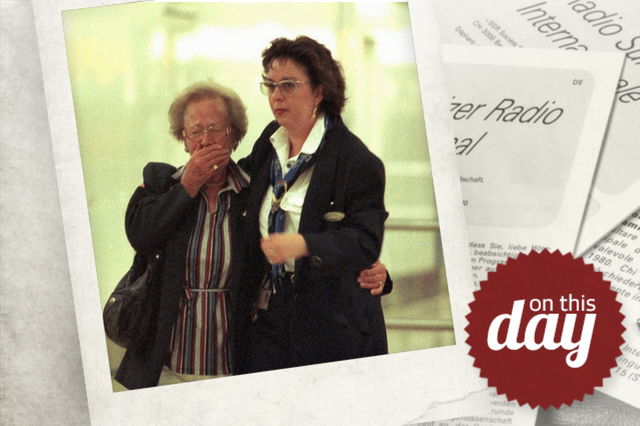
On the night of September 2, 1998, Swissair Flight 111 crashed into the waters of St. Margarets Bay, Nova Scotia, off the eastern coast of Canada, following a fire in the cockpit and a last-ditch attempt at an emergency landing in nearby Halifax. All 229 occupants of the plane, which had been en route from New York’s JFK airport to Geneva, lost their lives, most of them citizens of the United States, France and Switzerland.
In early October of this year, 111: Echoes from Halifax, a new Swiss-Canadian film based on the disaster opened in Swiss cinemas. It was directed and co-written by Swiss-Mexican filmmaker Mauro Mueller and tackles the scars the crash has left in the Swiss psyche.
External Content
Indeed, it’s hard to overstate the psychological impact the Flight 111 tragedy had within Switzerland. Reading and watching contemporary news reports, one encounters an atmosphere of shellshock. Journalists helplessly relay the maddening uncertainty over the exact reasons for the crash, raising questions about potential terrorist acts or structural faults with the MD-11-type aircraft.
TV anchors stumble over their words as they struggle to describe and contextualise the tragedy. Swissair officials respond to questions with prepared talking points and clipped one-word answers. Swiss government ministers gather for purely symbolic meetings; flags are flown at half-mast. In the days after the crash, images of passengers’ suitcases and other belongings floating in St. Margarets Bay flicker across Swiss television screens, searing themselves into the national consciousness.

Swiss-Mexican director Mauro Mueller has produced many acclaimed shorts and is a prolific producer and partner of New York-based production company Fidelio Films. ‘111: Echoes from Halifax’ is his third feature film.
Keystone / Michael Schmid
And again and again, there is darkly perplexed talk of Swissair’s reputation as one of the world’s safest, most reliable airlines – an unspoken sense of “it wasn’t supposed to happen to us” creeping in at the edges of the mediatised grief.
Now, of course, this particular refrain looks like ominous foreshadowing, a prologue to the troubled near future of aviation made in Switzerland.
Just three years after the Flight 111 crash, Swissair would slide into insolvency, its fleet would be grounded, and the airline would cease operations completely in the spring of 2002 – coincidentally the same year that, according to Swissair’s long-term planning, the controversial MD-11 aircraft was scheduled for decommissioning. If the end of Swissair had a beginning, dating it 2 September 1998 would not be a bad guess.
More

More
‘Swissair Souvenirs’
The tragic aftermath
On the surface, 111: Echoes from Halifax does not entertain any such notions. Co-produced by Swiss broadcaster SRF and marketed in Switzerland as a major prestige-cinema event, the film offers a fictionalised account of a handful of lives that are irreversibly changed by the Swissair 111 crash.
There is Carine (Ursina Lardi), a minor Swissair official, who is guilt-ridden after booking a workplace friend onto the doomed flight, and who then travels to Halifax as part of the airline’s on-the-ground support staff.
Once there, she meets and befriends an American surgeon named Saul (Kris Holden-Ried), whose son is among the victims, and whose marriage is pushed to breaking point by the two spouses’ incompatible ways of handling their grief. The third protagonist, whose path will cross those of Carine and Saul as well, is Geneva-based teenager Lou (Fathia Youssouf), whose mother dies in the crash, putting further strain on Lou’s already fraught relationship with her stepfather (Djebril Zonga).

Ursina Lardi in a scene from “111: Echoes from Halifax’. The Swiss actress has a strong presence in the German-speaking film scene, notably in Michael Haneke’s ‘The White Ribbon’, which won the Palme d’Or at Cannes Film Festival in 2009.
DCM Film
For reasons of narrative expedience, production budget, and, one would imagine, propriety in the face of real-life tragedy, the actual crash is respectfully sidelined. It is condensed into a visual metaphor-laden prologue and an oddly conceived epilogue, starring Swiss character-acting royalty Anatole Taubman as Flight 111 pilot Urs Zimmermann.
In lieu of disaster-movie spectacle, 111: Echoes from Halifax performs something of a dramatic tightrope walk, introducing and developing its characters alongside the aftermath of the crash but taking pains not to solely define them through it.
For Carine, the event becomes a vehicle through which to come to terms with her abusive, dementia-stricken husband’s impending death. For Saul, it is a way to work through the disappointment his late son’s life choices stirred in him; for Lou, a chance to accept both her stepfather and herself.
Mueller and co-writer Jennie Allen achieve their strongest results in the film’s opening third, where they mine the sheer horror of waking up to the news that a loved one has died in a horrific accident for some undeniably potent melodrama-tragedy.
As the film progresses, however, the emotional trajectories and directorial flourishes grow increasingly dubious. They move from a tonally misjudged mid-film dance sequence to a strangely clichéd third-act pivot to romance that appears to have been inspired by Blessed Stranger: After Flight 111, a television film that premiered on Canada’s CTV in October 2000, a mere two years after the crash.
External Content
Revisiting the last days of Swissair
Although the film is careful to not indulge in even the slightest hint of commentary regarding the future of Swissair, its very existence as a piece of cinematic entertainment is arguably predicated on the airline’s dramatic demise.
By dramatising a moment of aviation-related national mourning through emblematic small-scale stories of everyday Swiss people contending with the consequences of events outside of their control, 111: Echoes from Halifax seems, quite explicitly, to be hearkening back to one of the most successful moments in modern Swiss cinema – the 2006 release of Grounding: The Last Days of Swissair.
Co-directed by Tobias Fueter and popularist Swiss filmmaker extraordinaire Michael Steiner (Rascals on the Road, The Awakening of Motti Wolkenbruch), Grounding complements its behind-the-scenes chronology of Swissair’s collapse using this exact screenwriting formula.
Starring an all-star cast of Swiss name actors – including Hanspeter Müller-Drossaart, Gilles Tschudi, Pasquale Aleardi, Stefan Gubser, and Hans Heinz Moser – the movie cannily pitched itself to viewers as the Hollywood-like procedural thriller-drama treatment the fall of such a venerated national institution required.
External Content
Audiences proved extremely receptive to the pitch. The film sold over 377,000 tickets domestically, making it the eighth-most successful Swiss production since 1976. Grounding was neither Switzerland’s first modern blockbuster nor the first Swiss film to liberally borrow from the Hollywood toolkit.
But its attention-grabbing mixing of fictionalised character drama with national history and celebrity pantomime – Müller-Drossaart’s SAirGroup CEO Mario Corti and Tschudi’s UBS kingpin Marcel Ospel were the talk of the film-supplement town – makes it a significant point in the development of what could be termed an “international style” in Swiss cinema.
Twenty years on, 111: Echoes from Halifax very much operates under the influence of that style, though it remains to be seen whether it can match Grounding’s numbers, especially in the absence of a celebrity-pantomime aspect. For the time being, it is merely another testament of the enduring cultural legacy of the ill-fated Swissair brand.
More
More
The Swissair flight 111 crash: causes and consequences
Edited by Virginie Mangin/ds


