

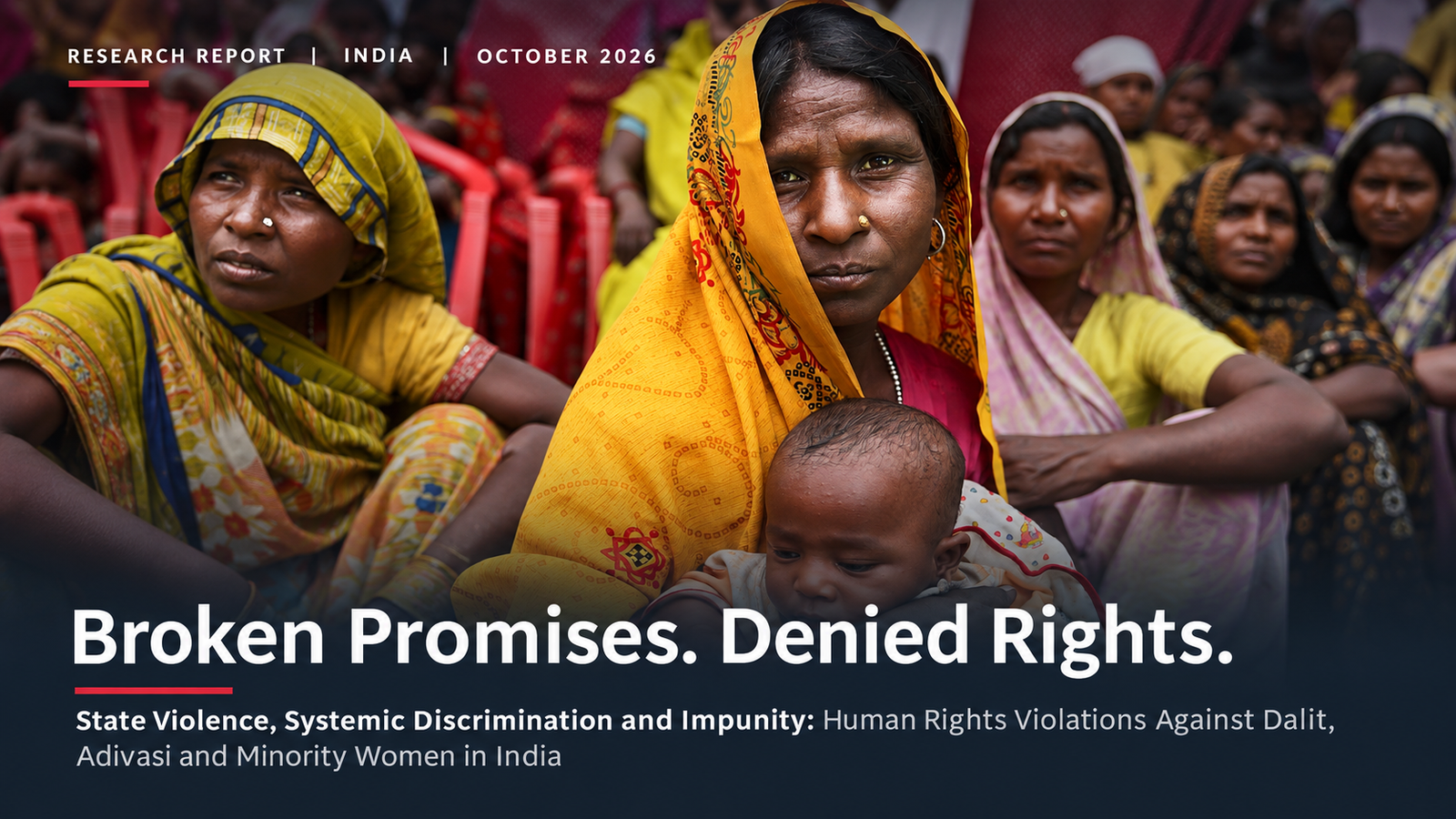
A comprehensive report by the Geneva Nations Institute raises serious concerns over caste-based violence, religious discrimination, institutional impunity and the continuing failure to protect Dalit, Adivasi and minority women in India, urging the United Nations and the international community to move from repeated expressions of concern to concrete action.
GENEVA | 4 November 2026 | The Geneva Times
GENEVA, Switzerland — Behind the statistics of violence, discrimination and judicial delay in India lies a deeply troubling human rights reality: women and girls belonging to marginalised communities continue to face significant obstacles in accessing justice, security and equal protection under the law.
A new research report prepared by the Geneva Nations Institute, titled Broken Promises. Denied Rights: State Violence, Systemic Discrimination and Impunity — Human Rights Violations Against Dalit, Adivasi and Minority Women in India, presents a detailed examination of these concerns, drawing on United Nations findings, judicial decisions, official statistics and investigations by international human rights organisations.
Published in October 2026, the 34-page report examines patterns of gender-based violence, institutional discrimination and alleged abuses involving state authorities, while questioning whether India’s domestic and international human rights commitments have translated into meaningful protection for its most vulnerable communities.
The report’s central argument is that the persistence of abuses cannot be understood solely as a series of isolated incidents. Rather, it identifies recurring institutional failures that have allowed discrimination, violence and impunity to continue despite repeated recommendations from international human rights mechanisms.
A Disturbing Pattern of Violence and Inequality
One of the report’s most significant findings concerns violence against Dalit and Adivasi women, whose experiences frequently reflect the intersection of caste, gender, economic disadvantage and social exclusion.
Citing an analysis of India’s National Crime Records Bureau data by Dalit rights organisations, the report states that an average of 12 Dalit women and girls and three Adivasi women and girls were raped each day during the 2019–2023 period.
It further highlights that 4,262 cases of rape involving Dalit women and girls were recorded in 2024, raising serious questions about the effectiveness of preventive measures and access to justice.
These figures, however, represent reported cases rather than the full extent of violence.
The United Nations Human Rights Committee, in its 2024 concluding observations on India, expressed concern over widespread violence against women and girls, particularly those belonging to Indigenous, minority and lower-caste communities.
The Geneva Nations Institute report argues that the combination of social vulnerability, inadequate protection and institutional barriers creates an environment in which survivors may face not only the consequences of violence but also significant obstacles when seeking legal remedies.
When Justice Becomes Another Struggle
Perhaps the most troubling dimension of the research is its examination of the justice system itself.
According to figures presented in the report, approximately 93.3% of rape cases involving Scheduled Caste victims were pending trial in 2024, while the conviction rate for completed trials stood at 29.8%.
The report also highlights documented instances of delayed police investigations, failures to register complaints, pressure on survivors and difficulties accessing legal assistance.
These findings raise a fundamental question concerning the responsibility of state institutions: What happens when the systems established to protect victims become obstacles to obtaining justice?
The report examines the 2020 Hathras case in Uttar Pradesh, in which the death of a young Dalit woman and the subsequent handling of her body generated widespread public outrage and concerns over institutional accountability.
It also revisits the case of Bilkis Bano, a survivor of sexual violence during the 2002 Gujarat communal violence, whose pursuit of justice continued for more than two decades.
In January 2024, India’s Supreme Court overturned the Gujarat government’s decision to grant remission to 11 men convicted in her case.
While the Supreme Court’s intervention demonstrated the capacity of the judiciary to correct an unlawful decision, the report identifies the earlier release as an example of the institutional decisions that can compound the suffering of survivors.
Minority Women at the Intersection of Multiple Forms of Discrimination
Beyond caste-based violence, the research examines the experiences of women belonging to Muslim, Christian and Sikh minority communities.
It addresses concerns involving religious discrimination, hate speech, barriers to education, citizenship-related insecurity, housing demolitions and restrictions affecting religious identity.
Particular attention is given to the effects of citizenship policies in Assam and their potential implications for women and children from vulnerable communities.
The report also discusses restrictions affecting Muslim girls’ access to education, including controversies surrounding the wearing of the hijab in educational institutions.
For the researchers, these examples demonstrate how discrimination based on religion, gender and socioeconomic circumstances can intersect, producing consequences that extend beyond individual incidents.
Access to education, secure housing, healthcare, legal recognition and political participation are presented as interconnected dimensions of women’s fundamental rights.
Manipur and Kashmir: The Human Cost of Conflict and Impunity
The report devotes substantial attention to alleged human rights violations in conflict-affected regions, particularly Manipur and Jammu and Kashmir.
In Manipur, it examines the sexual violence committed against women during the ethnic unrest that erupted in 2023, including the widely reported assault on two Kuki-Zo women.
United Nations experts previously expressed grave concern about reports of gender-based violence and what they described as an inadequate response by Indian authorities.
The report also discusses allegations concerning the conduct of police personnel. These must be distinguished from judicially established findings, particularly where criminal proceedings remain pending.
In Jammu and Kashmir, the research addresses allegations of sexual violence, enforced disappearances and the long-standing difficulties faced by women seeking accountability for the disappearance of family members.
It highlights the situation of so-called half-widows — women whose husbands have disappeared but whose deaths have never been legally established — and the resulting challenges concerning inheritance, financial support and legal recognition.
The report additionally revisits documented cases of injuries suffered by children from pellet-firing shotguns, including girls whose lives were permanently affected.
Together, these accounts illustrate the disproportionate consequences that conflict, insecurity and institutional impunity can impose upon women and children.
International Human Rights Obligations Under Scrutiny
India is a party to several major international human rights treaties, including the International Covenant on Civil and Political Rights, the International Covenant on Economic, Social and Cultural Rights, and the Convention on the Elimination of All Forms of Discrimination against Women.
The Geneva Nations Institute report argues that the central challenge lies not simply in the existence of legal commitments but in their implementation.
It draws attention to recommendations issued over many years by the UN Human Rights Committee, the Committee on the Elimination of Racial Discrimination and the Committee on the Elimination of Discrimination against Women.
The researchers contend that recurring findings across different UN mechanisms point to an enduring gap between international obligations and conditions experienced by marginalised women.
The report also references developments reported during 2026, including concerns surrounding voter registration, citizenship procedures, religious discrimination and allegations of abuses during protest-related detentions.
While these issues require careful examination of their individual legal and factual circumstances, the research presents them as part of a broader concern over equality, public accountability and effective access to fundamental rights.
A Call for Independent Investigation and International Engagement
Rather than limiting its conclusions to documentation, the report puts forward 22 recommendations addressed to the United Nations, national governments, international institutions and Indian authorities.
Among its principal proposals are:
- Greater engagement by relevant United Nations Special Rapporteurs and independent human rights mechanisms.
- Independent investigations into allegations of serious sexual violence and abuses in conflict-affected areas.
- Stronger accountability mechanisms for police and security personnel implicated in human rights violations.
- Improved legal protection, witness support and timely compensation for survivors.
- Effective implementation of international human rights recommendations through measurable commitments and follow-up procedures.
- Greater transparency in official statistics concerning violence, discrimination, citizenship and access to justice.
The report calls upon the Human Rights Council and other relevant UN mechanisms to strengthen monitoring and maintain sustained attention to violations affecting marginalised women.
It also urges Indian authorities to address institutional weaknesses while ensuring that victims can access independent investigations and effective legal remedies.
The recommendations reflect a wider debate within international human rights institutions over how to translate monitoring, reporting and diplomatic engagement into measurable improvements in the lives of affected communities.
From International Commitments to Human Dignity
The research brings together evidence published between 2007 and 2026, drawing upon UN treaty-body observations, official data, judicial records and investigations by civil society organisations.
Its principal contribution lies in connecting these sources within a single framework examining the relationship between discrimination, state responsibility and access to justice.
Importantly, the report is an independent research publication prepared by the Geneva Nations Institute, rather than an official investigation or determination by the United Nations. Its conclusions and recommendations should therefore be understood in that context, even where they draw upon findings issued by UN bodies.
Nevertheless, the concerns it addresses are of considerable relevance to the international human rights community.
India’s constitutional framework guarantees equality and prohibits discrimination, while its international treaty commitments establish obligations concerning the protection of fundamental rights.
The question raised by the report is whether these protections are being experienced equally by those who need them most.
Beyond Statistics: A Test of International Accountability
For the international community, the significance of Broken Promises. Denied Rights extends beyond the situation of any single country.
It raises a wider question concerning the credibility of international human rights protection: whether documented violations and repeated institutional recommendations ultimately lead to accountability, reform and meaningful remedies.
The report underscores that meaningful human rights protection requires more than constitutional guarantees, international declarations or periodic diplomatic discussions.
It requires effective institutions, independent investigations, accessible justice and a commitment to ensuring that no individual is excluded from protection because of caste, religion, ethnicity or gender.
Ultimately, the Geneva Nations Institute’s research delivers a message that resonates far beyond India’s borders.
The measure of a society’s commitment to human rights is not simply the promises contained in its laws, but the protection and justice experienced by its most vulnerable people.
For the women and girls whose experiences are documented in this report, the demand is neither extraordinary nor negotiable: dignity, equality, security and justice.
And for the international community, the challenge is equally clear — ensuring that repeated warnings are followed by meaningful action.
About the Research
Broken Promises. Denied Rights: State Violence, Systemic Discrimination and Impunity — Human Rights Violations Against Dalit, Adivasi and Minority Women in India is a research report prepared by the Geneva Nations Institute, Geneva, Switzerland, in October 2026.
Source: Geneva Nations Institute, Broken Promises. Denied Rights, October 2026.
Editorial note: This article is based on the findings and recommendations of the research report. Allegations, statistical analyses and institutional conclusions are attributed to their respective sources as presented in the publication. The Geneva Nations Institute is the organisation responsible for preparing the report.

