

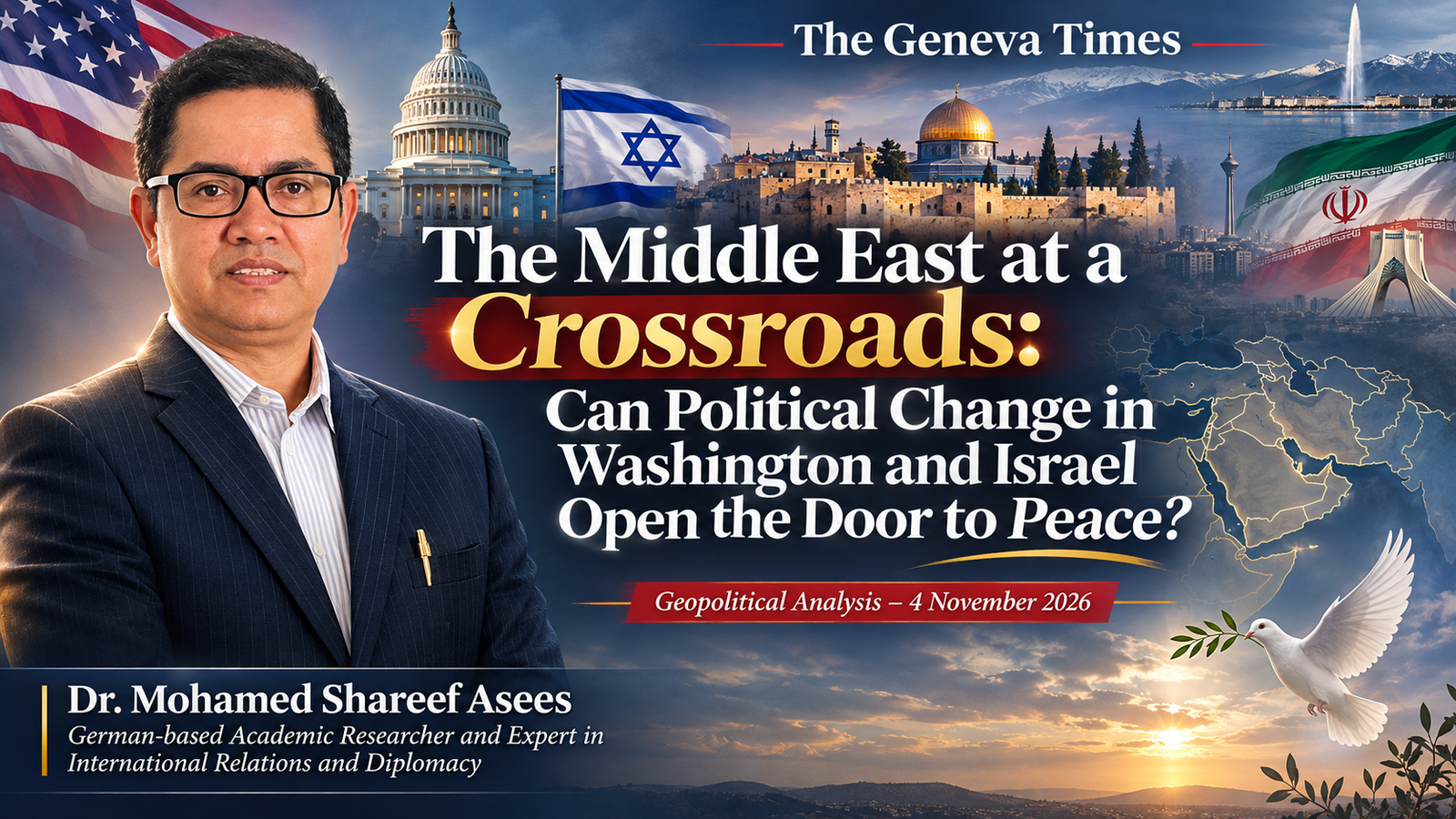
Dr. Mohamed Shareef Asees – German-based Academic Researcher and Expert in International Relations and Diplomacy
The international political landscape is entering a critical moment. From Washington to Jerusalem, recent electoral developments are raising questions about the future of the confrontation involving Iran, the United States and Israel. Meanwhile, growing public dissatisfaction across Europe and the economic consequences of regional instability are adding pressure on governments to reconsider their policies. Could these developments create an opportunity for peace, or is the Middle East heading towards another phase of confrontation?
Political uncertainty in Israel and Washington
Israel’s parliamentary elections on 27 October have produced an uncertain outcome for Prime Minister Benjamin Netanyahu. His political bloc secured 53 of the 120 seats in the Knesset, falling eight seats short of the majority required to form a government. The opposition secured 48 seats, while the remaining 19 went to Arab-led parties. Neither major political bloc has an immediate path to a parliamentary majority, making coalition negotiations particularly complicated.
Netanyahu’s political future is therefore uncertain. More importantly, the composition of Israel’s next government could influence its approach towards Iran and its relationship with Washington. Nevertheless, a change of leadership would not necessarily mean a fundamental shift in Israeli security policy.
Across the Atlantic, the American midterm elections of 3 November have delivered another significant development. Democrats have won control of both chambers of Congress, representing a major setback for President Donald Trump. The result reflects growing dissatisfaction among sections of the electorate over economic conditions, the cost of living and the administration’s handling of the war with Iran.
Although Trump retains considerable authority over foreign and military policy, a Democratic-controlled Congress will have greater opportunities to scrutinize his administration, influence budget negotiations and challenge its legislative priorities. The political costs of continuing an expensive and prolonged conflict could consequently become more difficult for the White House to ignore.
Iran: Is diplomacy becoming a strategic necessity?
The most important question is what these political developments mean for the confrontation between Iran, the United States and Israel.
The conflict has demonstrated that military superiority alone cannot resolve the underlying political and security disagreements. Iran’s nuclear programme, American sanctions, regional security arrangements and the future of the Strait of Hormuz remain central issues.
Developments on 4 November suggest that the possibility of further escalation remains real. Tehran has warned that it is preparing a stronger deterrence response in the event of another American attack. At the same time, the political consequences of the war in the United States have become increasingly visible, with Trump himself acknowledging the conflict as one factor behind Republican electoral losses.
This creates a complicated strategic situation. Washington faces domestic pressure to reconsider the costs of military confrontation, while Tehran continues to emphasize its security requirements. Netanyahu’s uncertain political position adds another variable to the equation.
Diplomacy remains possible, but a sustainable agreement would require compromises on nuclear restrictions, sanctions, maritime security and regional stability. Neither electoral developments nor domestic political pressure alone can guarantee such an outcome.
Europe: The domestic price of geopolitical confrontation
The consequences of the Middle East crisis are also being felt far beyond the region. Recent demonstrations across Germany, France, Italy, Spain and other European countries reflect growing dissatisfaction with living costs, housing shortages, public services and increasing military expenditure.
Although these protests are not exclusively directed against the war, they reveal a broader political challenge: European governments are under pressure to balance security commitments with domestic economic and social priorities.
For European citizens, international conflicts are no longer distant foreign-policy questions. Their consequences are reflected in energy costs, inflation, economic uncertainty and government spending priorities. If regional instability continues, European governments may face stronger public demands to support diplomatic initiatives and avoid further military escalation.
Oil prices and the economic argument for peace
Perhaps nowhere are the consequences of the conflict more visible than in international energy markets. The Strait of Hormuz remains a strategic artery for global oil supplies, and disruptions to maritime traffic threaten energy security and international trade.
On 3 November, Brent crude settled at approximately $103.60 per barrel, with markets responding to both military concerns and hopes for diplomatic progress. A lasting agreement between Iran and the United States, accompanied by the restoration of normal shipping through the Strait, could help reduce oil prices and ease inflationary pressures.
However, peace would not automatically translate into cheaper energy. The restoration of supply chains, market confidence and regional security would all influence the speed and extent of any reduction. For European economies and energy-importing countries across Asia, a sustainable settlement would therefore offer benefits extending well beyond the Middle East.
A turning point or another missed opportunity?
The developments of November 2026 reveal an increasingly important reality: the political and economic costs of the Middle East conflict are spreading across national borders.
Netanyahu faces an uncertain political future, Trump must contend with a newly strengthened congressional opposition, Iran continues to defend its security interests, and European governments face growing public pressure over the consequences of international instability.
These circumstances could create an opportunity for a new diplomatic approach. Yet political uncertainty does not necessarily produce political compromise, and domestic pressure does not automatically translate into a willingness to negotiate.
The coming months will test whether the principal actors are prepared to move beyond military confrontation and address the underlying security and economic disagreements.
Ultimately, the question is not simply which political leader or government emerges stronger from these developments. It is whether the international community can transform this moment of political uncertainty into a genuine opportunity for regional stability.
References and further reading
1. Reuters (3–4 November 2026). US midterms 2026: Democrats capture Congress. Election results and implications for President Trump’s remaining two years. Read Reuters report.
2. Al Jazeera (3 November 2026). Israel political deadlock leaves Netanyahu’s future hanging in the balance. Analysis of the election results and coalition negotiations. Read the report.
3. Al Jazeera (4 November 2026). Iran war live: Tehran prepares ‘maximum deterrence’ plan for any new attack. Latest developments in the Iran conflict. Read the live coverage.
4. The Guardian (31 October 2026). Cost of living protests to spread to Germany and reignite in France on Halloween. European demonstrations and public dissatisfaction. Read the report.
5. The Wall Street Journal (4 November 2026). Oil Futures Turn Lower as Market Holds Out Hope for Middle East Diplomacy. Oil market developments and the impact of diplomatic expectations. Read the report.
6. Congressional Research Service (30 October 2026). Israel: 2026 Elections and Government Formation. Background on the Israeli parliamentary election. Read the research report.


