


From rural internet connectivity to artificial intelligence and cross-border digital infrastructure, Kazakhstan’s experience offers practical lessons for international digital development.
Digital transformation is often measured by the adoption of artificial intelligence, new government platforms and advanced infrastructure. But for many countries, the most pressing questions are more basic: how can remote communities be connected, how can public institutions share data effectively, and how can digital networks remain reliable as demand grows?
For countries spanning vast territories with uneven population density, these challenges are particularly acute. Kazakhstan offers a case study with relevance beyond its borders. Over the past decade, it has expanded digital government services, invested in rural connectivity and developed capacity for data processing and artificial intelligence.
The international significance of these efforts lies not in presenting Kazakhstan as a universal model, but in identifying technologies, implementation lessons and policy approaches that other countries might adapt to their own circumstances.
Bridging the digital divide beyond major cities
Connecting sparsely populated regions is considerably more complex than expanding services in major urban centres. Kazakhstan’s rural broadband programme illustrates both the scale of the challenge and the need for multiple technologies.
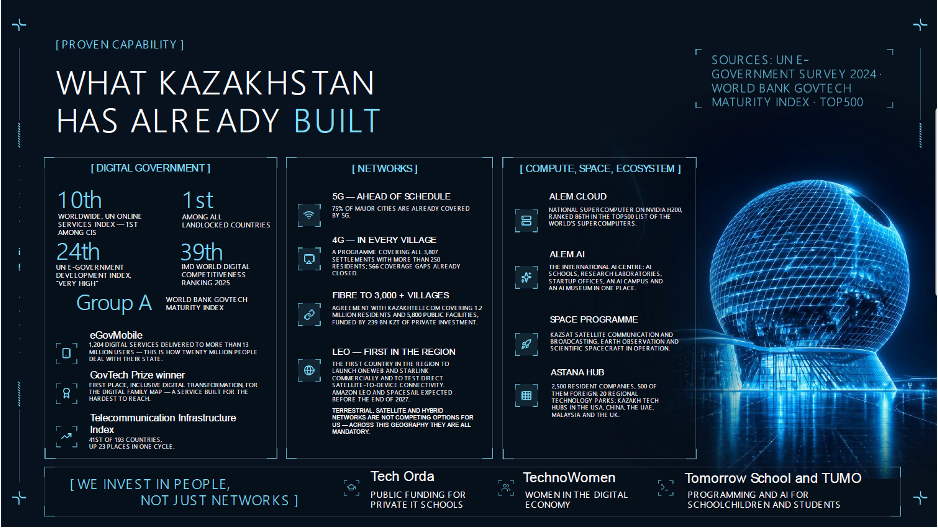
The Kazakh government has reported plans to connect more than 3,000 rural settlements and achieve 99% high-speed internet availability across villages by the end of 2027. Its approach combines fibre-optic networks with satellite connectivity for harder-to-reach communities.
Yet meaningful connectivity extends beyond whether a settlement has an internet connection. The International Telecommunication Union (ITU) assesses factors including availability, service quality, affordability, devices, digital skills and security. Each can determine whether an internet connection delivers tangible benefits.
For governments facing similar geographical challenges, the relevant questions concern the appropriate mix of fibre, mobile and satellite technologies; sustainable financing in low-density areas; and indicators that show whether digital access actually improves education, healthcare and public services.
The strongest basis for international cooperation is therefore evidence about implementation and measurable outcomes—not simply the replication of infrastructure projects.
How Kazakhstan’s GovTech experience can travel
Digital government offers a second avenue for regional cooperation: making national technologies understandable and reusable beyond the country in which they were developed.
In September 2026, the ITU reported that technical specifications for an Analytics Building Block based on Kazakhstan’s Smart Data Ukimet had been included in its Global Repository through the GovStack approach. The work includes technical specifications and a country case, and has been discussed in consultations involving Kyrgyzstan and Tajikistan.

Smart Data Ukimet is designed to integrate and analyse information from government systems. According to the ITU, its architecture supports data integration, real-time collection and analysis to inform public-sector decisions.
The wider significance is the process of documentation. A platform operating only within one national administration may have limited transferability. When its architecture, use cases, technical specifications and implementation experience are made available as reusable components, other governments gain a practical starting point for developing their own solutions.
That is central to the GovStack approach: interoperable building blocks can be adapted to national requirements rather than recreated from scratch. However, data-protection legislation, cybersecurity standards, procurement procedures and administrative systems still require careful local adaptation.
New digital routes across the Caspian
Kazakhstan’s geography also gives its digital infrastructure a regional dimension. As Central Asian economies become increasingly dependent on cloud computing, digital trade and cross-border data flows, the resilience of international connections becomes a strategic concern.
In October 2026, Kazakhstan and Azerbaijan launched a submarine fibre-optic connection across the Caspian Sea, providing an additional link between Kazakhstan and digital infrastructure in the South Caucasus. Kazakhstan has also been developing east–west fibre routes and additional international interconnection capacity.
More routes can reduce reliance on a limited number of corridors, but resilience is not guaranteed by cables alone. Interconnection agreements, traffic management, redundancy and the ability to redirect data during outages are equally important.
These considerations make submarine and terrestrial fibre networks, satellite communications and cross-border interconnection matters of regional cooperation as well as national infrastructure policy.
Building the computing capacity behind AI
Connectivity is only one element of the digital economy. Artificial intelligence, scientific research and large-scale data analysis also require substantial computing capacity.
Kazakhstan has begun investing in domestic high-performance computing. The country’s Ministry of Artificial Intelligence and Digital Development reported that its Alem.Cloud supercomputer ranked 86th in the TOP500 list and is intended to support AI, high-performance computing and big-data applications.
For countries seeking to build AI ecosystems, access to computational resources can influence research, education, government services and private innovation. Such infrastructure also creates substantial demands for capital, energy, expertise and ongoing operations.
The key question is therefore not only how much computing capacity a country builds, but who can access it, how effectively it is used and whether it is economically sustainable.
Digital inclusion must remain central
Advanced networks and AI-enabled services are not inherently inclusive. Digital public services can reduce administrative barriers, but only when people have the devices, skills, accessibility support and affordable connections needed to use them.
The ITU’s framework for universal and meaningful connectivity recognises this broader understanding of access. In AI-enabled public services, accessibility, digital literacy, data quality, responsible data use and appropriate safeguards are especially important.
Technology alone cannot ensure better public outcomes. The effectiveness of AI and digital-government systems also depends on institutional design, governance and the quality of underlying data. Kazakhstan’s expanding digital ecosystem provides a practical setting in which these questions can be examined.
From national investment to international cooperation
The examples from Kazakhstan point to three practical areas for cooperation through existing international institutions and mechanisms.
First, governments can exchange GovTech knowledge by documenting architectures, technical requirements, use cases and implementation lessons in reusable formats. Smart Data Ukimet illustrates how a national platform can contribute to a wider technical ecosystem without implying that every country should adopt the same system.
Second, rural connectivity programmes can be compared on financing, technology selection, service quality and social outcomes. Countries with dispersed populations may benefit more from detailed deployment experience than from broad policy declarations.
Third, the emergence of AI in citizen-facing services creates opportunities to exchange expertise on accessibility, digital skills, responsible use of data and methods for measuring real public benefits. Existing ITU initiatives offer potential channels for such discussions, without creating competing institutional structures.
A regional case with global lessons
No single country can provide a universal blueprint for digital transformation. Geography, public institutions, regulatory frameworks, population density and financial resources shape what is possible in each national context.
Kazakhstan’s experience is nevertheless relevant because it demonstrates how distinct elements of digital policy intersect: rural connectivity, reusable government technology, international network resilience and high-performance computing. The challenge now is to translate implementation into evidence and expertise that others can examine, test and improve.
For the ITU and its member states, this may be the most valuable form of digital cooperation. Instead of searching for a single model to reproduce, countries can draw on documented experiences to inform their own decisions.
Kazakhstan’s contribution to this wider conversation is therefore not simply the infrastructure it is building, but the practical knowledge that its transformation may make available across Central Asia and beyond.


