


An image from a thermal camera showing people in Bern on July 30, 2026. Blue indicates the lowest temperatures, red the highest, and white indicates the maximum temperatures.
Keystone / Gaetan Bally
Following Switzerland’s hottest summer on record, the government has unveiled a new strategy to help the country cope with rising heat and drought in future. Environmental groups, city authorities and politicians say the plan falls short.

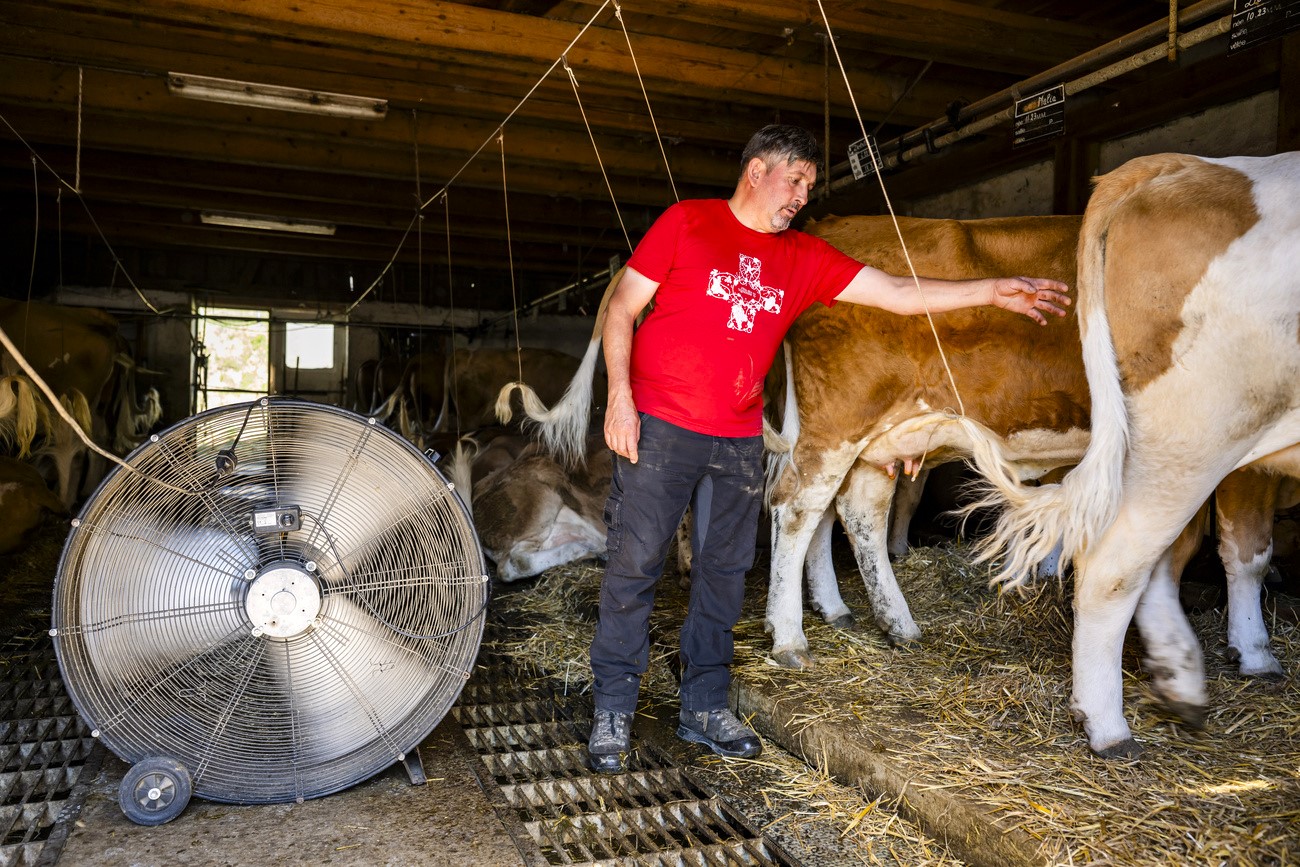
Summer 2026 will be remembered for successive heatwaves, record temperatures, melting glaciers, tropical nights, exceptionally low water levels and prolonged drought. The impacts were felt across agriculture, forestry, the economy and public health – around 600 people are thought to have died due to the heatwaves.
“It was extreme,” MeteoSwiss Director Stefan Uhlenbrook told a climate conference in Bern on Thursday. The summer offered a glimpse of a much warmer future, he warned. “We are probably moving towards a world that is 3°C warmer [above pre-industrial temperatures], and the climate scenarios will be even hotter.”
During the summer, Environment Minister Albert Rösti came under pressureExternal link over the government’s handling of the crisis.
On Wednesday, the government presented its updated climate adaptation strategyExternal link, a 92-page plan for the 2026-2031 period. It sets out 56 measures across 30 areas of action aimed at reducing climate risks and helping society, the economy and ecosystems adapt. It replaces a strategy adopted in 2012.
The plan focuses heavily on coordination and information-sharing. Measures include more precise early-warning systems, standardised heat maps for spatial planning, and support for cooling and greening projects in towns and cities.
The strategy is based on the Federal Office for the Environment’s 2025 climate risk analysisExternal link and climate scenarios developed by MeteoSwiss and the federal technology institute ETH Zurich. Its main priorities are protecting people from heat and improving drought management.
In August, the government announced a CHF70 million ($84.5 million) emergency package to help forests and farmers cope with climate change. Rösti highlighted the fact that a further assessment would be carried out by the end of October, with additional measures introduced if required.
More

More
Switzerland feels cost of record summer heat
Monitoring heat risks
Under the new strategy, the Federal Office of Public Health will establish a centre of expertise on heat- and climate-related health risks. This centre will coordinate stakeholders, develop a health monitoring system and improve the recording of heat-related deaths and hospital admissions.
The government also plans to seek agreement with employers and unions on minimum health and safety requirements for construction workers during heatwaves after earlier talks failed to produce a deal.
Additional funding will support research on animal health and food safety. Switzerland’s drought platform, launched in 2025, will be expanded to better monitor the economic impacts of water shortages. In addition, MeteoSwiss will develop new national heat maps and extreme weather scenarios.
The number of adaption measures has been reduced from 75 to 56 through the consolidation of existing programmes. Among them is Adapt+,External link a federal funding scheme launched in 2025 to support projects to reduce climate risks and strengthen resilience. The government says it intends to expand the programme following this year’s extreme summer.
Critics say plan lacks ambition
Environmental groups welcomed the strategy in principle but argued that it relies too heavily on existing initiatives and does not match the scale of the threat.
“The Federal Council’s plan contains hardly any measures that were not already mentioned in earlier strategies and/or are not already being implemented at local and cantonal level,” Nathan Solothurnmann, a climate expert with Greenpeace Switzerland, told Swissinfo.
He said the government remained too cautious on emissions reductions and relied excessively on voluntary measures. Greenpeace also argues the strategy lacks a long-term vision for agriculture, warning that future climate conditions may require more fundamental changes to food production and livestock farming.
Solothurnmann also criticised the government’s assessment of risks to the energy sector.
More

More
Why Switzerland is still not ready to face heatwaves
Patrick Hofstetter of WWF said this summer’s extreme weather showed Switzerland’s capacity to respond was already being stretched and that much of the burden of adaptation fell on cantons, municipalities, businesses and households.
“The adaptation strategy does not adequately address the challenges,” he told Swissinfo. “Without tackling the root causes – namely, reducing CO₂ concentrations in the atmosphere through massive emissions cuts in Switzerland and globally – the limits of adaptation are clear.”
WWF says drought remains an underappreciated risk and is calling for greater investment in river restoration and stricter implementation of water protection laws. The organisation argues that nature-based solutions can both strengthen climate resilience and absorb carbon dioxide.
More
Opinion

More
What Switzerland needs to learn from earlier and longer heatwaves
The Swiss Cities Association also welcomed the strategy but said municipalities, which are on the frontline of heatwaves, must play a bigger role in implementation.
“It is now essential that the Federal Council swiftly makes available the human and financial resources required to implement the planned measures, and that cities are involved from the outset,” spokesperson Benjamin Fröhlich told Swissinfo.
Politicians voice reservations
Christian Wasserfallen of the centre-right Radical-Liberal Party insists that key problems exposed during the summer remain unresolved, particularly in the construction sector. He told the Tages-Anzeiger that practical measures such as earlier working hours during heatwaves and greater flexibility when projects are delayed by extreme weather were needed.
Gabriela Suter of the centre-left Social Democratic Party welcomed measures on heat and drought monitoring but criticised the lack of binding requirements. “The level of protection afforded to older people and others particularly at risk from extreme heat must not depend on where they live. That is why we need binding heat action plans in all cantons,” she told the Tages-Anzeiger. “The next heatwave won’t wait for the federal government’s findings.”
In a statement, the Green Party accused the government of offering “little that is new”. It urged it to accelerate the phase-out of fossil fuels, arguing that delays make climate adaptation more difficult and more expensive.
More
More
Switzerland’s record-breaking summer by numbers
Edited by Reto Gysi von Wartburg/ts


