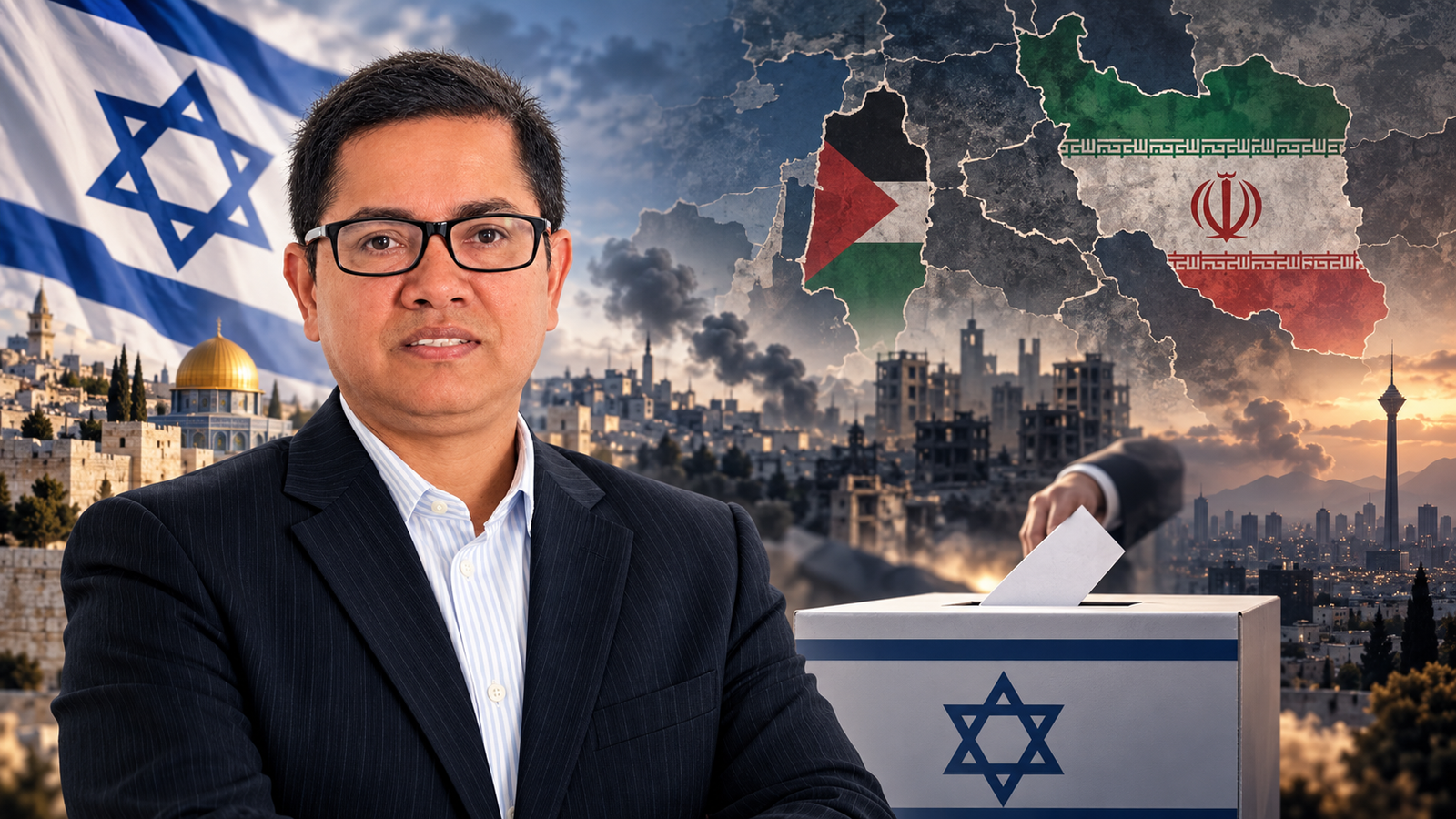
As Israelis go to the polls, the key question is whether a change of leadership can bring a genuine change in policy.
Mohamed Shareef Asees: PhD in Global Studies; MA in International Relations; BA in Political Science. Researcher and Lecturer in International Relations, Geopolitics, and Peacebuilding, based in Berlin, Germany.
Israel votes today, 27 October 2026, in an election that could reshape its political future. For Prime Minister Benjamin Netanyahu, the contest is a test of political survival after years of war, domestic division and international criticism. For his challenger, former military chief Gadi Eisenkot, it is an opportunity to promise a different style of leadership and restore confidence in Israel’s institutions and international standing.
But a change of government should not automatically be mistaken for a change of direction. The crucial question is whether this election will alter the policies sustaining conflict with the Palestinians and confrontation with Iran—or simply replace one leader with another pursuing similar objectives by different means.
A change of leader, not necessarily of policy
Netanyahu has built his political identity around national security, military strength and resistance to threats he considers existential. Supporters see him as experienced and determined; critics argue that his approach has deepened Israel’s isolation while offering Palestinians no credible political future.
Eisenkot represents an alternative to Netanyahu’s leadership, but not necessarily to his security doctrine. A former chief of staff of the Israel Defense Forces, he is also a security hawk who regards preventing Iran from acquiring nuclear weapons as a strategic priority. He has maintained a hard line on Hamas and the future of Gaza.
The differences between the two men still matter. Eisenkot could offer a less confrontational political style, improve relations with Israel’s allies and reduce the influence of far-right parties. Yet these changes would not automatically amount to a new regional strategy. Israel’s voters may choose a different prime minister without choosing a fundamentally different approach to conflict.
Palestine: the missing political horizon
The Palestinian question is the clearest test of whether this election represents a genuine turning point. Netanyahu has governed alongside political forces that support settlement expansion and reject Palestinian statehood. Eisenkot has criticized settler violence and opposed the most extreme elements of Netanyahu’s coalition. Such differences could have practical consequences for Palestinians living under occupation in the West Bank.
But a deeper problem remains: neither leader has offered a clear commitment to establishing an independent Palestinian state. Both take a hard line on Hamas and have argued that Israeli forces should not withdraw from Gaza before Hamas is disarmed.
A new government could restrain settlement expansion, improve relations with foreign governments and adopt a more diplomatic tone. Yet without a credible path to Palestinian self-determination, the underlying conflict would remain unresolved.
Israelis have legitimate security concerns. Palestinians have equally legitimate claims to freedom, dignity and national self-determination. Addressing one side’s fears while indefinitely postponing the other side’s rights is unlikely to produce lasting stability. Security cannot be separated from politics forever.
Iran: confrontation beyond the ballot box
The same dilemma applies to Iran. Netanyahu has made countering Iran a defining feature of his leadership, portraying its nuclear programme and regional influence as major threats to Israel. His government has supported military action to weaken those threats.
Eisenkot also regards preventing Iran from acquiring nuclear weapons as essential. The distinction lies partly in how that objective should be pursued: military pressure, diplomacy backed by the United States, or some combination of both.
That difference matters. Diplomacy could reduce the risk of a wider regional war, while further military escalation could deepen instability and provoke retaliation. But both leaders start from a similar strategic premise: Iran’s nuclear ambitions must be prevented.
Israel’s election will not, by itself, resolve the confrontation. Any lasting change will depend on decisions by Israel, Iran and the United States. It will also require an honest assessment of whether military force can deliver the security its advocates promise—or whether repeated attacks and retaliation simply perpetuate the conflict.
The power of the coalition
Israel’s parliamentary system provides another reason to look beyond the candidates. The composition of the next governing coalition will help determine what policies are possible.
Even if Netanyahu loses ground or Eisenkot emerges as a leading political figure, neither outcome guarantees a government capable of changing course. Coalition partners may constrain decisions on settlements, Palestinian statehood and diplomacy.
A government less dependent on far-right parties could have greater freedom to restrain settlement expansion and address settler violence. But if its survival depends on parties opposed to Palestinian statehood, a major diplomatic breakthrough may remain out of reach.
A leader may promise change and still be prevented from delivering it. Alternatively, political calculations may encourage a new government to preserve existing policies under a more moderate public image.
The real choice facing Israel
Today’s vote matters. Leadership shapes national priorities, military decisions and diplomatic relationships. Replacing a polarizing prime minister could create opportunities for a less divisive political culture and a more constructive relationship with Israel’s allies.
But the measure of change cannot be a new face or a different tone. It must be visible in policy.
Will the next government offer Palestinians a credible political future? Will it restrain settlement expansion and confront violence against Palestinian civilians? Will it pursue diplomacy with Iran where possible and reduce the danger of a wider regional war?
The consequences of Israel’s choice will extend far beyond its borders, affecting Palestinians, neighboring countries and a region exhausted by conflict.
The decisive question is not simply whether Netanyahu remains in power. It is whether Israel’s next government can imagine security beyond the battlefield and a future beyond permanent confrontation. Without that shift, Israel may change its leader today without changing the course of its wars.