


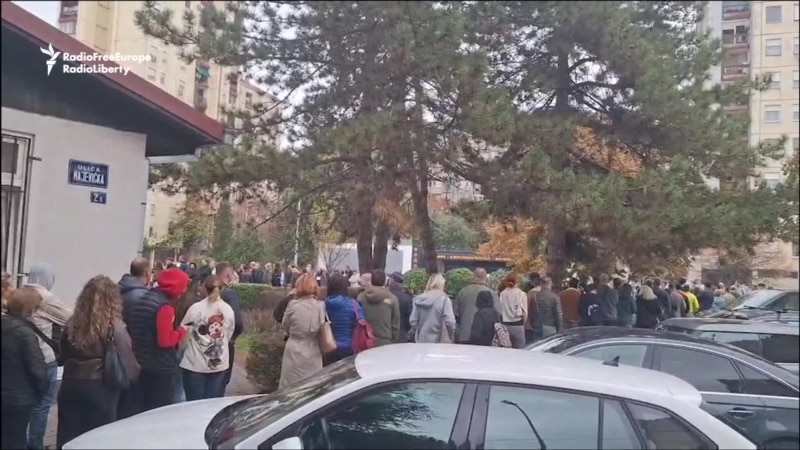
BELGRADE — Voters waited in a long lines to cast ballots in a snap election called by Aleksandar Vucic, as student-led demonstrations presented the long-time Serbian populist with the biggest challenge to his leadership in years.
Hundreds of people lined up outside numerous polling stations around the capital, Belgrade, in the early hours after voting opened on October 25.
Voters were also lining up at stations around Novi Sad, where 16 people died two years ago when a train station canopy collapsed.
That event sparked national fury amid reports that corruption had played a role in the construction flaws that led to the accident.
That, plus suspicions that Vucic was pushing the country toward authoritarianism, powered student-led demonstrations and a crop of reform-minded political candidates.
One man, who gave only his first name, Branko, said he was surprised to find lines outside his Belgrade polling station, even before it opened.
“I hope the elections will pass peacefully and without problems. Unfortunately, that has not been the case in previous years,” he told RFE/RL.
“After two years of protests, all the effort people have invested, and all this energy, I hope something will change, and I hope that both my friends and I will return to this country,” said Anja, a Belgrade native who said she had been living in France in recent years but returned home to vote.
“If that does not happen, I am afraid that even more of us will end up living abroad,” she said. She asked only to use her first name.
Turnout as of late morning was on track to surpass that of the last parliamentary vote in 2023, according to election observers.
Vucic, who called the snap election in September, resigned from his second term as president to run again for prime minister.
Despite the student demonstrations, many Serbs credit him with economic growth in the country and government spending on things like new highways and schools.
Opinion polls point to a tight race between Vucic supporters and reform-oriented challengers, whose agenda includes eliminating corruption and improving schooling.
The Students’ List comprises 250 largely unknown candidates, including farmers, university professors, and actors. The grouping is led by a cardiologist.
Vucic and his Serbian Progressive Party supporters have pushed back on the accusations of corruption and repression, and he has alleged that the student movement is funded by foreign agents.
“This has been one of the most difficult but the most emotional campaigns,” Vucic said at a rally on October 22. “We stood against those who wanted to destroy Serbia.”
One Ipsos poll published on October 22 showed the Serbian Progressive Party leading with 47 percent of likely votes, versus 40 percent for the student-led reformers.
In the southern town of Raska, some voters traveled from neighboring Kosovo to cast ballots.
Kosovo, which has an ethnic Serb minority concentrated in the north, declared independence from Serbia in 2008, but Belgrade has not recognized it as a separate country.
Bojan, from the city of North Mitrovica, said he was hoping Belgrade officials look after members of the Serbian community in Kosovo.
“I just hope everything passes peacefully,” he added.
Dragana, a woman from North Mitrovica, said she woke before dawn to take a charter bus to Raska to vote.
“I’m tired, I don’t know what to expect. Our life in Kosovo is miserable, and as for what I expect, I honestly can’t tell you,” she told RFE/RL.
Voting ends at 8 p.m. local time with first results expected by 10 p.m.


