

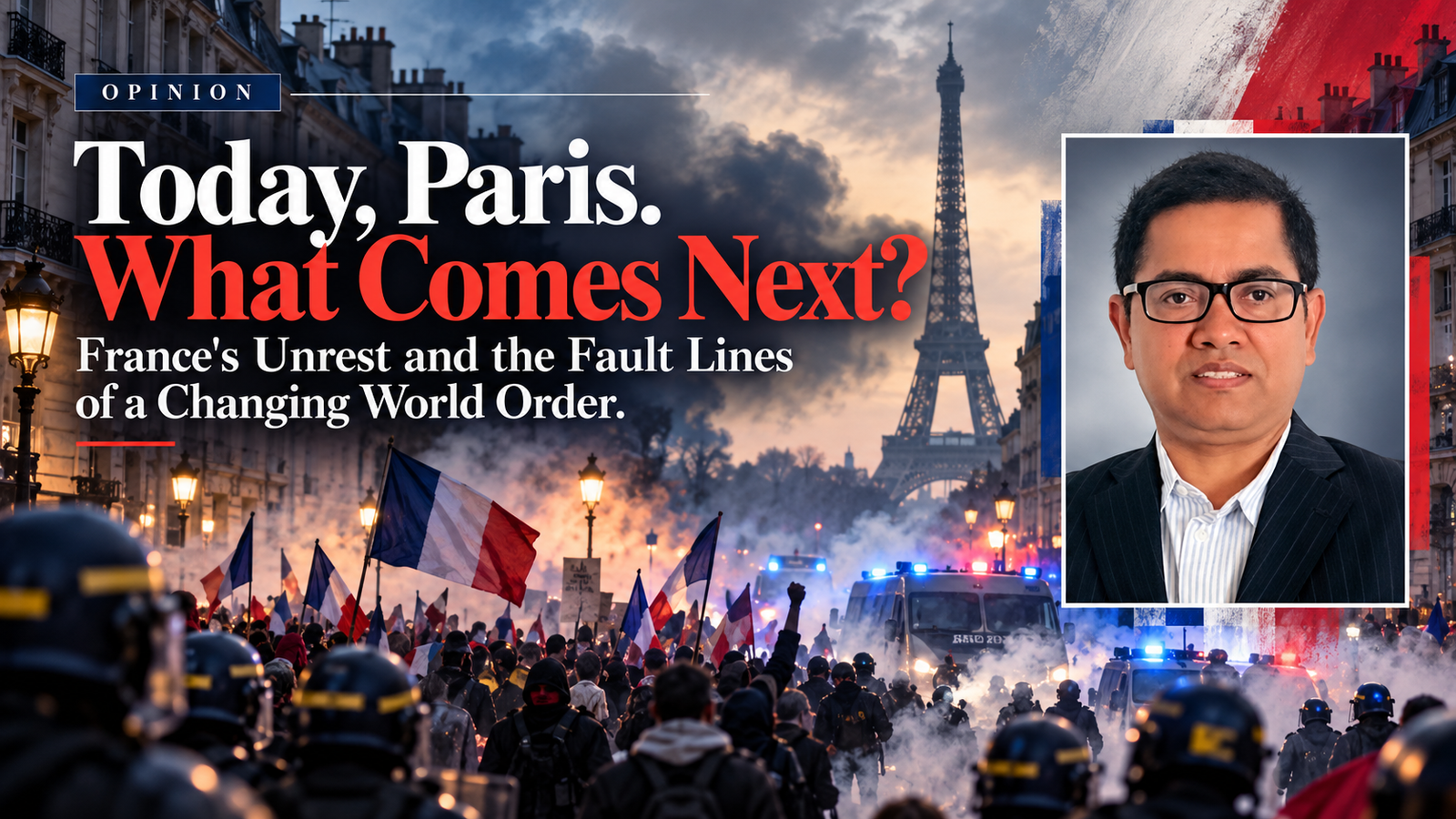
France’s Unrest and the Fault Lines of a Changing World Order
By Dr Mohamed Shareef Asees – PhD in Global Studies; MA in International Relations; BA in Political Science. Researcher and Lecturer in International Relations, Geopolitics, and Peacebuilding, based in Berlin, Germany.
The violence that swept across Paris and other French cities over the weekend represents more than a crisis of public order. It tests the French state’s ability to maintain security, address social grievances and preserve public confidence amid growing economic and geopolitical uncertainty. Whether the unrest will remain largely confined to France or become a reference point for wider mobilization across Europe remains uncertain. Yet the questions it raises extend far beyond France, touching on the resilience of European political institutions and the pressures reshaping the international order.
When protest becomes a crisis of the state
The demonstrations began with students demanding better school conditions, more teachers and adequately funded public services. They subsequently converged with broader dissatisfaction over the cost of living, inequality and concerns about the deterioration of France’s social model. During the weekend, demonstrations were accompanied by looting, vandalism and violent confrontations, raising questions about the authorities’ preparedness and ability to maintain public order.
The distinction between legitimate protest and criminal violence is essential. Economic frustration does not justify attacks on businesses, public buildings or citizens. Equally, the actions of violent groups should not be used to dismiss the grievances of peaceful demonstrators. The government’s responsibility is therefore twofold: to protect public safety and address the conditions undermining public confidence. Stronger policing may be necessary to restore order, but enforcement alone cannot resolve problems rooted in economic insecurity and dissatisfaction with public services. State authority ultimately depends not only on its ability to enforce the law but also on whether citizens believe their institutions can respond effectively to their concerns.
The grievances beneath the violence
The unrest reflects a combination of underfunded schools, declining living standards, public debt and growing economic insecurity. These pressures extend beyond France, echoing wider European concerns about housing, education, the cost of living and the quality of public services. Although immigration remains a central issue in European political debate, it should be distinguished from the specific grievances behind France’s student-led protests. Political actors interpret the unrest differently: some emphasize inequality and inadequate public services, while others point to migration policies and weakening state authority.
These competing narratives risk turning a domestic crisis into a broader political contest over Europe’s future, diverting attention from the underlying causes. The challenge for European governments is not only to restore public order but also to address the grievances driving discontent before existing divisions deepen.
Could the unrest spread across Europe?
The possibility deserves serious attention, but not alarmist predictions. Similar demonstrations in France, Belgium, Italy and other countries do not necessarily constitute a single movement. Their causes, participants and political objectives differ. Nevertheless, the coincidence of protests reveals common vulnerabilities: pressure on household budgets, concerns about public services and declining confidence in political leadership.
Social media can accelerate the spread of protest tactics and political narratives. Images of disorder in one capital may inspire mobilization elsewhere, particularly where existing grievances have already weakened public trust. Yet inspiration is not the same as coordination, and similar economic pressures do not guarantee identical political outcomes.
The greater risk may be less a continent-wide wave of riots than a gradual erosion of institutional legitimacy. If governments fail to respond credibly, dissatisfaction can deepen polarization, strengthen anti-establishment movements and make European cooperation more difficult. Paris may become a reference point for these developments, but it is too early to conclude that it marks the beginning of a general European uprising.
From the Middle East to Europe’s domestic politics
The unrest also unfolds against a changing international environment. Conflicts involving the United States, Israel and Iran, alongside the unresolved future of Gaza, have demonstrated the limits of military power as a means of securing durable political outcomes. Military superiority can destroy infrastructure, impose costs and alter the balance of forces; it cannot automatically produce political legitimacy, stable governance or a lasting settlement.
This does not mean that American power has disappeared or that any single regional actor has achieved all its objectives. Rather, it illustrates a broader geopolitical problem: the growing difficulty of translating material power into sustainable political results.
The consequences of international conflict also travel through economic channels. Energy disruption and higher fuel prices can intensify pressures on households and businesses, adding to domestic grievances that already exist. Reuters has reported that high fuel prices associated with the Iran war have compounded economic pressures during demonstrations elsewhere in Europe.
The connection between international conflict and unrest in Paris should not be overstated. The French protests have identifiable domestic causes. Yet the wider context matters: governments are being asked to manage domestic discontent while navigating external conflicts, economic uncertainty and increasingly polarized political narratives.
In this environment, domestic unrest can become an instrument of geopolitical competition. External political actors may portray events in Europe as proof of democratic failure, social collapse or the consequences of particular policies. Such narratives can deepen divisions even when they do not cause the original crisis.
What comes next?
Three possibilities deserve consideration. France may contain the violence and begin addressing the underlying grievances. The unrest may persist, feeding political polarization and weakening confidence in the government. Or the events may influence demonstrations elsewhere, where similar pressures already exist.
None is inevitable. The outcome will depend on government decisions, the conduct of protest movements and the ability of democratic institutions to respond without either tolerating violence or dismissing legitimate dissent.
For Europe, the challenge is to recognize that social stability and geopolitical resilience are connected. A continent struggling with public distrust at home may find it harder to maintain cohesion abroad. Conversely, credible institutions, responsive governments and effective European cooperation can help societies absorb economic and political shocks.
Paris is therefore neither proof of Europe’s imminent collapse nor an isolated disturbance that can be dismissed once the streets are cleared. It is a warning to examine the relationship between social grievances, political legitimacy and a changing international order.
Today, the focus is Paris. What comes next remains uncertain. The decisive question is whether European governments can respond to the pressures beneath the unrest before those pressures become more difficult to contain.


