


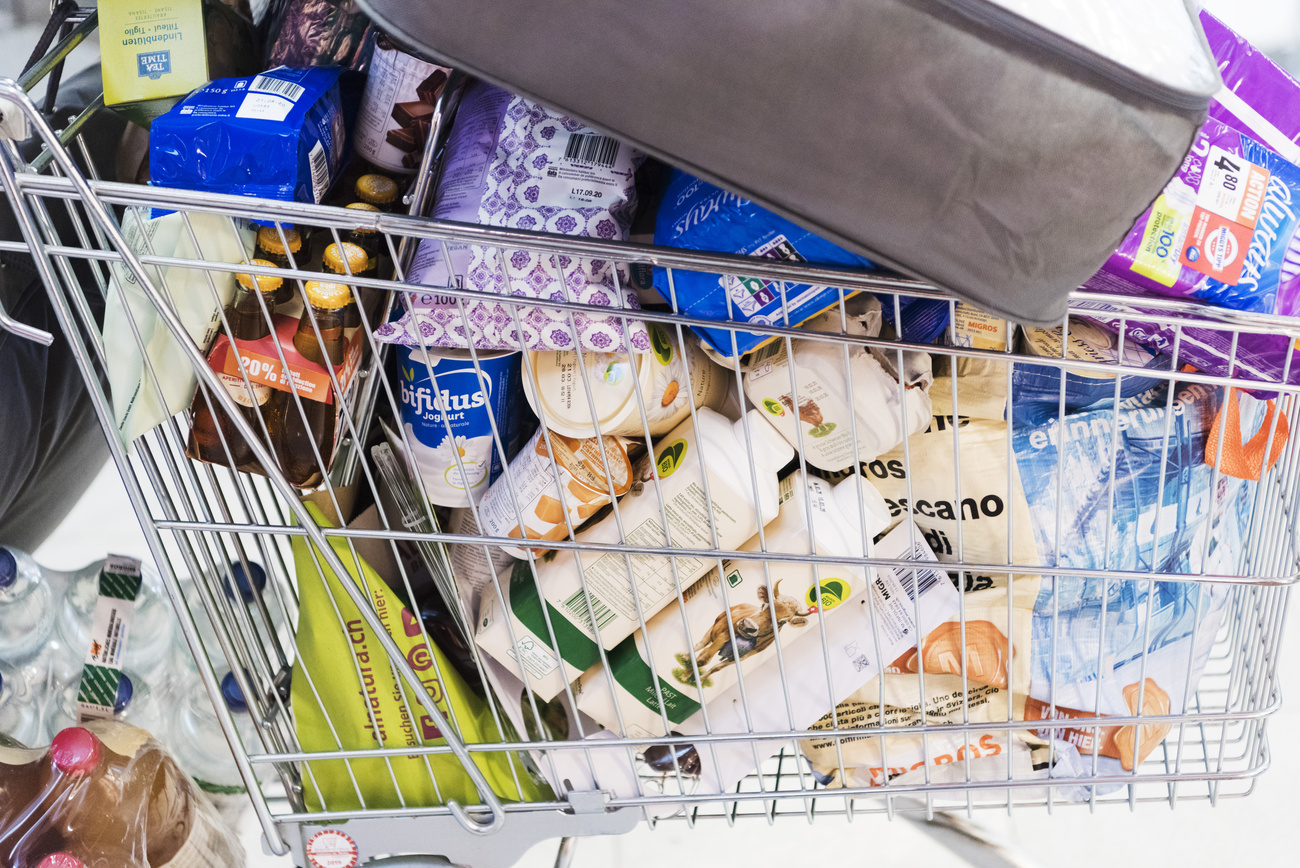
Getting more organic: a typical Swiss shopping basket.
Keystone / Goran Basic
A visit to a supermarket in Switzerland leaves many visitors from abroad amazed. With a higher proportion of organic products on the shelves than elsewhere, organic food has become part of everyday shopping in the country.
Almost one in three eggs sold in Swiss shops is organically produced. For vegetables, lettuce and potatoes, the proportion stands at around 27%.
With organic products accounting for 12.3% of all food sold, Switzerland tops the international rankings. It is followed by Denmark (11.6%) and Austria (11.4%).
‘Organic’ is not clearly defined
However, international data is inconsistent. Countries use different survey methods, and terms such as ‘food retail’ and ‘total food market’ are not always defined in the same way.
Furthermore, even the definition of ‘organic’ is not standardised worldwide. A product bearing an organic label in one place often meets different standards to those in other countries. For instance, Swiss certification requirements are stricter than the European Union’s Organic Regulation or the US Organic Standard.
Bio Suisse, the umbrella organisation for Swiss organic farms certified under the Knospe label,External link also points out that Swiss figures have been based on a new dataset since 2024. Some earlier figures have been recalculated.
Despite these limitations, the overall picture remains clear: organic products account for a larger share of Swiss consumers’ shopping baskets than those of shoppers in other countries.
Furthermore, Switzerland has for years topped the rankings when it comes to per capita spending on organic products, at the equivalent of €494 (CHF461) per person per year.
“However, the general price level [in Switzerland] is high in any case,” states the 2026 industry report by the German Federation for Organic Food and AgricultureExternal link (BÖLW).
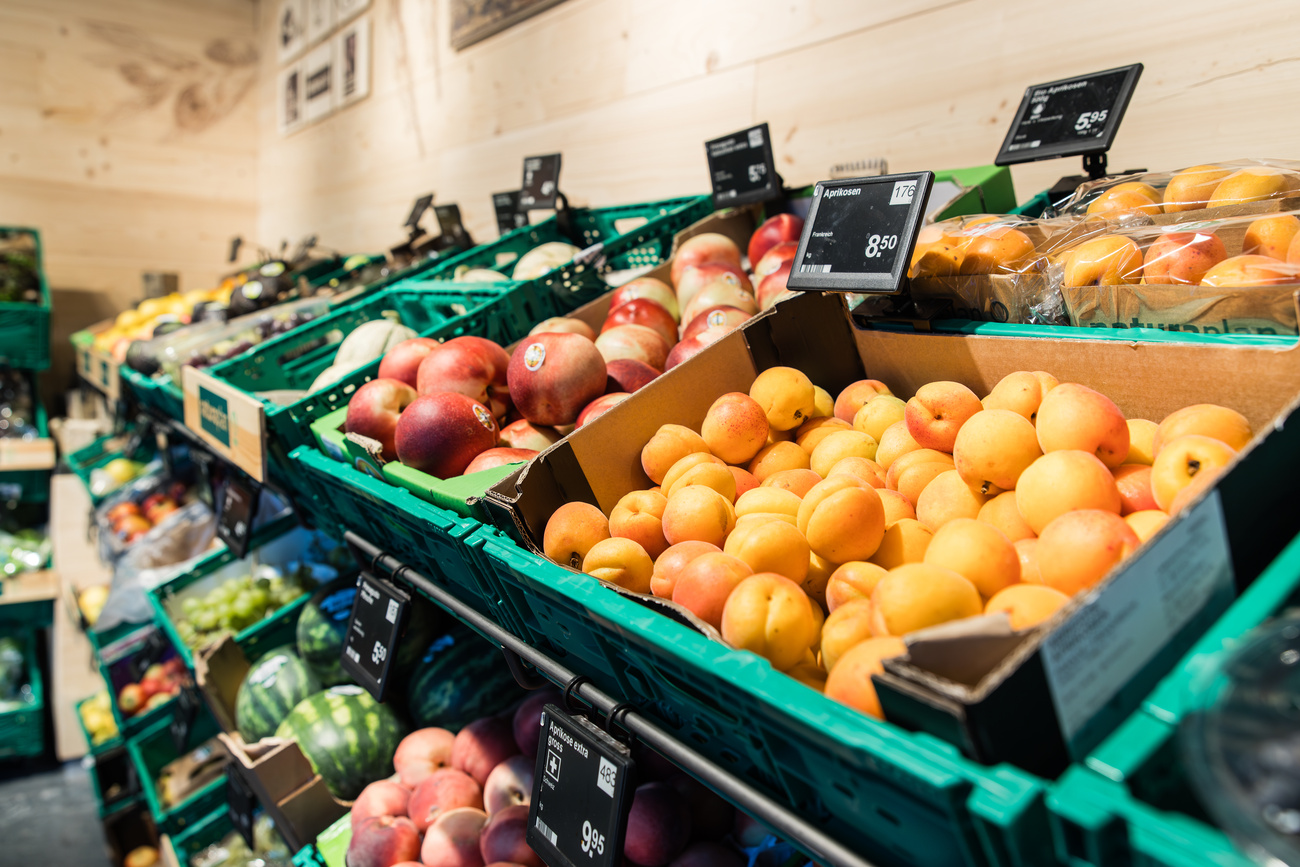
Although organic products are slightly pricier than conventionally produced food, many in Switzerland are willing to pay the extra cost for a variety of reasons.
Keystone / Stefan Bohrer
From niche market to political recognition
Switzerland’s success story did not begin with the sustainability boom. Local organic farming developed into an organised movement during the 20th century.
In 1981, five organisations founded the umbrella organisation for Swiss organic farming, which became Bio Suisse in 1997.
With its ‘Knospe’ (in the form of a bud), the association also created a common certification label. It is not simply the Swiss equivalent of the EU organic logo, but a private label with its own guidelines, which in several areas go beyond statutory minimum standards. The aim is to build trust in production methods and inspections.
Political recognition followed in 1992. At that time, organic farming was included in the Agriculture Act alongside integrated productionExternal link (IP label) as a form of production eligible for support.
Organic farming thus became an integral part of state agricultural policy. In Switzerland, organically produced products therefore moved out of the niche market and into the mainstream food system at a relatively early stage.
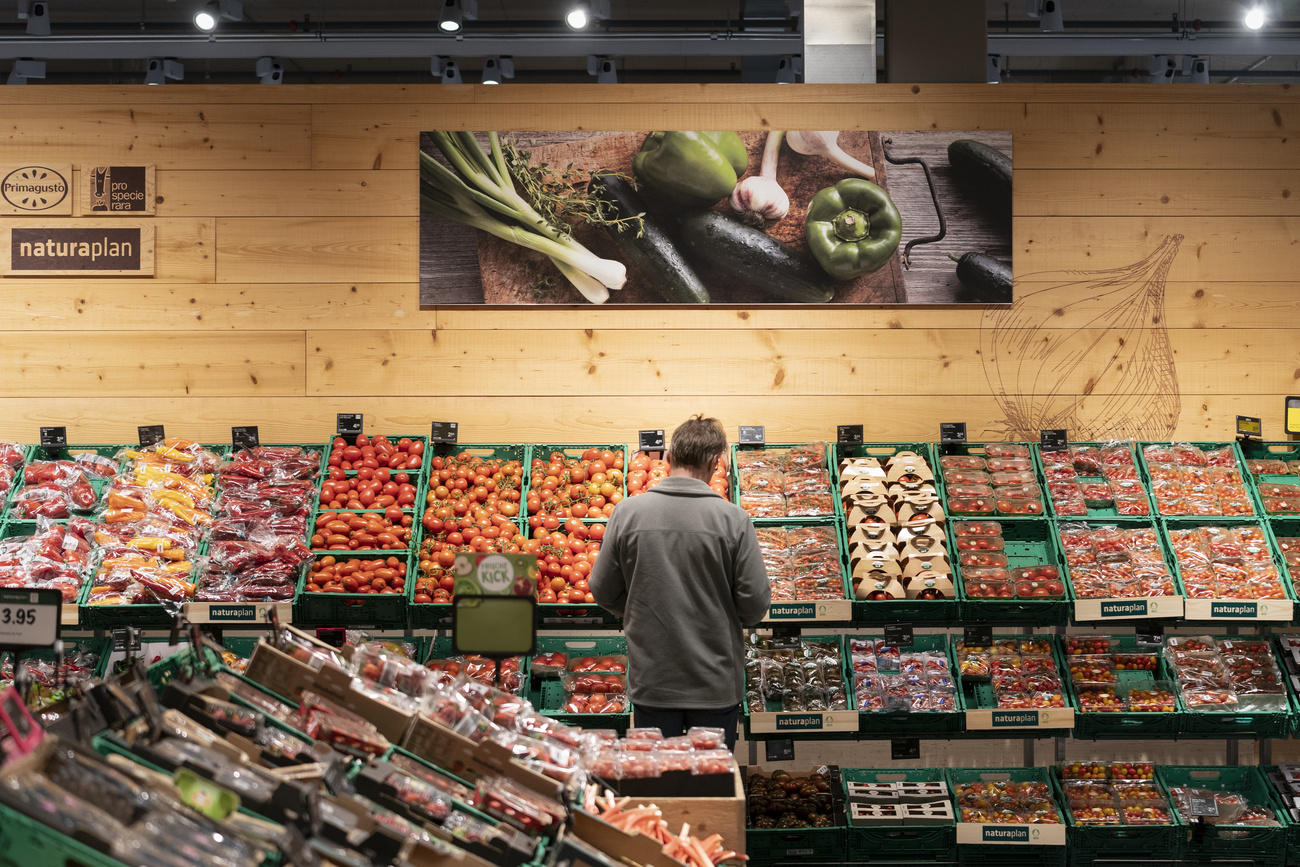
No supermarket in Switzerland can do without organic products these days.
Keystone / Gaetan Bally
Supermarkets enter the fray
The market received perhaps its most significant boost in the early 1990s. Coop launched its own organic brand, ‘Naturaplan’, in close collaboration with Bio Suisse. From then on, the products carried the ‘Knospe’ logo. Organic produce was thus no longer available only in specialist shops, but also in supermarkets.
Later, Switzerland’s second retail giant, Migros, also entered the organic market. The two cooperatives have long dominated the Swiss food retail sector and have an extensive network of stores.
This made organic produce easily accessible and part of everyday shopping. Today, no retailer can afford to ignore organic products.
While organic products accounted for 7.1% of the total food market in 2007, this figure had risen to 10.8% by 2020. By 2024, it reached its record high of 12.3%.
Sales of organic food amounted to CHF4.266 billion.
Organic products accounted for 12.3% of the food market.
Consumers spend CHF468 per capita on organic food.
52% of all consumers buy organic products daily or several times a week.
7,467 organic farms, market gardens and beekeepers in Switzerland and Liechtenstein produce in accordance with Bio Suisse guidelines.
18.4% of Switzerland’s agricultural land is farmed organically.
Source: Bio Suisse
Trust and purchasing power as reasons for success
One reason for the success of organic products in shopping baskets is likely to be the high level of trust that Swiss consumers place in organic labels.
After all, when shopping, nobody can personally check how a field is farmed or how animals are reared. Customers therefore rely on inspections and credible labelling.
However, ‘organic’ does not automatically mean that products were produced in Switzerland. As not everything can be produced domestically, Switzerland also has to import organic raw materials and foodstuffs. Care is taken to ensure that foreign producers comply with the Knospe guidelines.
Another reason is likely to be the high purchasing power of Swiss consumers. Organic products are expensive, and price is one of the main barriers. Higher-income households are more likely to buy organic products; education and place of residence also influence consumer behaviour.
Taste is less important
According to a 2022 study by the Federal Office for Agriculture and the Research Institute of Organic AgricultureExternal link (FiBL), taste is not the primary factor influencing purchasing decisions.
Instead, for 85% of those surveyed, animal welfare and the avoidance of pesticide residues are key considerations. These are followed by environmentally friendly production and the avoidance of preventive antibiotic use in animal husbandry.
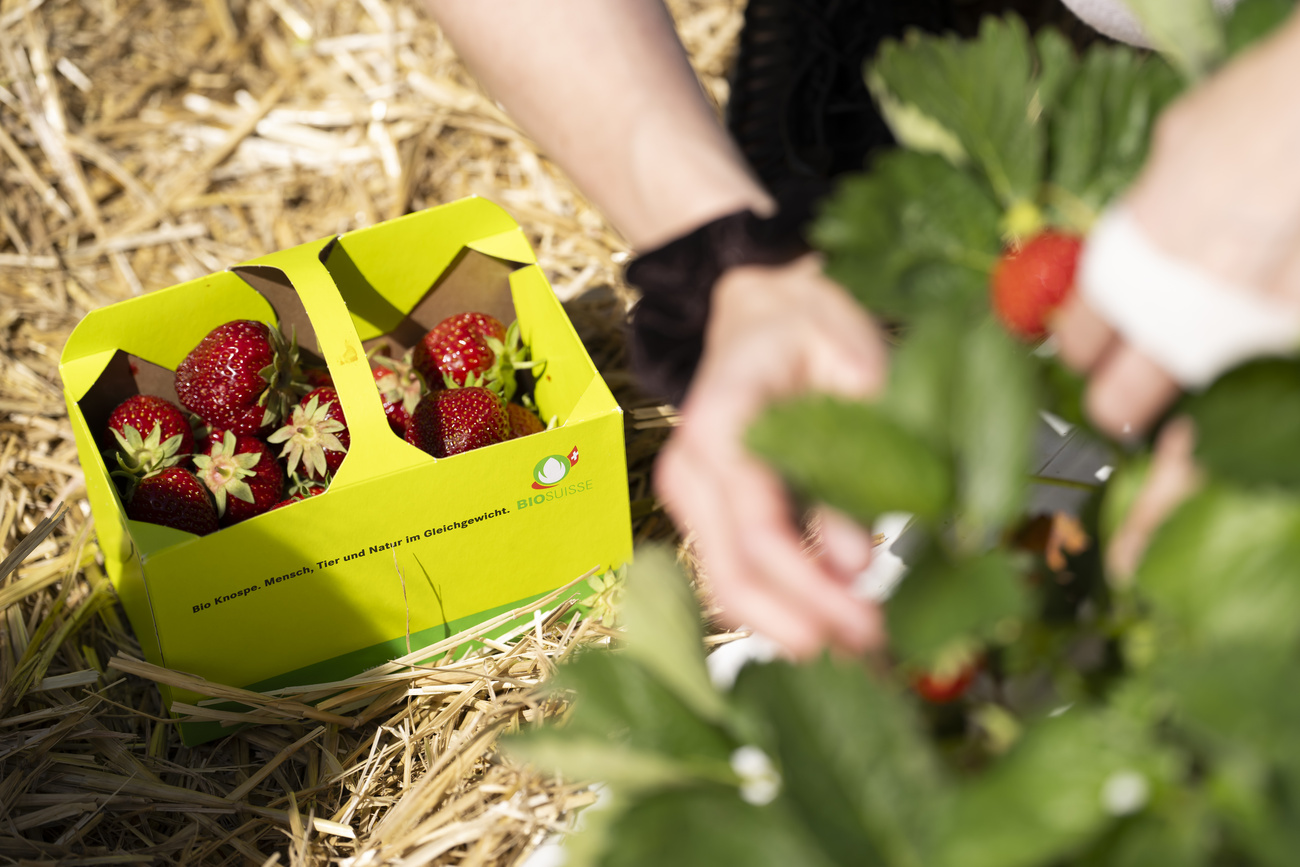
Harvesting organic strawberries at a farm in canton Fribourg.
Keystone / Anthony Anex
Liechtenstein has the highest proportion of organic production
According to figures from Bio SuisseExternal link, in 2025 almost 7,500 farms and market gardens in Switzerland and the Principality of Liechtenstein were producing in accordance with the organisation’s guidelines.
Although Switzerland is the world leader in organic consumption, it does not lead in production. In terms of the proportion of land farmed organically, Liechtenstein leads the worldExternal link at 43.5%. Spain, France and Italy have the largest areas of organic farmland in Europe in absolute terms.
Room for improvement in the catering sector
However, Switzerland’s leading position in terms of market share for organic products is by no means guaranteed. Market share is currently stagnating, prices are high, and some demand has to be met by imports.
The next challenge is to make organic produce more widely available outside supermarkets and affordable to broader sections of the population.
This also includes the catering sector: the aforementioned study by the federal government and FiBL identified strong demand among respondents for organic food in restaurants, canteens and takeaways.
For many people, organic food is less readily available when eating out than it is in supermarkets. Rising living costs can also lead even committed organic shoppers to opt for cheaper products.
Edited by Balz Rigendinger. Adapted from German by Alexandra MV Andrist/dos


