

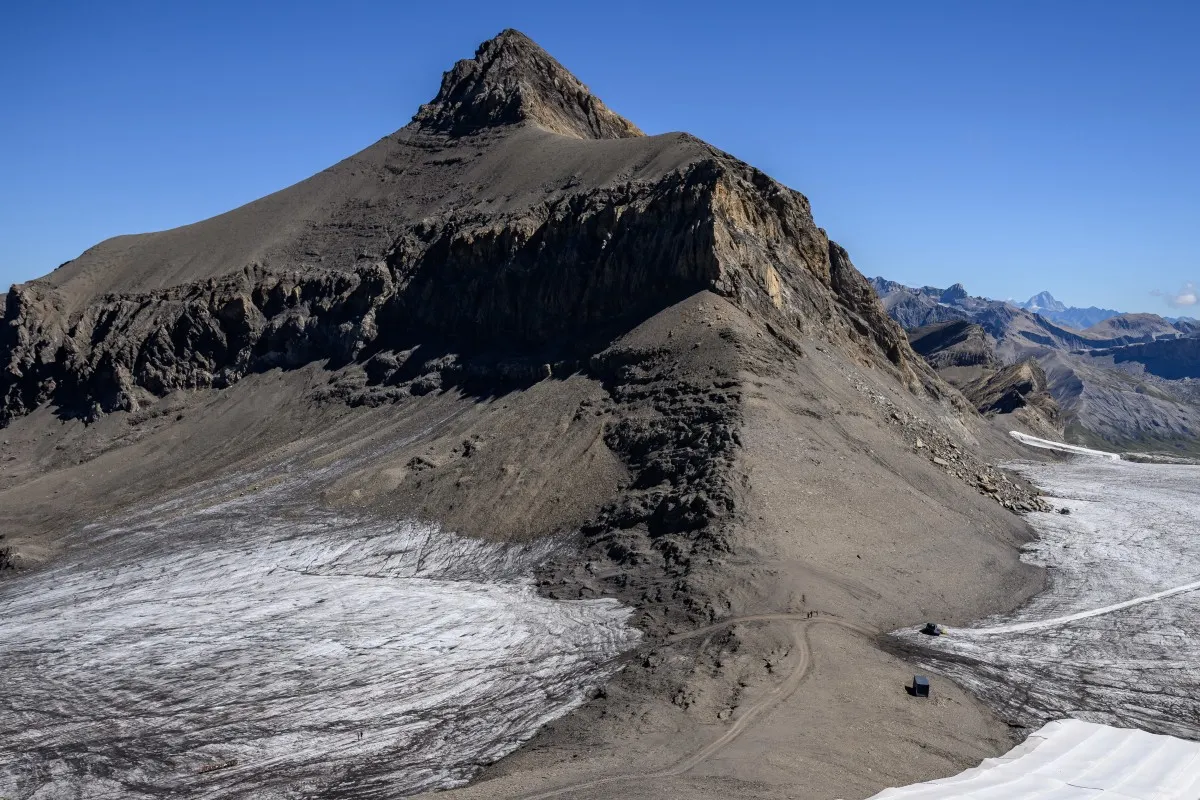
Its glaciers are melting at an alarming rate and extreme temperatures are breaking all-time heat records. But even more climate disasters will befall Switzerland in the future, a new study reveals.
New research from the Federal Polytechnic Institute (ETH) in Zurich shows that a temperature rise of around 3C by 2100 is currently the most probable scenario for Switzerland.
This would have far-reaching consequences, as temperatures in the country are rising more sharply than the global average.
Both the Swiss Academy of Science and the United Nations data indicate that Switzerland is warming faster than many other parts of the world.
The reason is that Switzerland is landlocked so it doesn’t benefit from the buffering effect of the oceans, which are able to absorb large amounts of heat.
Additionally, the altitude and morphology of the Alps also play an important role in accelerating global warming.
READ MORE: Why is Switzerland warming faster than most countries in the world?
What did the ETH study find?
According to ETH doctoral student and study author Gergana Gyuleva, “without immediate and drastic emissions cuts, we must expect a scenario in which warming increases by 25 percent.”
This assessment, based on satellite measurements of the Earth’s energy balance, is in line with another study, The Climate CH2025, which draws an even more catastrophic scenario.
That particular research, carried out jointly by the ETH and the Federal Institute of Climatology and Meteorology (MeteoSchweiz) found that if global warming increases by 3C, the temperature in Switzerland could go up by an average of up to 4.9C – with all the repercussions on glaciers and the environment in general.
READ MORE: ‘No chance of surviving’ – Swiss glaciers see catastrophic melting
Can anything be done to prevent this extreme scenario from happening?
Yes, and the solution is the same as the one suggested countless times before.
Though some of the damage can no longer be reversed, the researchers say that if the spread of greenhouse gas emissions could be curtailed – or better yet, stopped altogether – further damage would be prevented.
To achieve this goal, however, global emissions would have to be cut by half before 2030 and reduced to zero by 2050 at the latest.
