

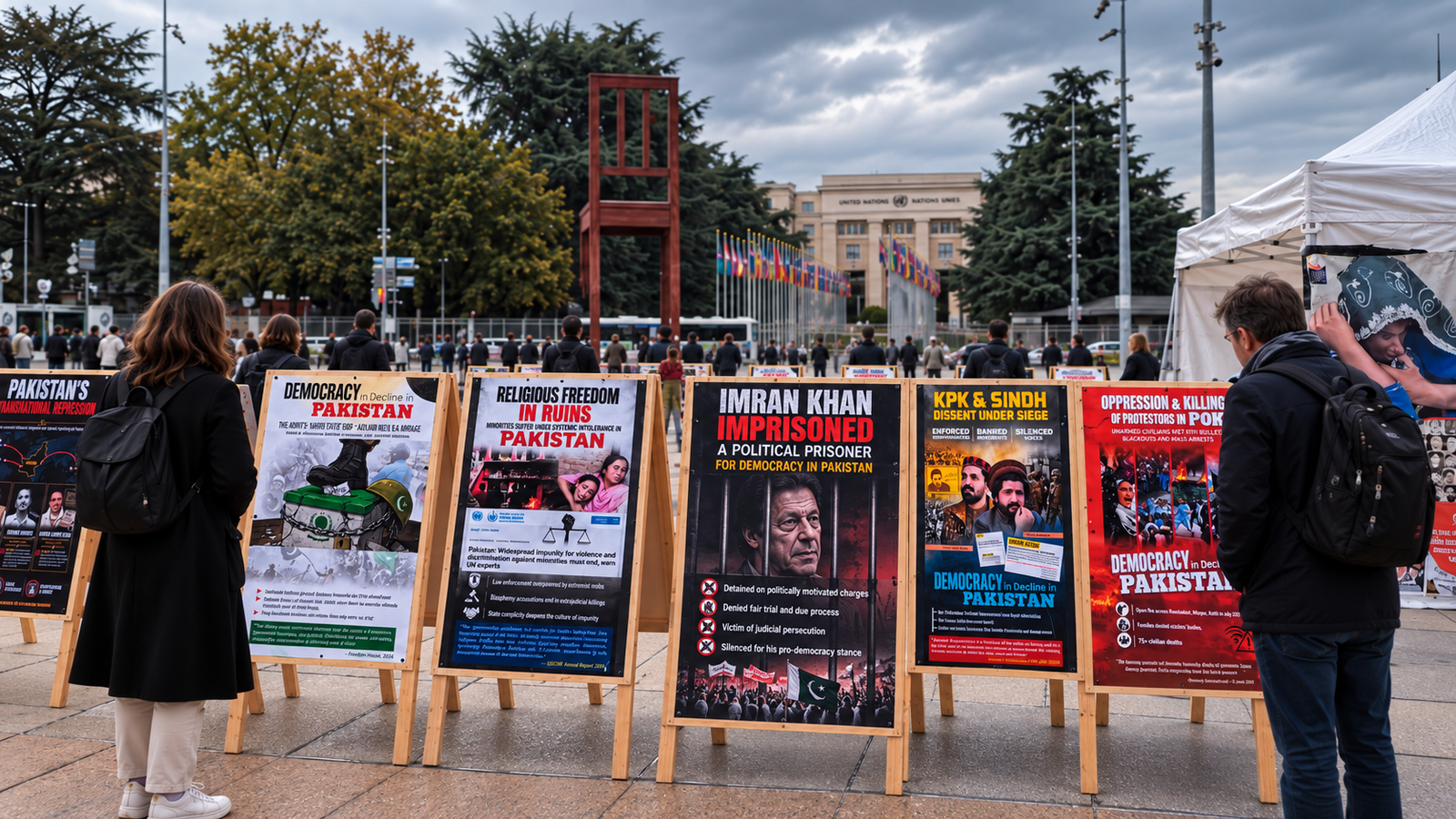
GENEVA, 4 October 2026 — A three-day public photo and poster exhibition focusing on minority rights, religious freedom, political dissent, democratic governance and civil liberties in Pakistan was held from 1 to 3 October 2026 at Place des Nations in Geneva, directly opposite the United Nations Office at Geneva and close to the landmark Broken Chair.
Installed in one of Geneva’s most prominent spaces for international human rights advocacy, the exhibition brought together a series of large-format visual displays addressing alleged discrimination against minority communities, restrictions on religious freedom, political repression, enforced disappearances, pressure on journalists and activists, judicial concerns, digital restrictions and broader questions surrounding democracy in Pakistan.
The exhibition was positioned to attract the attention of diplomats, United Nations officials, civil society representatives, journalists and international visitors passing through the area.
Minority Rights at the Centre of the Exhibition
Several displays focused specifically on the situation of religious and minority communities in Pakistan.
One prominent panel, titled “Religious Freedom in Ruins,” alleged that minority communities face systemic intolerance, discrimination and inadequate protection. Other visual materials called for stronger safeguards for vulnerable groups and highlighted individual cases presented by campaigners as examples of persecution, denial of rights or lack of access to justice.
The exhibition framed minority protection not merely as a domestic political issue, but as a matter connected to internationally recognised principles including equality before the law, freedom of religion or belief, protection from discrimination and the right to security and dignity.
Pakistan is home to a diverse population comprising different religious, ethnic, linguistic and cultural communities. The treatment of minorities has remained a recurring subject of discussion among human rights organisations, civil society groups and international institutions.
The Geneva exhibition sought to underline the argument that constitutional guarantees must be reflected in practice, particularly through effective protection, access to justice and equal treatment for vulnerable communities.
Democracy, Justice and Political Dissent
The exhibition extended beyond minority rights and presented broader criticism of Pakistan’s political and institutional environment.
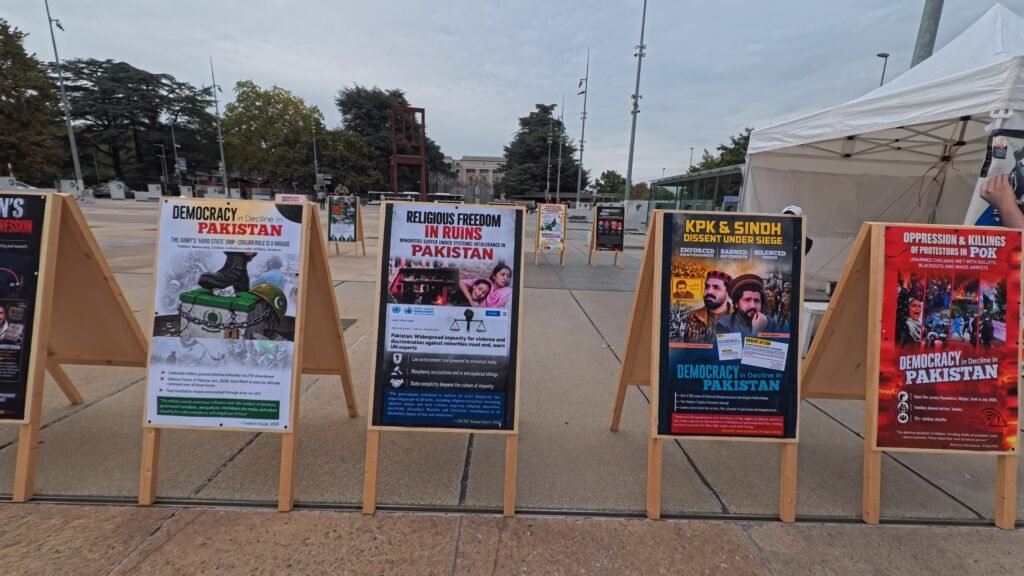
Posters carrying titles such as “Democracy in Decline in Pakistan,” “Justice Denied,” and “Collapse of Democracy” raised concerns about civilian institutions, the judicial system, military influence and due process.
Other displays focused on political dissent in Khyber Pakhtunkhwa and Sindh, while another addressed alleged killings and repression of protesters in Pakistan-administered Kashmir.
The posters contained claims concerning enforced disappearances, restrictions on political movements, mass arrests, intimidation and the suppression of critical voices. These allegations were presented by organisers and campaigners through the exhibition and should be understood as part of their advocacy message.
By placing regional, political and minority-rights concerns within the same exhibition, the organisers appeared to advance a broader argument: that the protection of minorities is closely connected to the strength of democratic institutions, judicial independence and freedom of expression.
Imran Khan’s Imprisonment Also Featured
The imprisonment of former Pakistani Prime Minister Imran Khan also featured in the exhibition’s visual material as part of a wider presentation on political freedoms, justice and the treatment of opposition figures.
Khan, who served as prime minister from 2018 until his removal through a parliamentary no-confidence vote in 2022, has remained at the centre of Pakistan’s political crisis since his arrest and imprisonment in 2023.
His legal cases and continued detention have become major points of political contention. Khan and his supporters have repeatedly argued that the cases against him are politically motivated, while Pakistani authorities have maintained that legal proceedings are matters for the courts and reject claims that the prosecutions are driven by political considerations.
The exhibition placed Khan’s imprisonment alongside wider concerns about judicial independence, political participation and restrictions on opposition activity.
His inclusion was significant because it broadened the exhibition beyond minority-rights advocacy alone. It linked the protection of minorities with wider questions about democratic governance, rule of law, political pluralism and the treatment of dissenting voices.
For an international audience in Geneva, the display presented Khan’s case as part of a larger debate about whether Pakistan’s democratic and judicial institutions are functioning independently and whether political actors are able to operate without undue pressure.
Concerns Over Digital Restrictions and Transnational Repression
The exhibition also addressed newer forms of pressure on civil society and political expression.
One panel focused on Pakistan’s digital regulatory environment and the Prevention of Electronic Crimes Act, portraying it as part of a broader crackdown on online speech and digital freedoms.
Another display, titled “Pakistan’s Transnational Repression,” alleged that critics and dissidents outside the country have also faced intimidation or pressure.
The inclusion of these themes demonstrated that the exhibition was not confined to a narrow definition of minority rights. Instead, it connected the protection of minorities with media freedom, digital rights, political participation, freedom of expression and the ability of activists and journalists to work without intimidation.
A Focus on Khyber Pakhtunkhwa, Sindh and Pakistan-administered Kashmir
Several posters highlighted concerns from specific regions.
A display titled “KPK & Sindh — Dissent Under Siege” referred to enforced disappearances, banned movements and what campaigners described as silenced political voices.
Another poster focused on alleged repression and killings of protesters in Pakistan-administered Kashmir, presenting images of demonstrations, clashes and civilian victims.
These displays reflected wider allegations raised by activists about state responses to dissent in different parts of Pakistan and territories administered by it.
As with other claims in the exhibition, these representations reflected the perspective of the campaigners and should be assessed alongside independent reporting and responses from the relevant authorities.
A Symbolic Location in Geneva
The choice of Place des Nations gave the exhibition particular significance.
Situated directly outside the United Nations Office at Geneva, the square has become an internationally recognised platform for protests, exhibitions and advocacy campaigns seeking the attention of the UN human rights system.
The nearby Broken Chair — widely associated with humanitarian advocacy and the protection of civilians — provided a powerful visual backdrop for an exhibition centred on dignity, rights and accountability.
Visitors walking through the square encountered rows of freestanding panels carrying photographs, testimonies, political messages and references to human rights concerns.
The open-air presentation made complex questions of governance and human rights accessible to the wider public, moving the discussion beyond diplomatic meetings and formal reports.
Advocacy, Evidence and the Need for Independent Scrutiny
The exhibition presented strongly worded allegations against Pakistani state institutions and authorities.
Such allegations require careful examination, independent verification and, where relevant, responses from those accused.
That distinction is important in responsible human rights reporting.
Advocacy can draw attention to neglected or underreported concerns, but its credibility is strengthened when allegations are clearly attributed, supporting evidence is examined and all relevant parties are given an opportunity to respond.
At the same time, public exhibitions of this kind play an important role in ensuring that the concerns of minority communities, political activists, victims’ families, journalists and civil society groups remain part of international debate.
Minority Rights as Part of a Wider Democratic Question
One of the clearest messages emerging from the exhibition was that minority rights cannot be viewed in isolation.
Religious freedom, judicial independence, democratic participation, media freedom, due process and equal citizenship are deeply interconnected.
When institutions weaken, minority and vulnerable communities are often among the first to feel the consequences.
For Pakistan, as for every state, the long-term test is not only whether rights are recognised in constitutional or legal language, but whether those protections are effectively implemented in everyday life.
The exhibition concluded on 3 October, but the questions it placed before the international community remain highly relevant: how should minority communities be better protected, how can democratic institutions be strengthened, how should allegations of political persecution be independently examined, and how can governments ensure that fundamental rights apply equally to all citizens?
Against the backdrop of the United Nations and the Broken Chair, the three-day exhibition delivered a broader message extending beyond Pakistan itself:
the strength of a democracy is measured not only by elections and institutions, but also by how effectively it protects minorities, respects dissent, upholds the rule of law and safeguards the rights of those who challenge power.

