

Tajikistan announced that it is now receiving oil and petroleum products from Iran, opening a potential new energy source for a country whose fuel supplies have long been dominated by Russia.
The deliveries began in late August, Tajikistan’s Energy and Water Resources Ministry told the Asia-Plus news agency, following talks between the two countries on expanding cooperation in the oil and gas sector.
The ministry has not disclosed the volume of the shipments, their commercial terms, or how the oil and petroleum products were transported to Tajikistan.
The move also raises questions about potential US secondary sanctions for doing business with Iran, particularly as Washington has stepped up pressure on Tehran’s oil revenues.
US Treasury spokeswoman Gigi O’Connell said the department would not comment on specific allegations of sanctions violations but warned that Iran’s petroleum and petrochemical sectors are subject to increased sanctions risk.
“Anyone operating in that sector incurs that risk themselves should they continue to choose to do so,” O’Connell said in an e-mailed response to RFE/RL.
Tajikistan has asked Iran to supply up to 2.55 million tons of crude oil and petroleum products annually, including gasoline, diesel, and jet fuel. But that figure represents a requested or potential volume rather than the amount currently being delivered.
The potential shift toward Iranian supplies could give Dushanbe another option, although the economics and logistics of moving large quantities of Iranian oil to landlocked Tajikistan remain unclear.
The oil deal comes as Tajikistan faces continued uncertainty over fuel supplies from Russia, which accounted for more than 91 percent of the country’s petroleum-product imports in the first half of 2026.
Russian fuel shortages and export restrictions, exacerbated by Ukrainian drone strikes on Russian oil refineries, have prompted Tajikistan and other Central Asian countries to seek alternative sources.
In July, Tajik authorities said they were in talks with neighboring countries to secure future supplies.
Tajik political analyst Parviz Mullojonov said the search for Iranian supplies was being driven in part by Tajikistan’s need to secure alternative energy sources.
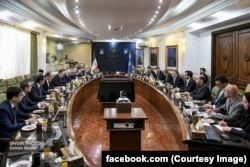
A Tajik delegation that visited Tehran in August held talks with Iranian officials responsible for oil products and railways, with energy supplies and logistics among the issues discussed, according to the Tajik Embassy in Tehran.
Warming Relations
The Iranian deliveries also come amid a broader warming of relations between Dushanbe and Tehran.
“The report that Iran has started to sell oil to Tajikistan comes as the relation between Dushanbe and Tehran is warming and they’re becoming closer,” said Edward Lemon, president of the Oxus Society for Central Asian Affairs.
Tajikistan and Iran, which share close linguistic and historic ties, established diplomatic relations in 1992. Tajikistan’s Foreign Ministry says bilateral trade reached $438 million in 2025, up 28 percent from the previous year, and that the countries have signed more than 200 agreements and memorandums.
At a meeting of the Tajik-Iranian intergovernmental commission in Dushanbe in May, officials discussed energy, transport, industry, investment, science, and technology.
The two countries also have defense ties. In 2022, Iran and Tajikistan inaugurated a drone-manufacturing facility in Dushanbe, designed to produce Iranian-designed Ababil-2 drones.
But relations between the two countries have not always been close. Ties deteriorated sharply in the mid-2010s, with Dushanbe wary of Tehran’s alleged support for Tajikistan’s banned Islamic Renaissance Party.
In 2017, Dushanbe also accused Tehran of involvement in a series of political killings in Tajikistan in the 1990s, allegations that Tehran denied.
The relationship began to thaw in the early 2020s. In 2022, Tajik President Emomali Rahmon visited Tehran, and the two sides pledged to strengthen diplomatic, trade, and security ties.
The Sanctions Question
A Tajik delegation that visited Tehran in August held talks with Iranian officials responsible for oil products and railways, with energy supplies and logistics among the issues discussed, according to the Tajik Embassy in Tehran.
But closer energy cooperation with Iran could also create complications for Dushanbe as Washington increases pressure on Tehran.
Under US Iran sanctions authorities, foreign companies and financial institutions can face sanctions for certain significant transactions involving Iranian petroleum and petroleum products.
O’Connell also emphasized the secondary sanctions exposure for those who continue doing business with the Iranian regime and said any entity facilitating money laundering or sanctions evasion on behalf of Iran risks being cut off from the US financial system.
The Treasury Department has repeatedly warned of sanctions exposure linked to Iranian oil and in August announced an expansion of conduct that could trigger secondary sanctions.
A State Department spokesperson said in an e-mailed response to RFE/RL that the United States would continue to “disrupt, expose, and dismantle” Iranian military and proliferation activities, procurement schemes, malicious cyberoperations, and illicit oil trade that sustain what Washington calls the Iranian regime’s “malign behavior.”
The spokesperson called on the international community to join the United States in holding those involved accountable.
Lemon said the possibility of secondary sanctions should factor into Dushanbe’s calculations as it expands purchases from Iran.
“Tajikistan could of course become one of those countries,” he said.
At the same time, Lemon said, the scale of Tajik-Iranian cooperation could be important in determining how seriously Washington views the relationship.
“The scale of cooperation is quite low, much in contrast to countries such as Russia or China,” he said.
Mullojonov said Tajikistan was seeking to balance relations with the United States, Russia, China, Turkey, and other powers while pursuing its own economic interests.
“Maintaining a diplomatic balance is incredibly difficult because these global powers often have conflicting agendas,” Mullojonov said.
For now, it remains unclear whether Iranian oil can become a substantial alternative to Russian supplies.
RFE/RL contacted Tajikistan’s Energy and Foreign Affairs ministries for comment but has not received a response.
