

Photo: Logika Design Bureau (Courtesy Image)
As the world’s militaries race to counter the threat of fiberoptic drones, a cable-cutting barrier has just been deployed onto Ukraine’s battlefields, according to the maker behind the fledgling technology.
Ukraine’s Chaharnyk (Shrub) was announced in September as an active defense measure designed to physically break fiberoptic cables drone pilots use to control many first-person-view (FPV) quadcopters.
The drones, which are immune to electronic jamming devices, have also emerged in recent weeks in conflicts in Myanmar and been used with deadly effect against Israeli forces, sparking a massive push in the Middle Eastern country to find a defense against the weapon.
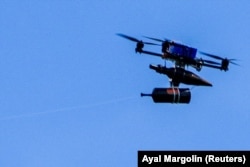
A weaponized drone operated through a fiberoptic cable flies over the border from Lebanon to Israel in May 2026. (file photo)
The director of Logika Design Bureau, the Ukrainian company behind Chaharnyk, told RFE/RL that “dozens” of the systems have been delivered to frontline Ukrainian units in recent days.
The technologist, who declined to be named for security reasons, added that it is “still too early to discuss official feedback or statistics” from the battlefield.
Chaharnyk resembles a fence for livestock, but the 80-centimeter-high barrier visibly comes to life when its acoustic sensor detects a drone nearby: Electric motors pull wires studded with hooks resembling razor wire through a “break zone,” of which exact details have not been disclosed. The cutter then severs the physical communication link between the drone and its pilot.

James Patton Rogers, co-director of the Future Threat Lab at London’s King’s College, likened the Chaharnyk to “smart barbed wire.” He predicts the barrier will face significant issues in an active war zone, including the device’s own vulnerability to attack. Additionally, he says, “depending where it is placed, it could be an obstacle to Ukrainian maneuver.”
But he told RFE/RL, “if placed along the front or around civilian villages and key military sites, alongside other counter drone tech, it could provide vital defense against a threat that has yet to be thwarted.”
In demonstrations, fiberoptic cables trailed by FPV attack drones have been snagged on the hooks of the Chaharnyk then pulled through the cutter that Logika claims severs the cables “95 percent” of the time.
The head of Ukraine’s Logika technology company told RFE/RL that many Russian FPV drones controlled through fiberoptic cables are equipped with a backup radio connection that takes over if the cable is cut.
“In that case, electronic warfare systems deployed in the area come into play,” he says, and “in most cases, the drone crashes and explodes.”
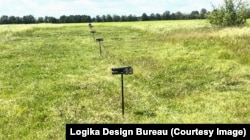
The Chaharnyk anti-drone barrier during testing in Ukraine
A recent Chinese report on counter-drone technologies analyzed a rudimentary barrier similar in principal to the Chaharnyk that was filmed in operation in Ukraine in late 2025.
That makeshift barrier had “clear” limitations, the Chinese assessment noted. “The [drone] pilot can fly around it; severing the fiber does not eliminate all damage because momentum may still carry the drone into a target; and the barrier itself reveals the defender’s operating area.”

Optical fiber used for remote control of FPV drones seen in the frontline Ukrainian town of Dobropillia in June.
“Could the enemy spot Chaharnyk and fly around it? Yes, that is possible,” the head of Logika told RFE/RL. “However, if a network of Chaharnyk systems is deployed correctly, taking into account the site or area that needs protection, there will be no way to fly around it.” The comments indicate small frontline Ukrainian positions that are routinely subject to FPV drone attacks may be an early priority for emplacement of the technology.
The Logika head added that the system can be camouflaged and the low-resolution video feeds used by drone pilots mean such a device could be hard to identify from a distance.
“We’re not claiming that Chaharnyk will keep everyone safe, but we are confident that it will improve protection against fiberoptic FPV drone attacks,” he added.
